
You are in the middle of a blissful petting session, your cat is purring on your lap — and then, without warning, teeth sink into your hand. If you keep asking why does my cat bite me, you are far from alone: the same mouth can deliver a tender “love bite” one minute and a hard warning nip the next.
Here’s the good news: most cat biting is communication, not cruelty. Once you learn to read the body language behind it, you can tell affection from overstimulation, play from genuine fear — and respond in a way that stops the biting without damaging your bond.
Table of Contents
- What Are Cat Love Bites?
- Love Bites vs Warning Bites: How to Tell
- 6 Reasons Why Your Cat Bites You
- Body Language Warning Signs to Watch
- How to Stop Your Cat Biting You
- What NOT to Do When Your Cat Bites
- When Biting Means a Vet Visit
- Frequently Asked Questions
- Final Thoughts
What Are Cat Love Bites?
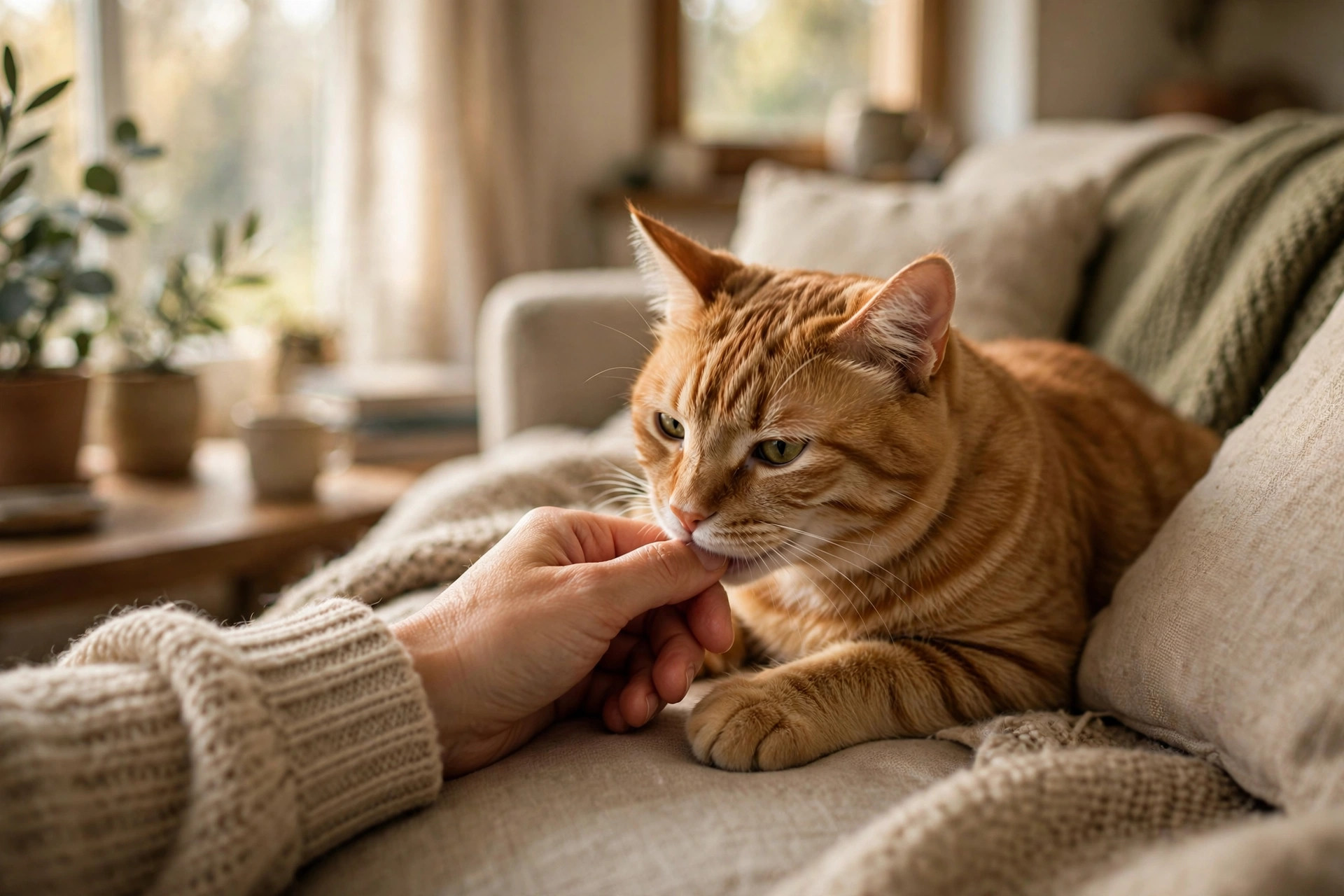
Love bites are the gentle, inhibited nibbles cats often give while being petted or while licking you — your cat places their teeth on you with obvious control. Veterinary behavior resources including PetMD note that love bites are often preceded by social grooming: your cat licks your hand, then adds a soft nibble.
Why do cats do it? The behavior appears to be a leftover from kittenhood, when kittens nibbled on littermates during grooming. In adult cats, a love bite can mean several things at once:
- Affection and bonding — “you’re part of my colony, so I’m grooming you the way I’d groom another cat.”
- Polite boundary-setting — “I’m enjoying this, but I’m getting a little overstimulated — please ease off.”
- A request to continue — some cats nibble to encourage more petting in a specific spot.
The key insight: a love bite is a conversation, not an attack — but it can escalate into a harder bite if you miss the message.
Love Bites vs Warning Bites: How to Tell
The difference is rarely about the bite alone — it’s about everything happening around it. Use this comparison:
| Signal | Love Bite | Warning / Aggressive Bite |
|---|---|---|
| Pressure | Gentle grazing, doesn’t break skin | Hard, may puncture or scratch |
| Duration | Lasts a second or two, then stops | Holds on, may grab with claws |
| What came first | Licking, purring, relaxed petting | Tail lashing, skin twitching, restlessness |
| Ears | Upright, forward, relaxed | Flattened back or rotating sideways |
| Pupils | Normal or softly dilated | Wide, staring, “whale eye” |
| After | Goes back to licking or settling down | Swipes, hisses, or leaves |
Rule of thumb: if the bite is accompanied by licking, kneading, or purring, it’s almost certainly a love bite. If it’s accompanied by a swishing tail, flattened ears, or a tense, low body — your cat is telling you to back off, and you should.
6 Reasons Why Your Cat Bites You
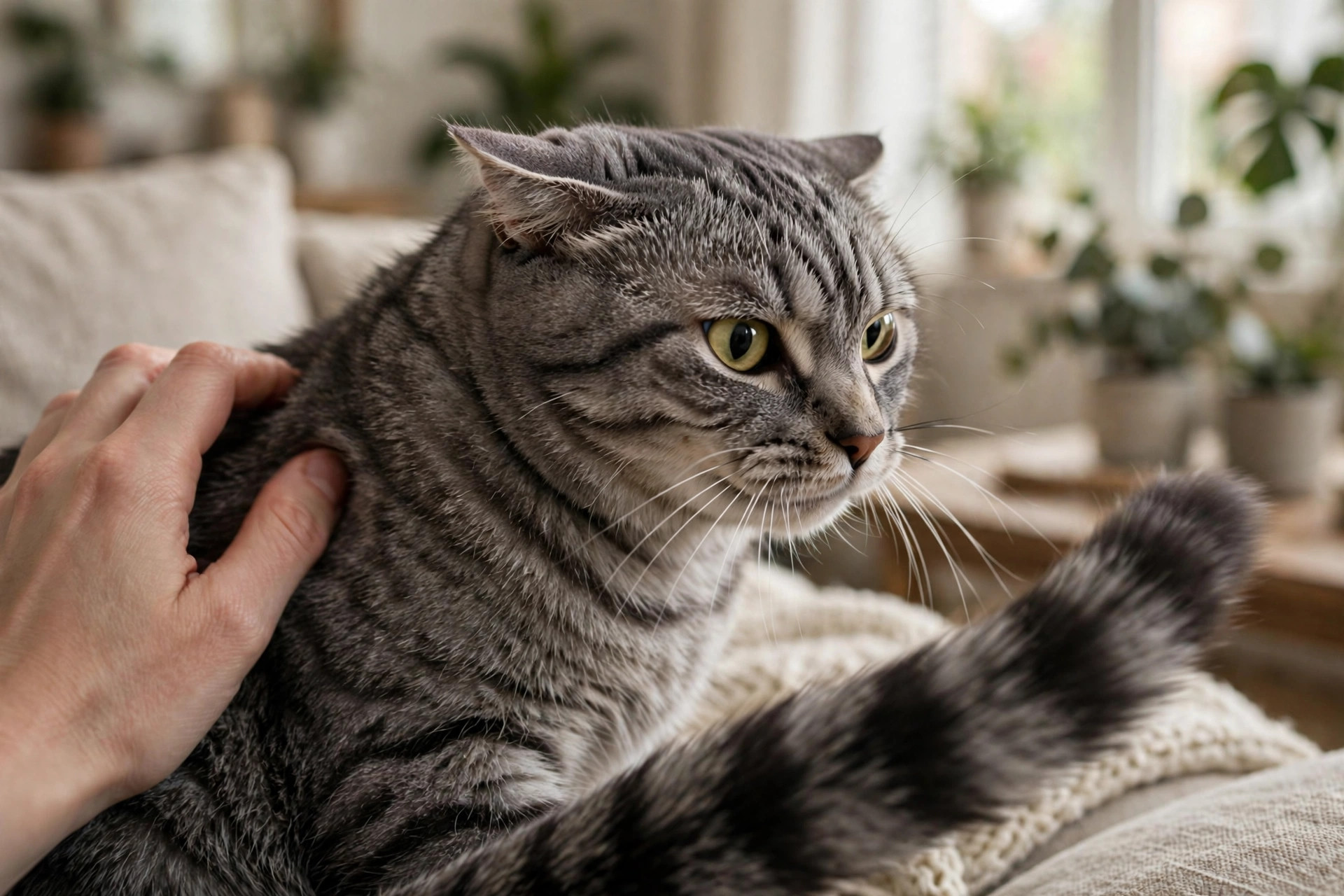
There is no single answer — the meaning depends entirely on context. Here are the six most common causes, from the sweetest to the most serious.
1. Love Bites and Affection
The classic gentle nibble during relaxed petting is usually social behavior — some cats combine it with chin-rubbing and slow blinks. It’s one of the highest compliments a cat can pay you.
2. Petting-Induced Overstimulation
This is the most common cause of “out of nowhere” bites. Your cat enjoys the first few minutes of petting, but repeated strokes — especially along the back, sides, and belly — build up stimulation faster than you realize. Cats can purr through rising irritation too, so watch the tail: when it starts twitching or lashing, the pleasure is fading and a bite is loading.
3. Play Biting and Rough Play
Kittens learn to play by wrestling littermates, and hand-played-with kittens never learn that human skin is off-limits. If your cat grabs your hand and bunny-kicks it, that’s predatory play — your moving fingers look exactly like prey. Cats with too little daily play are the most likely to “hunt” their owners.
4. Teething Kittens
Kittens chew and nip when their adult teeth come in, usually between 3 and 6 months of age. Gnawing relieves sore gums. If a kitten bites your fingers, it’s often dental discomfort rather than any behavioral problem — redirect to a safe chew toy and be patient.
5. Fear, Stress, and Redirected Aggression
A frightened cat bites to protect itself — triggers include visitors, new pets, loud noises, or sudden movements. There’s also redirected aggression: your cat sees a strange cat through the window, can’t reach it, and lashes out at whoever is nearest. The body tells the story: crouched low, fur puffed, growling or hissing. Give a scared cat space, not scolding.
6. Pain or Illness
A cat that suddenly starts biting when touched in a specific area may be in pain — dental disease, arthritis, and skin infections all lower a cat’s tolerance for handling. If your normally gentle cat becomes nippy, book a vet check rather than a training plan.
Body Language Warning Signs to Watch
Cats almost always warn before they bite hard — but the warnings are subtle. During any petting session, watch for: a slowly waving or sharply lashing tail (the number-one pre-bite signal); skin twitching along the back; ears turning sideways or flattening; sudden pupil dilation; the freeze — your cat going suddenly still under your hand (a still cat is not a relaxed cat); and a sudden head turn toward your hand — the bite is next.
Learn your own cat’s personal limit, too. Many cats have a “petting budget” — two minutes for some, twenty for others. Ending the session while your cat is still happy is the fastest way to reduce biting over time.
How to Stop Your Cat Biting You

You can’t (and shouldn’t) train the instinct out of a cat — but you can teach better outlets. Follow this vet-approved routine:
- Learn the limit and quit while you’re ahead. Count how long your cat enjoys petting before the tail starts moving — then stop a full minute before that point, every time. Good sessions end happily, so your cat stops enforcing the ending with teeth.
- Never use hands as toys. The moment a cat mouths your hand in play, freeze, go limp, and withdraw calmly — then immediately redirect to a wand toy, stuffed kicker, or ball.
- Build in daily play. Ten to fifteen minutes of interactive play twice daily burns off the hunting drive behind ankle attacks and hand-grabbing. End each session with a “catch” so the hunt feels complete.
- Respect the belly zone. Most cats dislike belly rubs no matter how much they seem to offer the belly — it’s a trust display, not an invitation. Stroke cheeks, chin, and behind the ears instead.
- Keep routine and environment calm. Stressed cats bite more; pheromone diffusers, consistent routines, and safe hiding spots reduce fear-driven biting.
- Teach gentle mouth manners. If your cat gives a soft love bite, don’t yank your hand away (that triggers the chase reflex). Go still, wait for the release, then calmly disengage.
Also Read: Stop Cat Scratching Furniture: Vet Tips (2026) — redirecting destructive scratching uses the same calm-redirection approach that fixes biting.
What NOT to Do When Your Cat Bites
The wrong response can turn a communication problem into a fear problem. Avoid these common mistakes: don’t yell, hit, or spray water — punishment teaches fear, not restraint. Don’t yank your hand away fast — fast movement looks like fleeing prey and excites the chase instinct; go still instead, then withdraw slowly. Don’t play-fight with hands — wiggling fingers trains your cat that human skin is prey. And never corner a fearful cat — a scared cat that can’t flee will bite, so always leave an escape route.
When Biting Means a Vet Visit
Most biting is behavioral, but some bites are a medical red flag. Call your veterinarian if your cat’s biting changes suddenly, biting happens when a specific body part is touched, or biting comes with appetite loss, hiding, or lethargy.
Also Read: Why Is My Cat Not Eating? Warning Signs & When to Worry (2026) — appetite changes often accompany the pain conditions that make cats bite.
One safety note for you: if a bite breaks skin, clean it immediately with soap and water. Cat bites can inject deep bacteria — watch for spreading redness or swelling and see a doctor if you develop fever, increasing pain, or red streaks.
Frequently Asked Questions
Why does my cat bite me when I pet her?
Most often, petting-induced overstimulation. Your cat enjoyed the petting at first, but repeated strokes — especially on the back, sides, or belly — build up stimulation until a bite ends the session. Watch for tail lashing and ear flattening, and stop petting before those signals appear.
Are cat love bites actually affection?
Usually, yes — gentle love bites that don’t break the skin are social behavior, often following licking. But they can also mean your cat is reaching their stimulation limit, so read the body language: relaxed posture means affection, tense posture means “back off.”
Why does my cat bite my hand but not my partner’s?
Your cat may associate you with rougher play, longer petting sessions, or unpredictable handling. Adjusting your handling style usually evens things out.
Is it normal for kittens to bite?
Yes. Kittens bite during teething (3–6 months) and while learning play boundaries. Never hand-play with a kitten; always redirect to toys, and reward gentle mouth behavior so they learn soft mouthing as adults.
Should I punish my cat for biting?
No. Punishment increases fear and makes biting worse. Redirect biting to appropriate toys, learn your cat’s warning signs, and end interactions before they escalate — positive redirection works far better than any punishment.
Final Thoughts
So, why does my cat bite me? Because your cat is talking to you — with teeth instead of words. A gentle love bite says “you’re family.” A harder bite with warning body language says “I’ve had enough.” Play bites say “I’m bored, let’s hunt.” And a sudden change in biting says “something hurts — take me to the vet.”
Learn the body language, respect the limits, redirect the energy to toys, and never punish. Do that consistently, and most cats dramatically reduce biting within a few weeks — while your bond gets stronger, not weaker.