
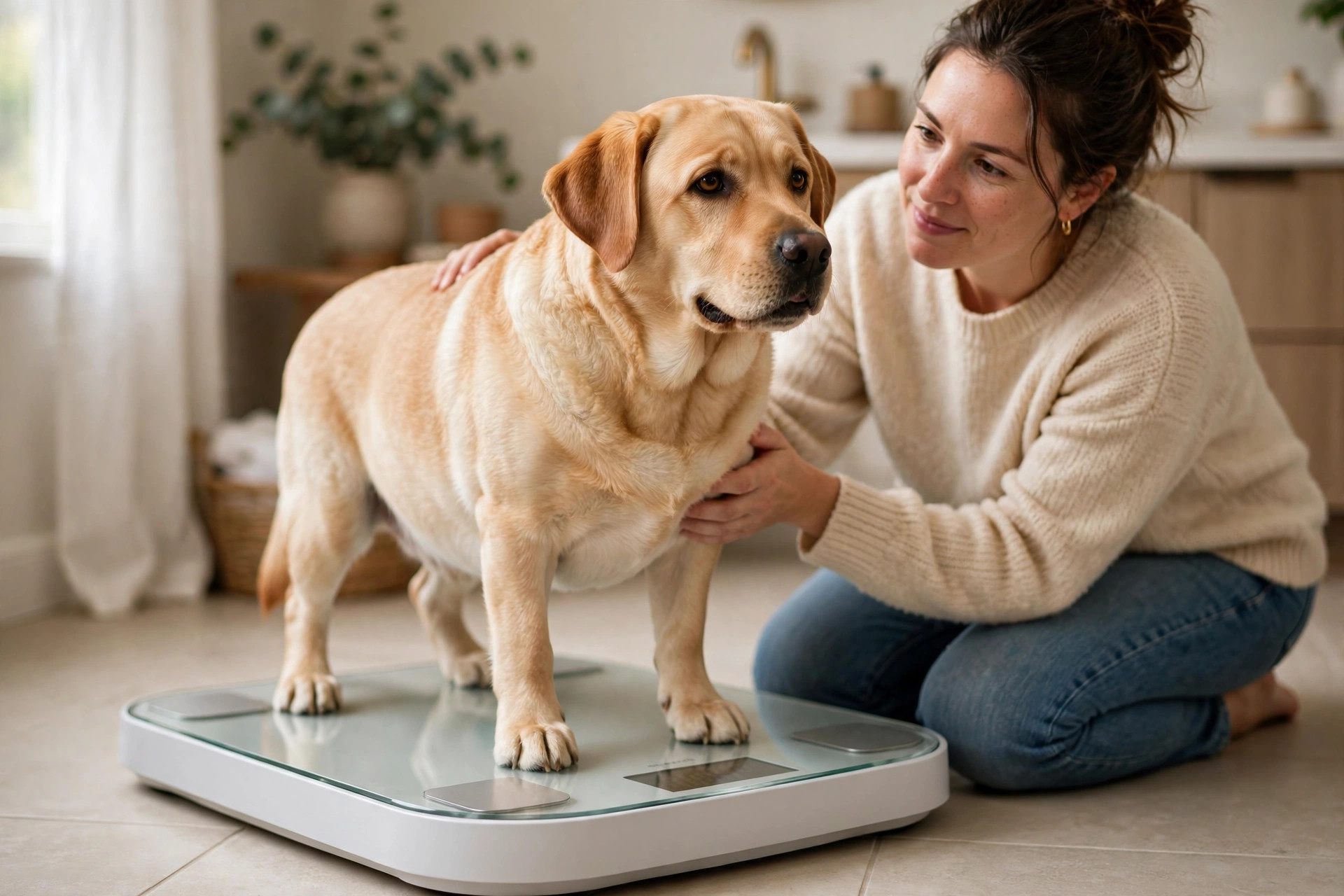
If your dog’s collar needs a notch more room than it used to, or the waistline that once tucked neatly behind the ribs has quietly disappeared, you’re probably asking: is my dog overweight? It’s one of the most common questions dog owners ask — and one of the hardest to answer honestly, because most of us don’t notice the extra weight creeping on a handful of treats at a time.
Here is the good news: excess weight is one of the most fixable health problems a dog can have. This 2026 vet-style guide shows you how to score your dog’s body condition with your own hands and eyes, what the extra pounds are really doing inside, and how to build a safe, vet-approved weight-loss plan that actually works.
Table of Contents
- The 3-Minute Home Weight Check
- What Is a Body Condition Score (BCS)?
- Why Extra Weight Is Dangerous for Dogs
- Why Dogs Gain Weight
- The Safe Dog Weight-Loss Plan
- Weight-Loss Mistakes to Avoid
- How Long Will Weight Loss Take?
- Frequently Asked Questions
The 3-Minute Home Weight Check
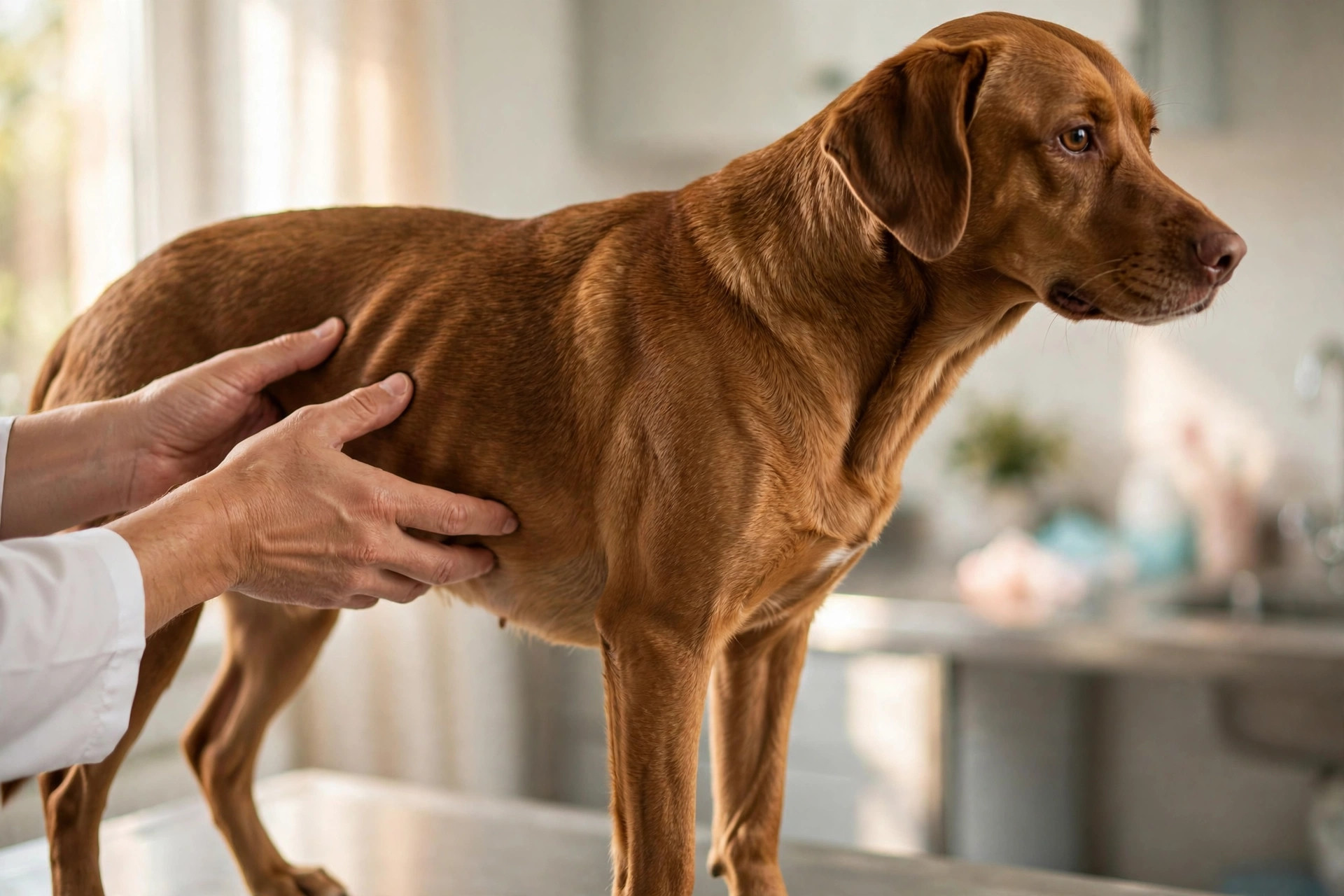
You don’t need a fancy body scanner or a trip to the clinic to get a reliable answer. Veterinarians use a simple look-and-feel routine you can do at home in about three minutes — no scale required.
Step 1: Feel the ribs
Run your hands flat along your dog’s sides. At a healthy weight, the ribs should feel easy to find under a thin layer of fat — veterinarians often say it should feel like the back of your hand when you run a finger over it. If you have to press firmly through padding to locate the ribs, your dog is carrying too much fat.
Step 2: Look from above
Stand over your dog and look down. Between the rib cage and the hips, you should see an hourglass waist that curves inward. A straight line from ribs to hips — or an outward bulge — means excess weight.
Step 3: Look from the side
View your dog from the side. The belly should tuck up from the chest toward the hind legs. A belly that hangs down level with (or below) the chest is a classic sign of an overweight dog.
If all three checks pass — feelable ribs, visible waist, belly tuck — your dog is very likely in a healthy range. If any of them fail, it’s time to learn the scoring system below.
Also Read: Slow Feeder Dog Bowls: Vet Guide for Fast Eaters (2026) — fast eaters often overeat before fullness signals kick in, and a maze bowl is one of the easiest weight-management tools you can buy.
What Is a Body Condition Score (BCS)?
A body condition score is the vet world’s standard way of describing a dog’s body fat — far more useful than the raw number on a scale, because a healthy weight looks completely different for a Greyhound than for a Bulldog. The most common system is the 9-point scale: 4–5 is ideal, 6–7 is overweight, and 8–9 is obese. Veterinary sources including PetMD’s body condition score guide explain how both vets and owners can use it at home.
| Score (1–9) | Category | What You’ll Notice |
|---|---|---|
| 1–3 | Too thin | Ribs, spine, and hip bones easily visible; dramatic belly tuck; obvious muscle loss |
| 4–5 | Ideal | Ribs easily felt, waist visible from above, belly tuck from the side |
| 6–7 | Overweight | Ribs felt with some effort under fat; waist barely visible; around 10–20% over ideal weight |
| 8–9 | Obese | Ribs hard to feel; no waist; belly may sag; around 30–40%+ over ideal weight |
Roughly 59% of US dogs are overweight, according to the Association for Pet Obesity Prevention — yet most owners genuinely don’t see it. Familiarity breeds blindness: we look at our dogs every day, so a slow 2–3% weight gain per year never registers until a vet raises the alarm. Score your dog honestly today, and re-score once a month.
Why Extra Weight Is Dangerous for Dogs
A few extra pounds on a dog is not a cosmetic issue — it is a health crisis hiding in plain sight. Fat tissue is not inert; it releases inflammatory signals that quietly strain nearly every organ system.
1. Shorter lifespan
The landmark lifetime Purina study found that lean dogs lived roughly 1.8 years longer than their overweight littermates. Fewer pounds literally means more birthdays.
2. Arthritis and joint damage
Every extra pound multiplies the force on hips, knees, and elbows. Overweight dogs develop arthritis earlier and show it more severely — and weight loss is often the single most effective “treatment” for a limping senior dog.
3. Diabetes
Obesity is a leading risk factor for canine diabetes, a lifelong disease requiring twice-daily insulin injections. Maintaining a healthy weight dramatically lowers that risk.
4. Breathing and heart strain
Fat around the chest and throat narrows airways. Overweight dogs pant sooner, overheat faster, and flat-faced breeds can develop genuinely dangerous breathing difficulty. The heart works harder every day just to carry the load.
5. Higher surgical and illness risk
Obese dogs face greater anesthesia risk, slower wound healing, and higher rates of pancreatitis and certain cancers. The weight affects almost every diagnosis your vet will ever make.
Why Dogs Gain Weight
Understanding the why makes the fix stick. The usual culprits, in order of impact:
- Too many calories, full stop. Extra treats, table scraps, and generous “heaping” scoops of kibble account for the vast majority of dog weight gain. The 10%-overfeeding trap is real: just 10% extra calories daily can add around 7% body weight in a couple of months.
- Guessing portions instead of measuring. Most owners eyeball food. Switching to an actual measuring cup routinely reveals they’ve been overfeeding by 20–40%.
- Spaying and neutering. Fixed dogs burn roughly 20–30% fewer calories — but owners rarely reduce food after the procedure.
- Too little movement. Aging, busy schedules, and bad weather cut walk time while food stays the same. Senior dogs especially slow down.
- Breed tendency. Labradors, Beagles, Pugs, Cocker Spaniels, and Dachshunds are genetically predisposed to weight gain and need tighter portion control.
- Medical causes. Hypothyroidism and Cushing’s disease can cause weight gain that no diet will fix alone — which is why a vet check comes before any diet.
The Safe Dog Weight-Loss Plan
Dog weight loss works exactly like human weight loss — with one difference: your dog can’t cheat, so you control 100% of the outcome. Follow these steps in order.
Step 1: See your vet first
Before cutting a single calorie, get a vet visit. Your vet will rule out medical causes (thyroid, Cushing’s), score the body condition professionally, set a realistic target weight, and recommend whether a therapeutic weight-loss food is needed. Dogs at BCS 7+ should always have vet supervision.
Step 2: Calculate the calorie target
Vets base weight-loss feeding on the dog’s ideal weight, not current weight. A common starting point: feed roughly 80% of the resting energy requirement (RER) for the ideal weight, where RER ≈ 70 × (ideal weight in kg)^0.75. Example: a dog whose ideal weight is 20 kg has an RER of about 660 kcal/day, so the starting weight-loss target is roughly 530 kcal/day. Your vet can fine-tune this number — and many therapeutic diets print weight-loss feeding guides right on the bag.
Step 3: Measure every meal — no exceptions
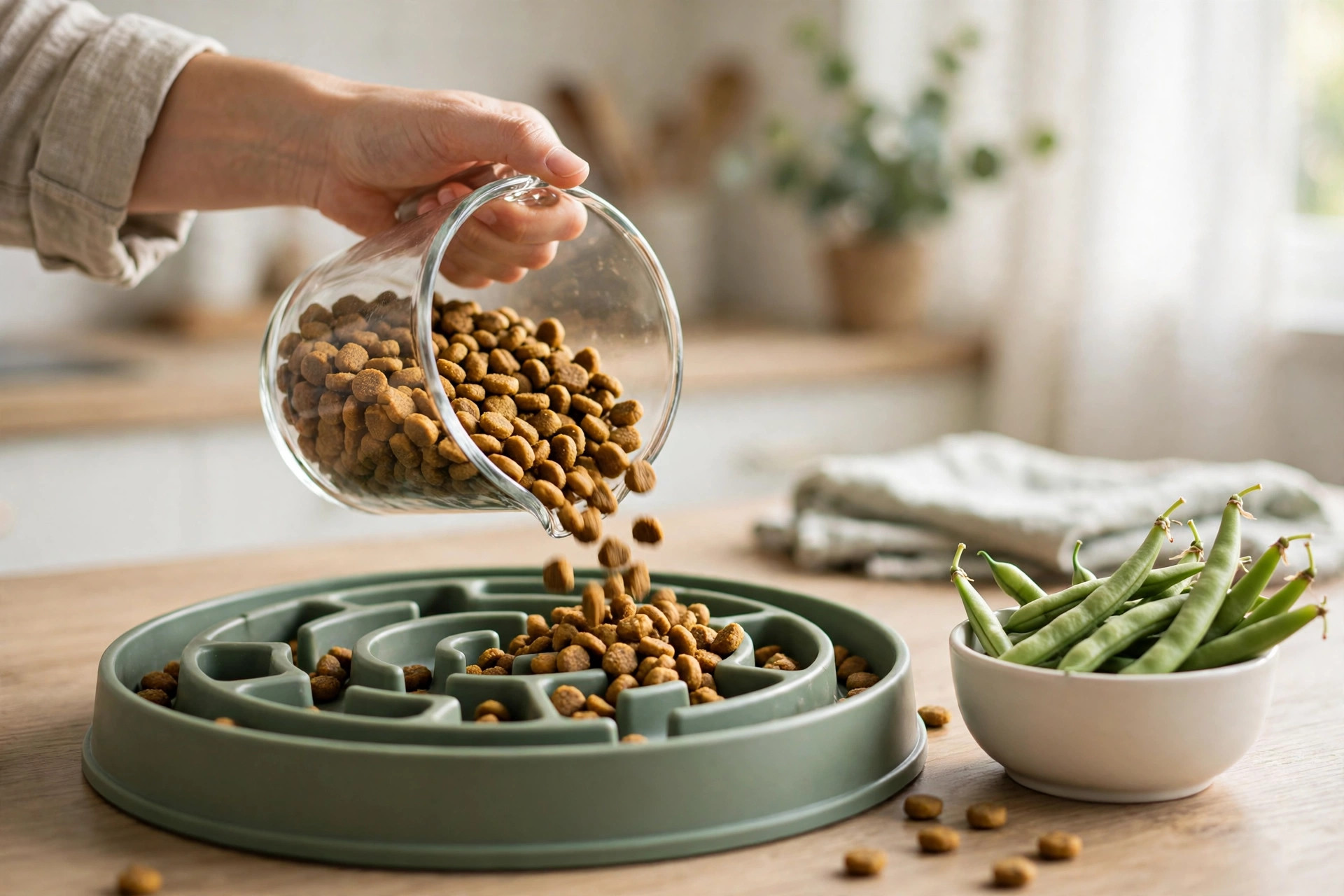
Buy a proper measuring cup or, better, a kitchen scale. Split the daily allowance into two meals. End free-feeding: the bowl goes down for 15–20 minutes, then comes up. Knowing exactly how much goes in is the foundation everything else rests on.
Step 4: Apply the 10% treat rule
Treats, dental chews, table scraps, and training rewards combined must stay under 10% of daily calories — and yes, that includes the peanut butter in the Kong. Swap high-calorie treats for low-calorie swaps: baby carrots, apple slices (no seeds), blueberries, and green beans are classic vet-recommended fillers.
Also Read: Can Dogs Eat Green Beans? Benefits, Risks & Safe Feeding Guide (2026) — vets often suggest green beans as a low-calorie meal filler for dogs on a diet.
Step 5: Feed smarter, not just less
A weight-loss diet should be high in protein (to protect muscle) and fiber (for fullness) while lower in fat. Simply feeding less of a rich maintenance food can shortchange vitamins and minerals — ask your vet about a purpose-formulated weight-management food. Serve meals in a slow feeder or snuffle mat so eating takes 10+ minutes; that gives satiety hormones time to signal fullness.
Step 6: Move more — gradually
Add 5–10 extra minutes of walking per day each week until you reach 30–60 minutes of daily activity, adjusted for age and breed. For overweight dogs, low-impact exercise (steady walks, swimming) beats intense running. Cut nothing back on enrichment: nose games and training sessions burn mental energy and replace the “bored snack” habit.
Step 7: Track and adjust
Weigh your dog every 2–4 weeks and re-check the body condition score monthly. Safe loss is about 1–2% of body weight per week (closer to 0.5–1% for very obese dogs). No progress after a month? Something uncounted is sneaking in — usually treats, an extra feeder in the family, or a mis-measured scoop. Revisit your vet if the scale refuses to move.
Weight-Loss Mistakes to Avoid
- Crash dieting. Cutting food drastically causes muscle loss and nutrient deficiencies — and a miserable dog. Slow and steady wins.
- Skipping the vet visit. A medical cause like low thyroid makes dieting pointless and delays real treatment.
- “Just a little bit” from every family member. Weight-loss plans fail most often because three people each give “one” treat. Get everyone on board and count every calorie.
- Forgetting the cat’s food, the kids’ snacks, the dropped crumbs. Multi-pet households need managed feeding areas.
- Exercising an obese dog too hard, too fast. Overweight joints are already stressed. Build up gradually and watch for limping or excessive panting.
- Feeling guilty about smaller portions. Your dog is not suffering — dogs adapt to correct portions within days, especially when meals are enriched with slow feeders and low-calorie fillers.
How Long Will Weight Loss Take?
Honesty time: it takes longer than owners expect. At 1–2% per week, a dog that needs to lose 10% of its body weight needs roughly 2–4 months; a dog at BCS 8–9 needing to shed 30%+ may need 6–9 months or more. That’s normal — and it’s why monthly re-checks with your vet keep motivation alive. Celebrate non-scale wins too: more energy on walks, easier breathing, and the return of that tucked-up waist.
Frequently Asked Questions
Is my dog overweight if I can’t feel his ribs?
Almost certainly. Easily felt ribs are the single most reliable sign of a healthy body condition. If you have to press firmly through fat to find them, your dog is over ideal weight — score them on the 9-point BCS chart above and see your vet.
How fast should a dog lose weight?
Aim for 1–2% of body weight per week (0.5–1% for very obese dogs). Faster loss risks muscle wasting and nutritional deficiencies. Weigh every 2–4 weeks to stay on track.
Should I just feed my dog less of his regular food?
Mildly overweight dogs (BCS 6) can often start with a modest 10% calorie reduction of their current food. But significantly cutting a maintenance food can cause nutrient gaps — ask your vet about a high-protein, high-fiber weight-management formula designed for calorie restriction.
Are green beans really a good diet filler for dogs?
Yes — veterinarians have recommended green beans as a low-calorie filler for years. They’re filling, low in calories, and most dogs enjoy them. See our guide on green beans for dogs for safe serving sizes.
Can spayed/neutered dogs avoid weight gain?
Yes. Reduce daily food by roughly 20–30% in the weeks after the procedure (or switch to a spayed/neutered formula), keep up exercise, and score body condition monthly. The metabolism change is predictable — the weight gain isn’t inevitable.
When is an overweight dog a vet emergency?
See your vet promptly if rapid weight gain comes with heavy drinking and urination, hair loss, a pot belly (possible Cushing’s), breathing difficulty, sudden lethargy, or inability to walk comfortably. These can signal medical causes that need treatment before any diet begins.
Final Thoughts
So, is my dog overweight? If the ribs hide under padding, the waist has vanished, and the belly sags instead of tucking up — yes, and now you know exactly what to do about it. Score the body condition honestly, get your vet’s target weight and calorie plan, measure every meal, keep treats under 10%, and move a little more each week. October’s focus on pet obesity is the perfect nudge: the pounds that crept on over months can come off over months, and every one of them buys your dog more healthy years with you.