
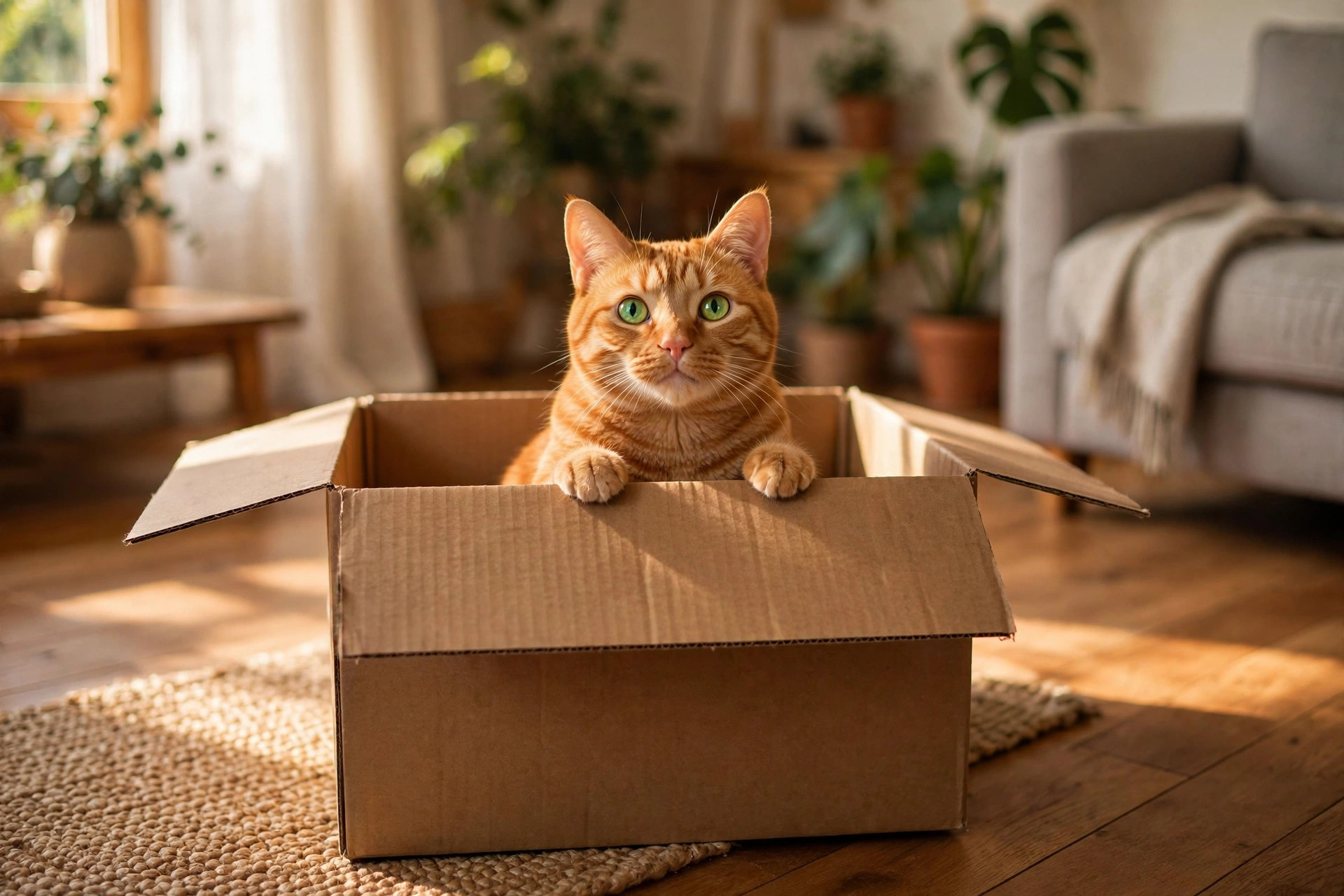
You buy your cat the fanciest tower you can find — and within a day, she is fast asleep in the shipping box it arrived in. If you keep wondering why do cats love boxes so much, you are asking one of the most-asked questions in pet behavior — and the answer is far more interesting than it looks.
A cardboard box is not random furniture to a cat. It is a safe den, a hunting blind, a stress shield, and a warm cocoon, all in one. Feline behavior researchers have studied this obsession, and what they found explains everything from why your cat squeezes into boxes that are comically too small to why a simple box can calm a stressed shelter cat faster than almost anything else.
In this complete 2026 guide, we break down the real science behind why cats love boxes: the ambush-hunting instinct, the warmth factor, the stress-relief research, how to pick the right box, box safety rules, and answers to the most common questions cat owners ask.
Table of Contents
- The Science of Why Cats Love Boxes
- Reason 1: They Are Born Ambush Hunters
- Reason 2: Walls Mean Safety and Control
- Reason 3: Boxes Are Warm — and Cats Run Cold
- Reason 4: Boxes Lower Stress (The Research Says So)
- How to Pick the Perfect Box for Your Cat
- Box Safety: 6 Rules to Keep Your Cat Safe
- Frequently Asked Questions
The Science of Why Cats Love Boxes
Here is the one-sentence answer: a box gives your cat exactly what millions of years of evolution taught her to want — a sheltered spot where she can watch the world without being seen, stay warm, and switch off the alarm bells of her nervous system. Domestic cats are ambush hunters that are also small enough to be prey, and a box satisfies both sides of that equation at once: cover to hide in, and a blind to hunt from.
That is why the box usually wins over the expensive cat bed. The bed may be softer, but the box feels safer — and to a cat’s brain, safety outranks softness every time.
Also Read: Why Does My Cat Bite Me? Love Bites Explained (2026) — biting is another instinct-driven behavior that makes more sense once you understand the cat brain.
Reason 1: They Are Born Ambush Hunters
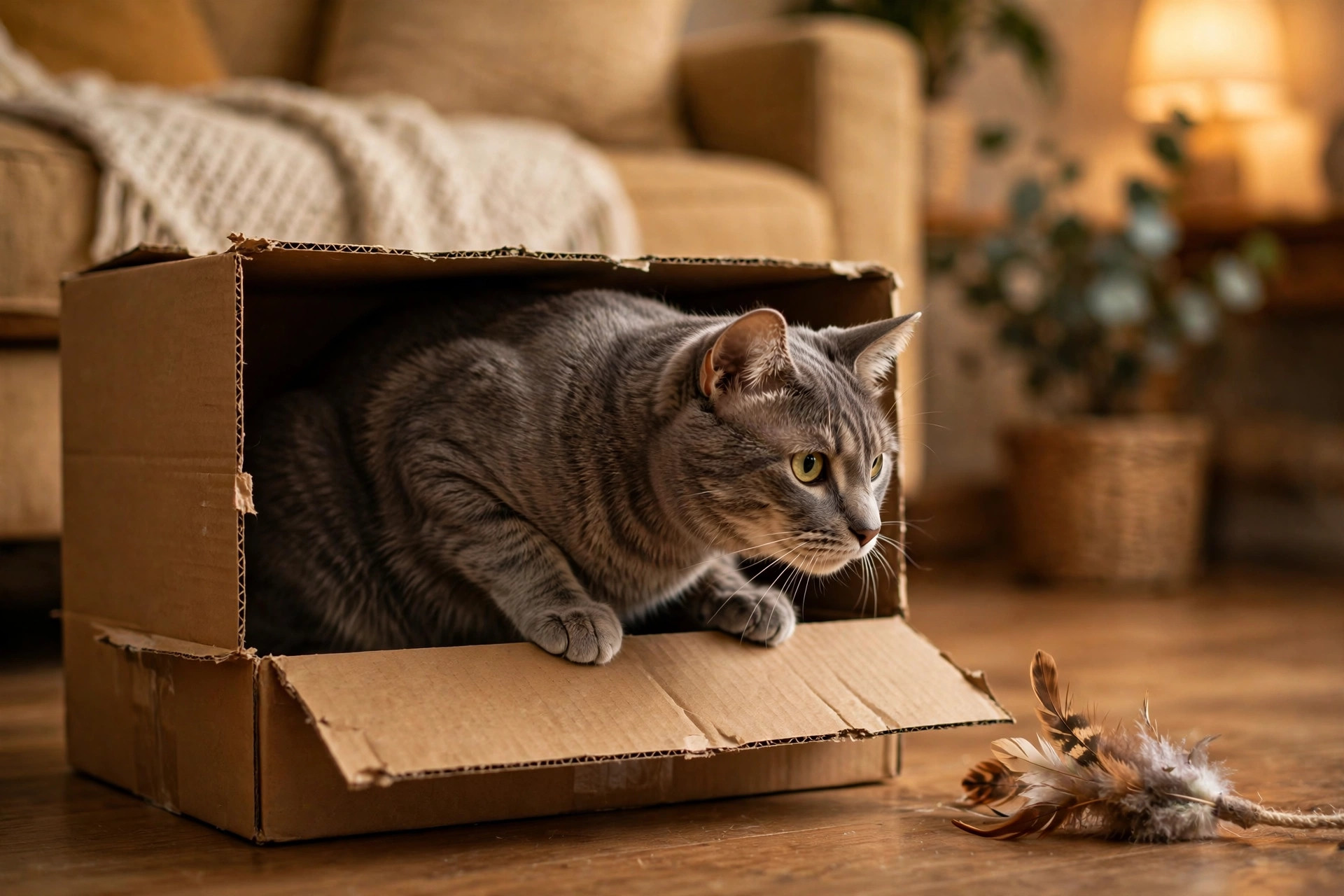
Cats are ambush predators. In the wild, small felids do not run down their prey — they find dense cover, stay perfectly still, and strike only when the target wanders close enough. That strategy is baked into your cat’s nervous system whether she has ever set foot outside or not.
A box is cover. Sitting inside one, your cat can watch the room without being seen, with walls on three sides and one controlled entry point. That is not a coincidence — it is exactly the kind of position a wild cat would seek before a hunt.
Watch your cat in a box and you will see the hunting posture: ears forward, eyes scanning, body low and coiled. That is not relaxation — that is surveillance. The box lets her do the mental work of hunting — watching, waiting, planning the pounce — and the sudden explosive pounce satisfies a predatory drive that needs an outlet.
Reason 2: Walls Mean Safety and Control
It is not only about hunting. Cats are small enough to be prey themselves, and in the wild, a cat resting unprotected in the open is a target. Enclosed, tight spaces eliminate that threat: the walls signal nothing can approach me from behind. Cats do not assess physical fit the way humans do; they assess safety — a defined boundary reduces anxiety and increases perceived control.
A box also gives your cat something deeper: control over her exposure. When the house gets loud, strangers visit, or another pet is being annoying, retreating into a box lets a cat regulate how much of the world she has to deal with. That is not antisocial behavior — it is self-preservation, and it is healthy.
Also Read: Is My Cat Jealous? Signs & How to Help (2026) — in multi-cat homes, boxes act as micro-sanctuaries that give each cat her own guaranteed territory.
Reason 3: Boxes Are Warm — and Cats Run Cold
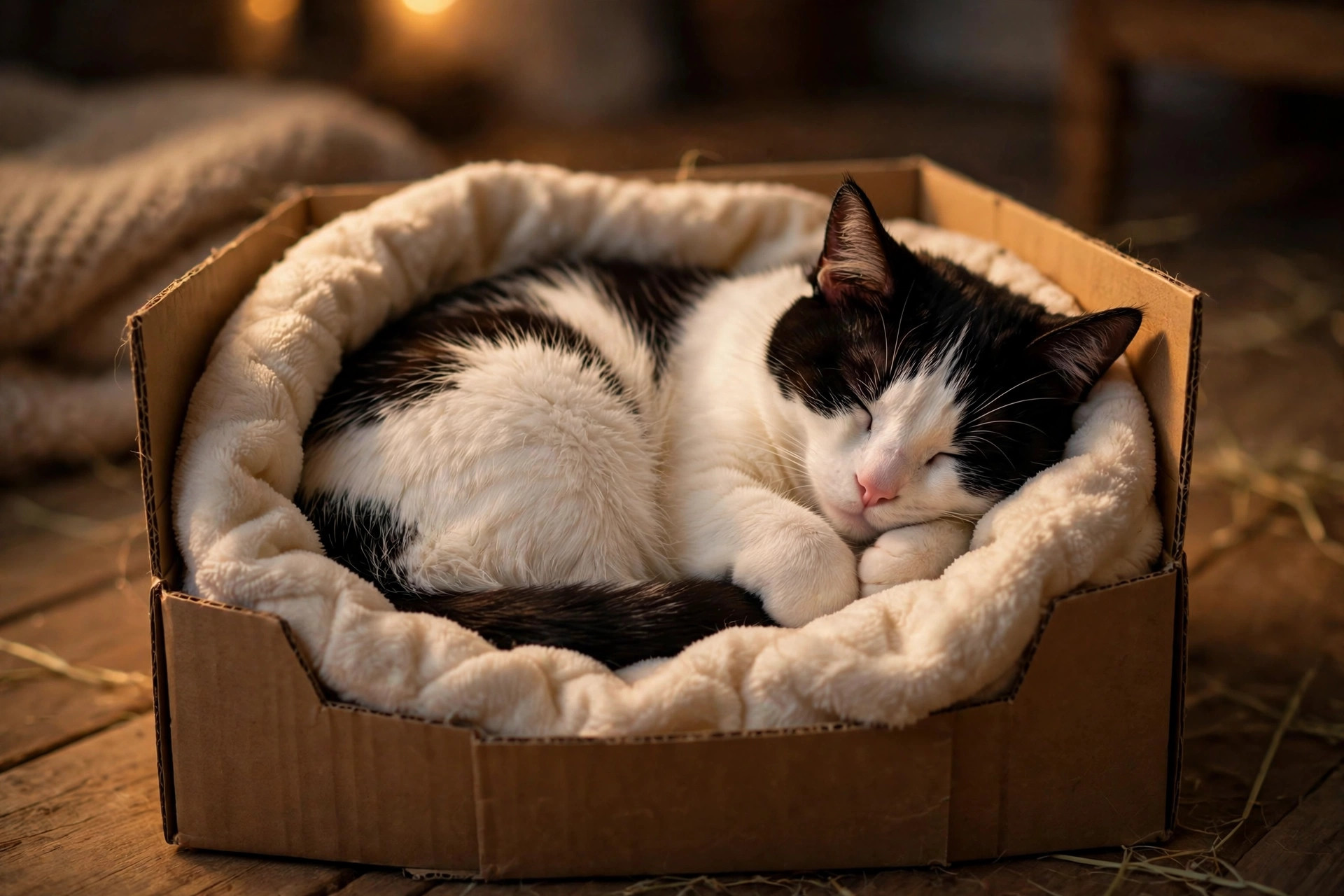
Cats love warmth, and most homes are colder than cats would choose. Research published by the National Research Council found that cats are most comfortable in temperatures between roughly 86 and 97°F — yet most homes sit around 72°F. Your cat is, effectively, a little chilly most of the time.
Cardboard is a surprisingly good insulator. The walls of a box trap your cat’s body heat, and the confined space forces her to curl up into a ball, which preserves even more warmth. Add the insulating warmth of cardboard and the comfort of feeling hidden on three sides, and a box becomes — from your cat’s perspective — close to perfect.
Reason 4: Boxes Lower Stress (The Research Says So)
This is not just owner intuition — it has been measured. A study at Utrecht University in the Netherlands gave shelter cats access to hiding boxes and compared them with cats that had none. Researchers tracked cortisol (the stress hormone) and behavioral signs like vocalizing, hiding, and activity levels.
The results were clear: cats with boxes showed significantly lower stress levels and adapted to the new environment much faster than cats without. The walls of a box create a barrier that reduces sensory overload, helping cats manage anxiety when everything around them is unfamiliar.
This principle works at home too. Moving furniture, hosting a party, bringing home a new pet, or even a week of construction noise next door can unsettle even a confident cat. A readily available box becomes a coping mechanism — an instant safe zone she can claim and control. Veterinary behavior experts note that providing hiding places is one of the most effective welfare tools available for cats in stressful situations.
The takeaway for owners: never take away a hiding box “so the cat will socialize.” A cat without a retreat fights harder; a cat with one relaxes sooner.
Also Read: First-Time Cat Owner Checklist: 12 Things to Buy & Do (2026) — a simple cardboard box with a doorway counts as a legitimate hiding spot for a new cat’s first week.
It is also why cats squeeze into boxes that look comically too small: the brain registers contact with walls, not square footage, and the pressure triggers a calming response. She is not misjudging the size — she is choosing the sensation.
How to Pick the Perfect Box for Your Cat
Good news: the best cat toy in your house is free. But not every box is equal. Follow these owner-tested guidelines:
- Size: Pick a box your cat can comfortably curl up in — but do not worry if it looks snug. The too-small ones still get used.
- Entrance: Cut a doorway in one side so your cat can walk in and out. A second opening on the opposite side prevents cornering in multi-cat homes.
- Cleanliness: Use clean, dry boxes. Avoid boxes from supermarkets that held meat or chemicals, and skip any box with mold, wet spots, or strong smells.
- Stability: Tape the bottom shut so the box does not collapse when your cat jumps in. Flaps folded outward make a wider, sturdier base.
- Comfort upgrade: Line the bottom with a soft blanket or worn T-shirt. Your scent on the fabric makes the box even more reassuring.
- Location: Place boxes in quiet, low-traffic spots with a view of the room — a window-side box is cat paradise. One box per cat plus one extra is the ideal ratio, just like litter boxes.
Rotate boxes every few weeks. A fresh box is exciting, and a worn box collects dander and dust. Veterinary sources including PetMD confirm that enclosed cardboard spaces are one of the simplest, most effective forms of enrichment for indoor cats.
Box Safety: 6 Rules to Keep Your Cat Safe
Cardboard is generally safe, but a little caution keeps the fun worry-free:
- Remove staples, tape, and labels before offering a box — cats chew cardboard, and adhesives can irritate stomachs.
- Cut away handles on shopping bags and box flaps with narrow slots where a cat’s head could get stuck.
- No plastic bags as substitutes — plastic is a suffocation and entanglement hazard; stick to cardboard.
- Check for sharp edges after cutting doorways; fold tape or cardboard flaps over any rough cuts.
- Do not let cats eat cardboard in quantity. A little nibbling is normal, but a cat that chews and swallows a lot of cardboard — especially one with tape or ink — can develop stomach upset or, rarely, a blockage.
- Supervise kittens in tall boxes they can climb into but not climb out of; a trapped kitten panics fast.
Frequently Asked Questions
Why does my cat ignore the expensive bed and sleep in a box?
Because a box feels safer. A bed may be softer, but open sleeping spots expose a cat on all sides. The box’s walls satisfy the instinct to rest unseen — warmth and security outrank softness in a cat’s brain.
Is it normal for my cat to chew on cardboard boxes?
Yes, mild chewing is normal exploration — cats explore with their mouths. It becomes a problem only if your cat swallows large amounts of cardboard, tape, or ink. Redirect heavy chewers to cat-safe chew toys and offer scratching boxes made for the purpose.
Do cats prefer boxes over cat trees and beds?
Not exactly — they prefer boxes for sleeping and hiding, and cat trees for climbing and surveying. Each satisfies a different instinct. The best homes offer both: vertical territory plus ground-level hideouts.
Can a box really reduce my cat’s stress?
Yes. A published shelter-cat study found that cats given hiding boxes showed measurably lower stress and adapted to new environments faster than cats without them. At home, boxes work as instant calm-down zones during noise, guests, or household changes.
Should I take my cat’s box away so she socializes more?
No. Removing hiding spots never increases sociability — it increases anxiety. A cat with a guaranteed safe retreat relaxes faster and socializes on her own terms. Let her set the pace.
Final Thoughts
So, why do cats love boxes? Because a humble cardboard box is one of the few objects in your home that speaks directly to your cat’s oldest instincts: hunt from cover, rest where nothing can sneak up on you, stay warm, and control how much of the world you face at once.
The science backs up what cat owners have always known — boxes reduce stress, provide enrichment, and make indoor cats measurably calmer. So the next time a package arrives, save the box. Your cat has already decided what it is for, and she is right.
By Dr. Ayaz Ali