
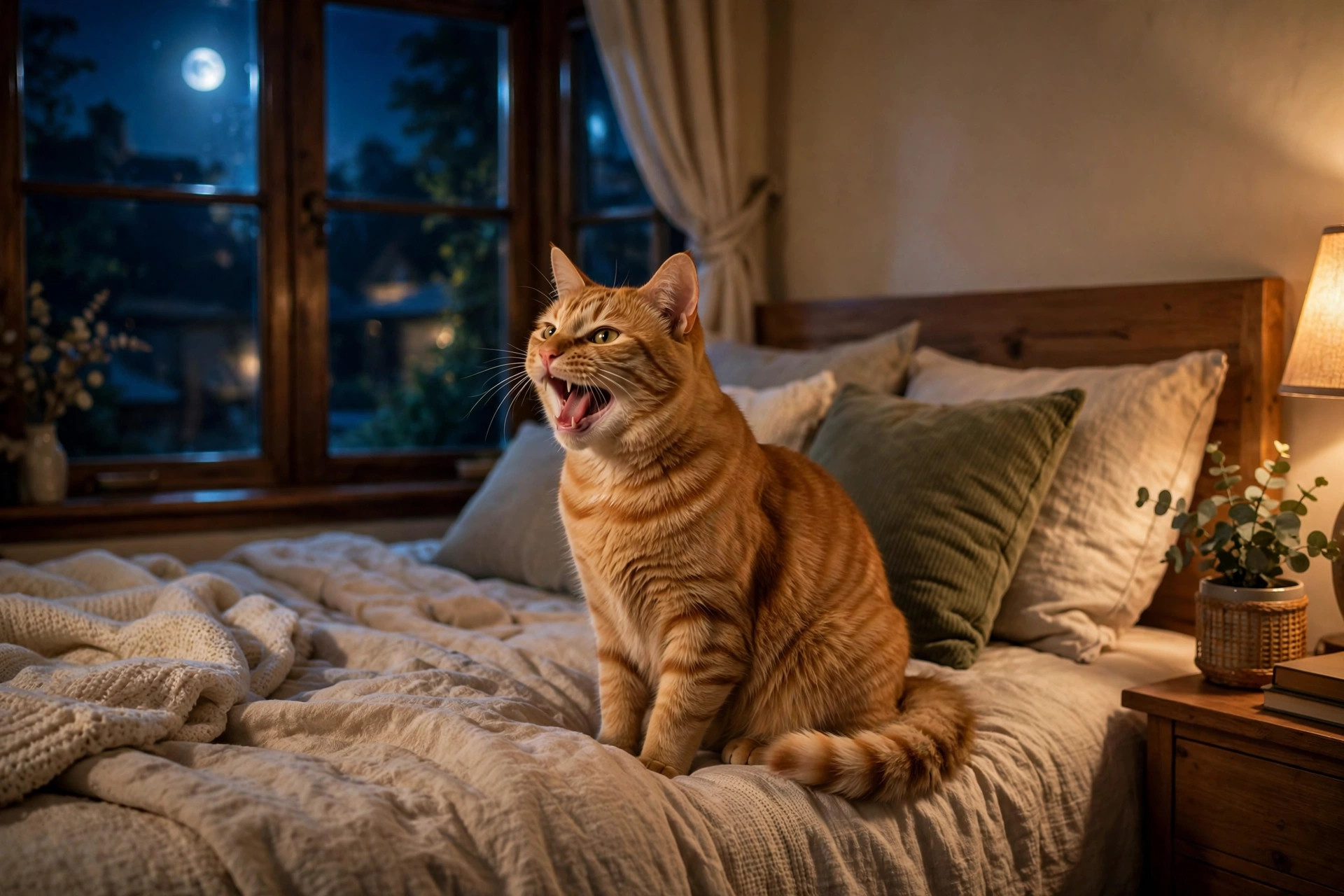
You know the scene: it’s 3 a.m., and then it starts — meow… meow… MEOW. If you keep asking yourself why does my cat meow at night, you are far from alone. Most night meowing has a fixable cause — this guide covers the 7 most common reasons, when the behavior is a medical warning sign, and the 7-night plan that helps most cats sleep through the night again.
Table of Contents
- Why Cats Are More Active at Night
- Why Does My Cat Meow at Night? 7 Causes Explained
- When Nighttime Meowing Is a Medical Concern
- 4 Mistakes That Make Night Meowing Worse
- The 7-Night Plan for Quiet Nights
- FAQs: Why Does My Cat Meow at Night?
- Final Thoughts
Why Cats Are More Active at Night
Understand this first: cats are crepuscular, meaning their peak activity hours are dawn and dusk — when their wild ancestors hunted. Your cat’s internal clock simply says “wake up” right when you want to sleep.
This mismatch is the root of most nighttime noise. A cat that napped all day reaches midnight with a full battery, and that energy goes into meowing, zoomies, and pouncing on your feet under the blanket. You can’t train the instinct out of a cat — but you can shift its energy into the evening so it is genuinely tired when you are. That’s what the 7-night plan below does.
Why Does My Cat Meow at Night? 7 Causes Explained
Once you’ve ruled out a medical issue, almost every case comes down to one of these seven causes.
1. Leftover Energy and Boredom
The number one cause in indoor cats. A cat that dozed all day with no play or mental stimulation is wide awake at midnight with nothing to do. When meowing comes with zoomies, boredom is almost always the driver.
2. Hunger or a Mistimed Feeding Schedule
Does your cat meow at the same time every night? Hunger is the likely culprit. Cats fed once in the morning can be genuinely hungry by 3 a.m. A small final meal before bedtime fixes this in most cases.
Also Read: Why Is My Cat Not Eating? Warning Signs (2026)
3. Attention-Seeking (and It Worked Before)
If a meow once got you out of bed — to feed, pet, or scold them — the cat has learned the night meow is a reliable tool. Even shouting back counts as a reward, because the cat wanted a reaction.
4. Loneliness
Cats bonded to their people can feel lonely at night, especially with the bedroom door closed and the house dark. The meowing is a genuine call for company. A warm sleeping spot near you — or just leaving the door open — often ends it.
5. Mating Behavior (Unspayed/Unneutered Cats)
Unspayed females in heat produce loud, drawn-out yowls that carry through the neighborhood. If the nighttime concerts started suddenly in an intact cat, hormones are the cause — spaying or neutering stops the behavior in almost all cases.
6. Environmental Changes and Stress
A new home, new pet, or stray cat outside the window can surface as nighttime vocalizing. Look for stress signs alongside it: pacing, hiding, or litter-box changes.
Also Read: Does the Time Change Affect Cats? Fall-Back Guide (2026)
7. Health Problems (Senior Cats Especially)
A sudden increase in nighttime vocalizing — especially in a cat over 7 — is a veterinary matter until proven otherwise. The main medical drivers are hyperthyroidism, high blood pressure, cognitive decline, deafness, and pain, covered next.
| Cause | Clues | Quick Fix |
|---|---|---|
| Boredom / energy | Zoomies, daytime laziness | Evening play session + puzzle toys |
| Hunger | Same time nightly | Meal right before bedtime |
| Attention-seeking | Stops when you appear | Ignore at night; reward quiet moments |
| Loneliness | Meows by closed doors | Cozy spot near you, open door |
| Mating | Yowling, restlessness, intact cat | Spay/neuter |
| Medical | Sudden increase, senior cat | Vet visit — see next section |
When Nighttime Meowing Is a Medical Concern
Rule of thumb: a brand-new pattern of nighttime meowing in a cat over 7 is a medical sign until a vet says otherwise. The main conditions, per resources such as PetMD’s guide to cat meowing:
Hyperthyroidism
The most common medical cause. An overactive thyroid speeds up appetite, heart rate, and restlessness — and many hyperthyroid cats meow at night while pacing. Clues include weight loss despite a big appetite. It is very treatable once a blood test confirms it.
Cognitive Dysfunction Syndrome (CDS)
The feline equivalent of dementia. Cats with CDS lose their day-night rhythm and may yowl at night in an empty room, seemingly at nothing. Night lights, consistent routines, and easily reached resources help — and your vet can discuss supportive options.
High Blood Pressure and Deafness
Hypertension often accompanies hyperthyroidism or kidney disease and can increase vocalizing. Deafness works differently: a cat that can’t hear itself gets louder. If your senior cat also stops responding to sounds, mention it at the checkup.
Pain (Arthritis, Dental Disease)
Chronic pain — stiff arthritic joints on a cold night, or an aching tooth — can make a cat cry out when the house is quiet. Limping, hesitating to jump, or dropping food from the mouth point toward pain.
Also Read: Do Self-Cleaning Litter Boxes Work? (2026) — smart litter boxes that track bathroom habits can flag some of these conditions early.
4 Mistakes That Make Night Meowing Worse
Most owners accidentally reinforce the behavior. Avoid these traps:
- Getting up to feed or soothe the cat. This teaches the cat that night meowing works. Breakfast must wait for the alarm, not the first meow.
- Responding inconsistently. Ignoring the meow five nights and giving in on the sixth is the worst outcome — it teaches the cat that persistence pays off.
- Yelling or punishing. Shouting adds stress without teaching anything, and punishment can damage trust or increase anxiety-driven vocalizing.
- Skipping daytime enrichment. No amount of ignoring works if the cat is genuinely under-stimulated. A bored cat needs more activity, not more discipline.
The 7-Night Plan for Quiet Nights
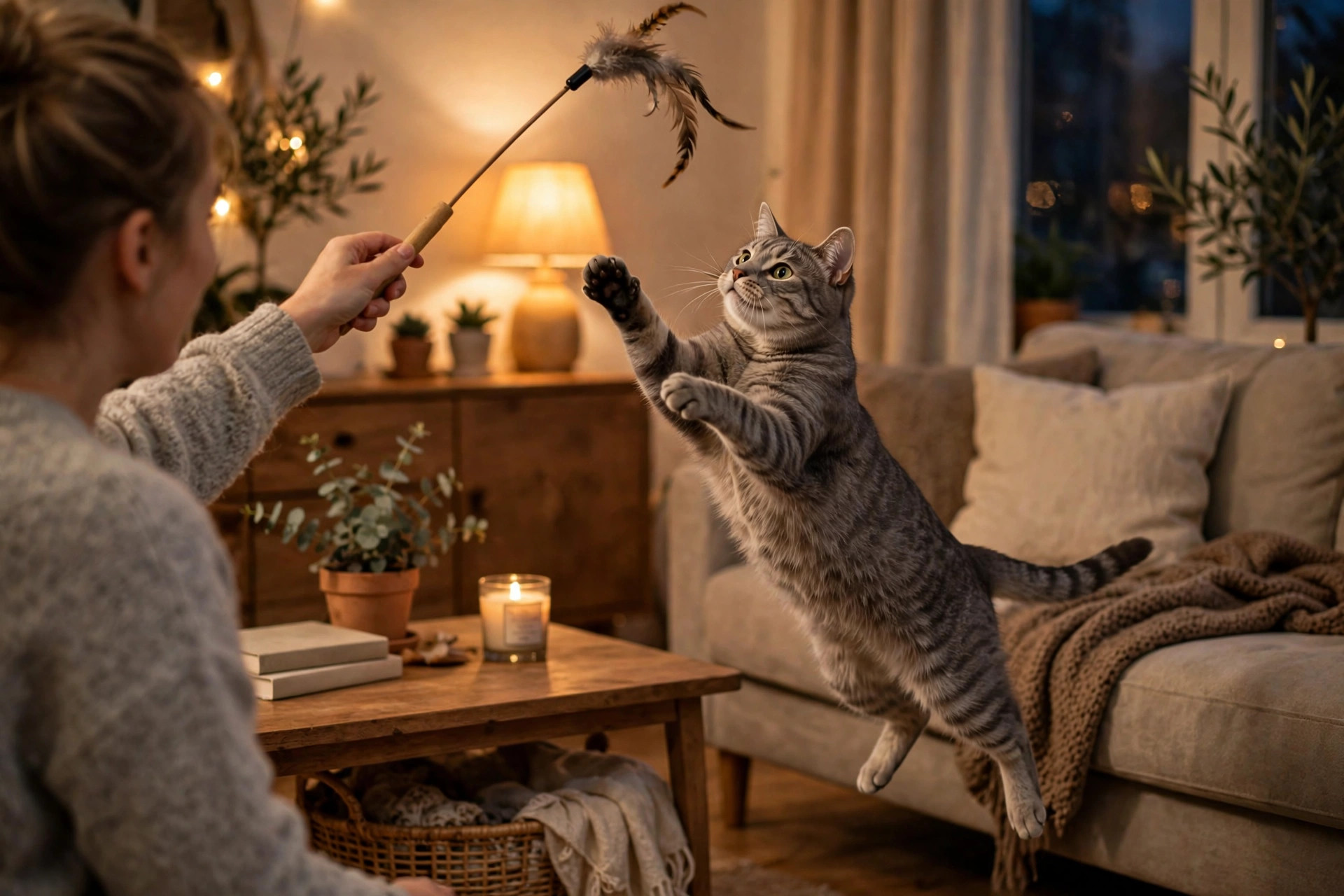
Shift the cat’s active window into the evening and teach it that meowing at night produces nothing. Follow these steps in order:
- Play before bed — every night. A 10–15 minute interactive play session (feather wand, chase toy) in the evening. Let the cat “catch” the toy at the end to complete the hunt.
- Serve the final meal after play. Hunt, catch, eat, groom, sleep — that’s a cat’s natural cycle. A small meal after play tells the body it’s time to wind down.
- Add daytime enrichment. Puzzle feeders, a window perch, and short play sessions during the day drain the battery before night.
- Make nights boring. When the meowing starts, give zero reaction — no talking, no eye contact, no getting up. Improvement usually appears within a week.
- Reward the quiet, not the noise. When your cat is calm in the morning, give attention and breakfast promptly. Quiet mornings earn rewards; noisy nights earn nothing.
- Keep the routine identical. Same feeding times, same play time, same bedtime every day. Cats relax into predictable rhythms.
- Rule out medical causes first. If nothing changes after a week — or a senior cat’s meowing started suddenly — book a vet visit.
FAQs: Why Does My Cat Meow at Night?
Why does my cat meow at night?
Usually because cats are crepuscular and reach the night with leftover energy — or because they are hungry, lonely, bored, or have learned that meowing works. In senior cats, new nighttime yowling can signal hyperthyroidism or cognitive decline.
Should I ignore my cat meowing at night?
Ignore demand meowing — but only after ruling out real needs. Check food, water, a clean litter box, and no signs of pain or illness first. Then wait for a quiet pause before giving attention, so silence gets rewarded instead of noise.
Why is my senior cat suddenly yowling at night?
Sudden loud nighttime vocalizing in a cat over 7 is most commonly caused by hyperthyroidism, high blood pressure, hearing loss, or feline cognitive decline. Book a vet visit, especially if your cat is also losing weight, drinking more, or seems confused at night.
Why is my cat suddenly meowing at night when it never did before?
Check for pain, appetite or litter-box changes, recent stress, or being in heat if unspayed. If the change comes with any other symptom, call your veterinarian rather than waiting it out.
Will my cat stop meowing at night on its own?
Rarely. Behavior that works continues — a cat whose meowing earns food, play, or attention has no reason to stop, so without intervention the pattern continues or worsens.
Final Thoughts
So, why does my cat meow at night? For most cats, the answer is simple: a crepuscular hunter with a full battery, an empty stomach, or a learned habit. Shift the activity into the evening, feed after play, and hold a firm, boring line at 3 a.m. — and most cats settle within a week. But never ignore a new pattern in a senior cat: nighttime yowling is one of the earliest signs of hyperthyroidism and cognitive decline, and an early vet visit can make all the difference.
By Dr. Ayaz Ali