
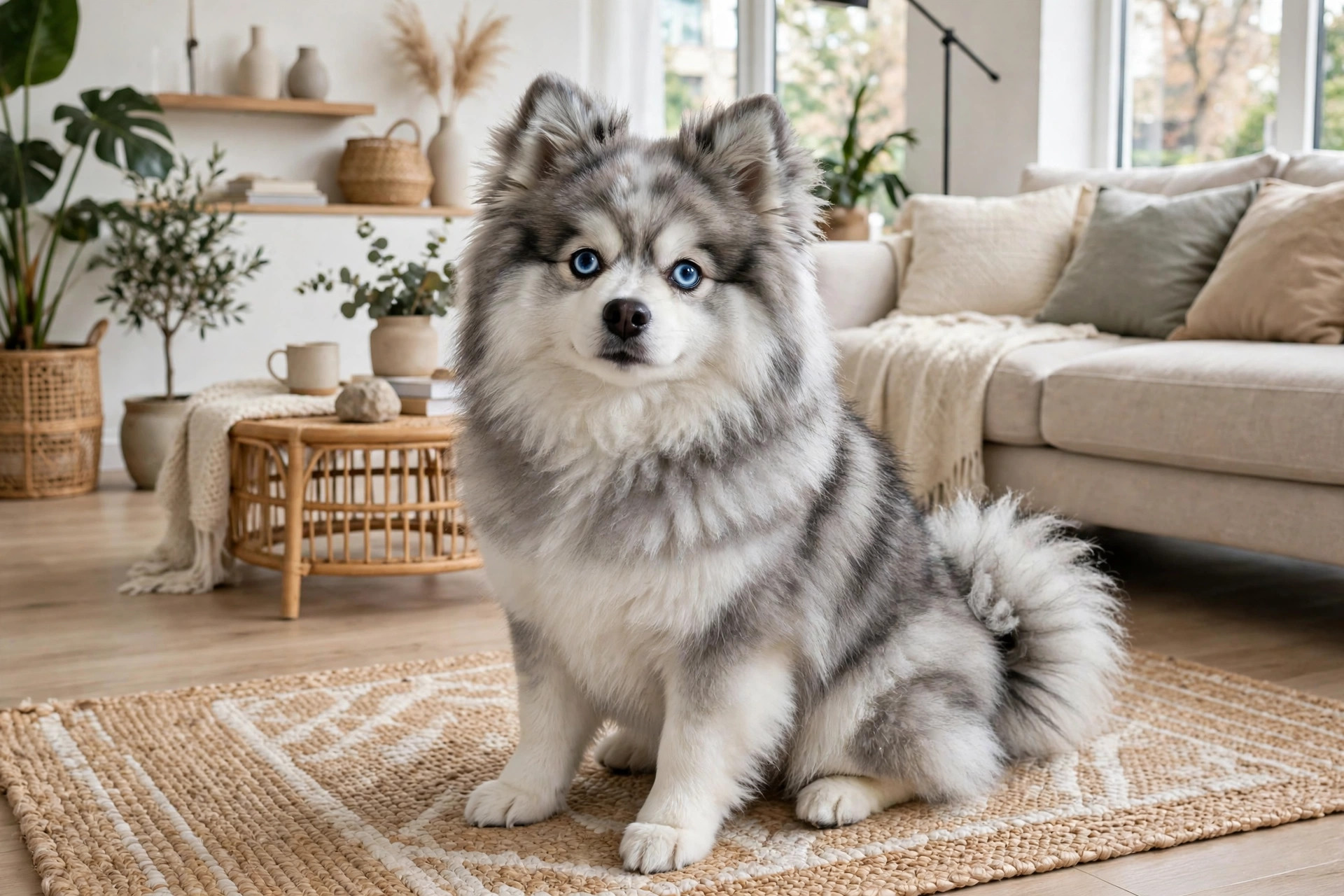
If you have ever wished for a Husky that fits in a small apartment, you have probably already fallen for the Pomsky. This pomsky breed guide covers everything you need to know about the Pomeranian and Siberian Husky cross that Rover named the #1 trending dog breed of 2026, up 13% year over year. A Pomsky packs Husky looks, blue eyes, and a big personality into a dog that stands just 10 to 15 inches tall.
But behind the adorable face is a clever, vocal, high-energy dog with a heavy-shedding double coat and a stubborn streak from both parents. Before you bring one home, read on: this guide covers Pomsky size, temperament, exercise, grooming, health, training, and cost — plus the honest answer to whether this designer cross is right for your family.
Table of Contents
- What Is a Pomsky?
- Pomsky Temperament & Personality
- Pomsky Facts at a Glance
- Exercise & Energy: How Much Does a Pomsky Need?
- Training a Pomsky: The Honest Truth
- Grooming & Shedding: Surviving the Coat Blow
- Pomsky Health Problems to Watch For
- Feeding Your Pomsky
- How Much Does a Pomsky Cost?
- Is a Pomsky Right for You?
- Frequently Asked Questions
- Final Thoughts
What Is a Pomsky?
A Pomsky is a designer crossbreed between a Pomeranian and a Siberian Husky, bred to look like a miniature Husky with the Pomeranian’s foxlike curled tail. The cross has only been around since about 2012, and the International Pomsky Association was established in 2014 to work toward breed standards. Groups such as the American Pomsky Kennel Club (APKC) continue that work today — but Pomskies are not recognized by the American Kennel Club, and there is no official breed standard yet.
That matters more than it sounds. Because the cross is so new and unstandardized, no breeder can guarantee exactly how a puppy will turn out. One littermate may look like a tiny Husky; another may lean heavily Pomeranian. Most adults land somewhere in the middle: a small-to-medium, fluffy dog with Husky markings, erect ears, and blue, brown, or mismatched eyes.
Because of the large size difference between the parent breeds, Pomskies are created through artificial insemination, with the Husky as the mother and the Pomeranian as the father. First-generation crosses are called F1 Pomskies; later generations (F2, F3) come from breeding Pomsky to Pomsky, and their size and looks vary even more.
For a vet-reviewed overview of the cross, see PetMD’s Pomsky breed guide.
Pomsky Temperament & Personality
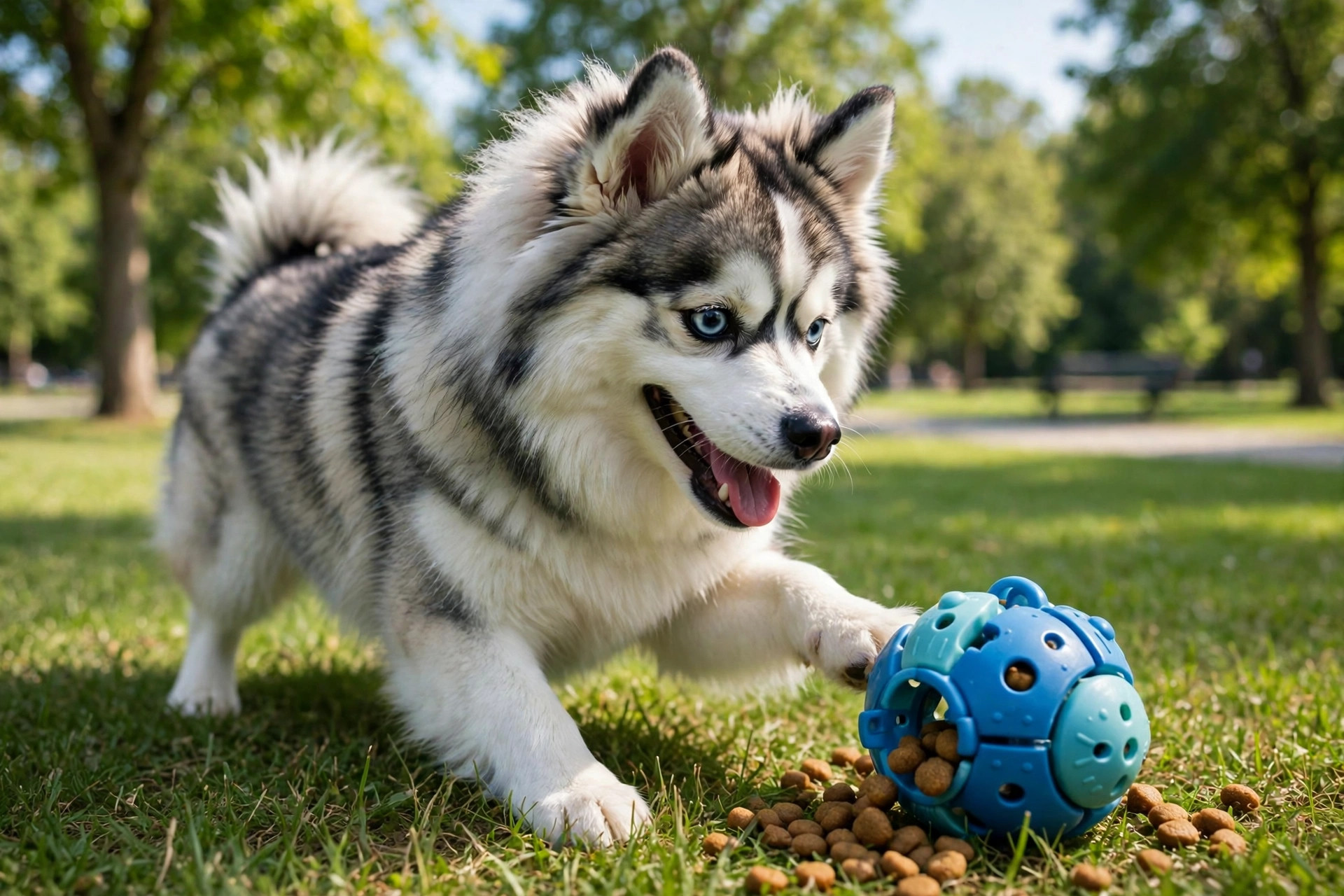
Pomskies inherit personality from both sides, and the mix is lively. From the Husky side they get high energy, a strong prey drive, a love of escaping, and a wide vocal range — barking, howling, and the famous Husky “talking back.” From the Pomeranian side they get boldness out of proportion to their size, alertness, and a tendency to bark at anything new.
Most Pomskies are:
- Affectionate and loyal — they bond closely with their families and often attach strongly to one person.
- Clever and curious — quick to learn tricks, but also quick to learn how to open doors and bins.
- Playful clowns — they love games, toys, and attention, and many stay puppy-like well into adulthood.
- Vocal — expect barking at visitors like a Pomeranian and howling like a Husky. Quiet households should think twice.
- Independent and sometimes stubborn — both parent breeds are thinkers, and Pomskies inherit that quality along with variable willingness to comply.
With children, Pomskies are usually friendly and playful, but their small size and high energy mean play should always be supervised — a Pomsky can be accidentally hurt by rough handling, and an overexcited Pomsky can nip. With small pets, caution is needed: the Husky prey drive is real, and a loose Pomsky may bolt after squirrels and other small animals.
One trait new owners often underestimate is separation anxiety. Pomskies are highly loyal dogs that get very attached to their people, and the APKC’s owner survey shows many experience stress when left alone. Early alone-time training and crate training help a great deal.
Also Read: Siberian Husky Breed Guide: Temperament, Care & Health (2026) — meet the Pomsky’s larger parent breed and see where the energy, voice, and escape skills come from.
Pomsky Facts at a Glance
| Trait | Pomsky |
|---|---|
| Size | Small to medium; 10–15 inches tall, 15–30 pounds (some reach 35 pounds) |
| Lifespan | 12–15 years |
| Coat | Thick double coat in standard, wooly, or plush types; many colors and Husky markings |
| Eyes | Blue, brown, or one of each (heterochromia) — all normal for the cross |
| Energy | Moderate to high; 45–60 minutes of activity daily plus mental stimulation |
| Shedding | Heavy; sheds year-round and “blows” the undercoat in spring and fall |
| Good with kids | Yes — friendly and playful, best with older children and supervised play |
| Good with small pets | Caution — Husky prey drive can be strong |
| Barking | High — barks and howls; not a quiet-apartment dog by default |
| Best for | Active owners who can commit to daily exercise, training, and heavy grooming |
Exercise & Energy: How Much Does a Pomsky Need?
Do not let the small size fool you: a Pomsky is an athletic companion dog. The APKC describes their energy level as moderate to high, and most breeders and vets recommend 45 to 60 minutes of structured physical activity every day, split into at least two sessions — a morning walk and an evening play session works well for most adults.
Physical exercise alone is not enough. This is a thinking dog that needs mental work to stay balanced. Fifteen minutes of puzzle-solving or training can tire a Pomsky as effectively as a longer walk. Good options include food puzzles, nose work, trick training, agility, and short hikes. Boredom in this cross quickly turns into behavior problems: barking, chewing, digging, and escape attempts.
A practical warning: Pomskies inherit the Husky prey drive, so walks should always be on a leash with a secure harness. A loose Pomsky that spots a squirrel may bolt and not look back. A securely fenced yard helps, but remember that Huskies are famous escape artists — and some of that talent shows up in their smaller offspring too.
Training a Pomsky: The Honest Truth
Pomskies are intelligent and learn quickly — which means they also learn bad habits quickly and figure out exactly which rules are negotiable. Training a Pomsky takes more patience than training a Golden Retriever, but the payoff is a remarkably responsive and engaged companion.
Three principles work best:
- Start immediately. Do not wait until your puppy is older. Pomskies form habits fast, and every interaction is a training session whether you intend it or not.
- Use positive reinforcement only. Treats, praise, and play are your tools. Harsh corrections backfire with this cross — a Pomsky that feels bullied simply stops cooperating.
- Keep sessions short. Ten to 15 minutes at a time holds their attention best. End on a success, and train in short bursts through the day rather than one long session.
Early socialization is essential. The critical window runs from about 3 to 16 weeks, and the experiences your puppy has in that period shape how they will react to the world for the rest of their life. Expose your Pomsky puppy to many people, dogs, sounds, surfaces, and places in calm, treat-paired sessions.
Crate training is a great place to start, and it can also help with separation anxiety — build up alone time gradually, pair departures with enrichment, and never use the crate as punishment.
Also Read: Puppy Socialization Checklist: First 16 Weeks (2026) — the week-by-week plan for your Pomsky puppy’s critical window. And Crate Training Your Puppy: Step-by-Step Guide (2026) for a calm, positive crate routine from day one.
Grooming & Shedding: Surviving the Coat Blow
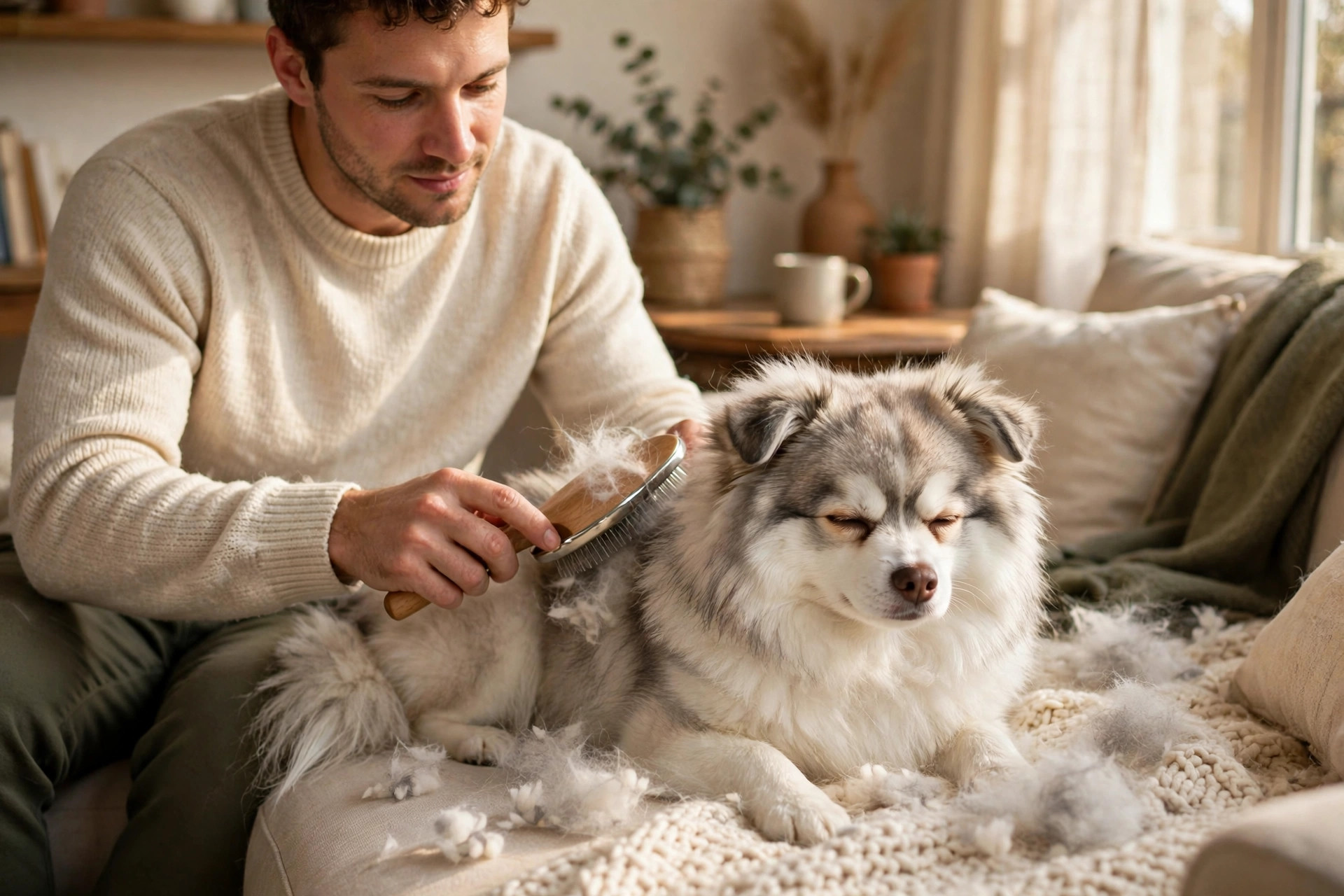
Both parent breeds have high-maintenance coats, and the Pomsky inherits the worst of both worlds: the Husky’s dense double coat that sheds heavily, and the Pomeranian’s tendency to mat. Pomskies come in three coat types — standard (short and dense), plush (short and fluffy), and wooly (long and thick) — and all three shed a lot.
Your grooming routine should be:
- Brush 2–3 times a week most of the year with an undercoat rake or slicker brush, focusing on the tangle-prone areas behind the ears, the backs of the legs, and the armpits.
- Brush daily during coat blows in spring and fall, when the undercoat comes out in clumps for several weeks. A de-shedding shampoo and blowout at the groomer helps.
- Never shave your Pomsky. The double coat insulates against both cold and heat, and shaving can damage it permanently and cause sunburn and overheating.
- Bathe about once a month or when visibly dirty — Pomskies are naturally clean dogs with little doggy odor.
- Trim nails every 4–6 weeks and brush teeth daily — small mouths crowd teeth, so dental disease is a real risk in this cross.
If anyone in your household has allergies, note that Pomskies are heavy shedders and are not hypoallergenic. Fur on clothes, furniture, and food is a permanent feature of Pomsky life — embrace it or pick another dog.
Pomsky Health Problems to Watch For
Pomskies are generally healthy, with a lifespan of 12–15 years, but as a cross they can inherit conditions from either parent. Ask breeders for health-test results in writing, and watch for these:
- Patellar luxation. A kneecap that slips out of place, common in small breeds. Watch for skipping or holding up a back leg.
- Eye conditions. Huskies are prone to cataracts (including juvenile cataracts), progressive retinal atrophy, and corneal dystrophy. Ask about eye exams on both parents.
- Collapsing trachea. Seen in Pomeranians. A honking cough is a common sign — use a harness instead of a collar for walks.
- Hip dysplasia. Can come from the Husky side. Ask for hip results on the parents and keep your dog lean.
- Hypothyroidism. An underactive thyroid can cause weight gain, lethargy, and coat changes; it is manageable with daily medication once diagnosed.
- Dental disease. Small mouths crowd teeth. Daily brushing and regular dental checkups help.
- Allergies. Inflamed, itchy skin, recurring ear infections, or hair loss can all signal allergies — ask your vet about testing.
- Heat sensitivity. That thick coat makes Pomskies prone to overheating. Exercise in the cool parts of the day, provide shade and water, and never leave your dog in a parked car.
Health tests to ask a breeder about: OFA hip evaluations on the Husky parent, OFA patella exams on the Pomeranian, a recent eye exam by a board-certified veterinary ophthalmologist on both parents, and ideally thyroid testing. A breeder who cannot show these results is a breeder to walk away from.
Feeding Your Pomsky
Feed a high-quality, complete dog food appropriate for your Pomsky’s age and activity level, split into two meals a day for adults. The Pomsky Owners Association recommends a food high in protein and made for high-energy dogs. Huskies are famously efficient eaters and often need less food than other dogs their size, so watch body condition rather than the bowl: you should be able to feel ribs under a thin layer of fat but not see them prominently.
Treats — including training treats — should stay within 10% of daily calories. Pomskies gain weight just like any dog when treats pile up, and extra weight worsens the joint problems this cross is already prone to. Puppies need a puppy-formulated food until about 12 months, when most Pomskies reach adult size.
How Much Does a Pomsky Cost?
A Pomsky puppy from a reputable US breeder typically costs $2,500 to $5,000, depending on generation, coat color, eye color, and the breeder’s health-testing program. Blue eyes and rare coat colors often command higher prices — but a high price is no guarantee of a healthy puppy. What matters is health testing, a written contract, and a breeder who will take the dog back if things do not work out.
Be wary of two red flags. First, “teacup” and “miniature” Pomskies are sales labels, not official sizes — and breeding for extreme smallness raises the risk of fragile bones, low blood sugar, heart defects, dental crowding, and a collapsing windpipe. Second, any breeder who cannot show health-test results for both parents, or who always has puppies available, is a puppy mill warning sign. Rescue is also an option: Pomsky-specific rescues and Husky rescues sometimes have Pomskies whose owners underestimated the exercise and grooming needs described above.
Is a Pomsky Right for You?
A Pomsky could be perfect for you if you are an active person or family who can commit to 45–60 minutes of exercise daily, you enjoy training a clever dog, you do not mind heavy shedding and constant fur, and you love a dog with personality, humor, and opinions. Apartment living can work — the dog is small — as long as the exercise and mental stimulation happen every day.
Think twice if you work long hours away from home, you need a quiet dog, you want reliable off-leash recall, you want a low-shedding or hypoallergenic dog, or you have small pets you cannot keep fully separate. None of these are failures — they are simply mismatches, and recognizing one now saves a heartbreaking rehoming later. Either way, meet adult Pomskies before you commit, talk to breeders and rescues, and be honest about your lifestyle.
Frequently Asked Questions
Are Pomskies good family dogs?
Yes, for active families. Pomskies are affectionate, playful, and usually great with children, especially older kids. They do best in homes that can meet their exercise needs and tolerate their shedding and vocalizing.
How big do Pomskies get?
Most adult Pomskies stand 10–15 inches tall and weigh 15–30 pounds, though some reach 35 pounds. No breeder can guarantee a puppy’s adult size, because the cross is unstandardized and size varies by generation.
Do Pomskies shed a lot?
Yes — heavily. They have a thick double coat that sheds year-round and “blows” the undercoat twice a year, in spring and fall. Brush 2–3 times a week normally and daily during coat blows.
Are Pomskies hypoallergenic?
No. Pomskies shed heavily and produce dander, so they are not a good choice for allergy sufferers.
Are Pomskies easy to train?
They learn fast but obey selectively. Short, fun, reward-based sessions of 10–15 minutes work best. Expect a dog that understands the command perfectly and sometimes decides not to follow it.
How long do Pomskies live?
Typically 12–15 years — a long commitment, especially given their energy levels in the early years.
How much does a Pomsky cost?
A puppy from a reputable breeder typically costs $2,500–$5,000. Avoid “teacup” labels — extreme smallness carries serious health risks — and always ask for the parents’ health-test results.
Final Thoughts
So, is the Pomsky breed right for you? If you want a beautiful, funny, athletic companion in a small package — and you can honestly meet its exercise, training, and grooming needs — a Pomsky will reward you with loyalty, laughter, and adventure for well over a decade. If you want a calm, quiet, low-shedding dog that stays where you put it, look elsewhere, and love Pomskies from a respectful distance.
The most important thing to remember is that a Pomsky is not a miniature Husky in behavior: it is its own mix of two strong-willed, vocal, high-energy breeds. Meet adult Pomskies, ask breeders hard questions about health testing, and be honest about your lifestyle before you commit. The right match makes all the difference — for you and for the dog.
By Dr. Ayaz Ali