
Every multi-cat household has one: the cat who inhales her own bowl in thirty seconds and then saunters over to the other cat’s dinner. It’s a nuisance when both cats eat the same food — and a real problem when one cat is on a vet-prescribed diet that the other one absolutely cannot touch. That’s the exact problem a microchip cat feeder was invented to solve.
A microchip cat feeder is a sealed food bowl with a lid that opens only for the registered pet. It reads your cat’s implanted microchip (or a lightweight RFID collar tag) and glides the lid open when the right cat leans in — then closes it again when the cat walks away.
Table of Contents
- What Is a Microchip Cat Feeder?
- How Does a Microchip Feeder Work?
- Benefits of a Selective Cat Feeder
- The 3 Types of Selective Feeders Compared
- Where Microchip Feeders Fall Short
- How to Train Your Cat to Use One
- Frequently Asked Questions
What Is a Microchip Cat Feeder?
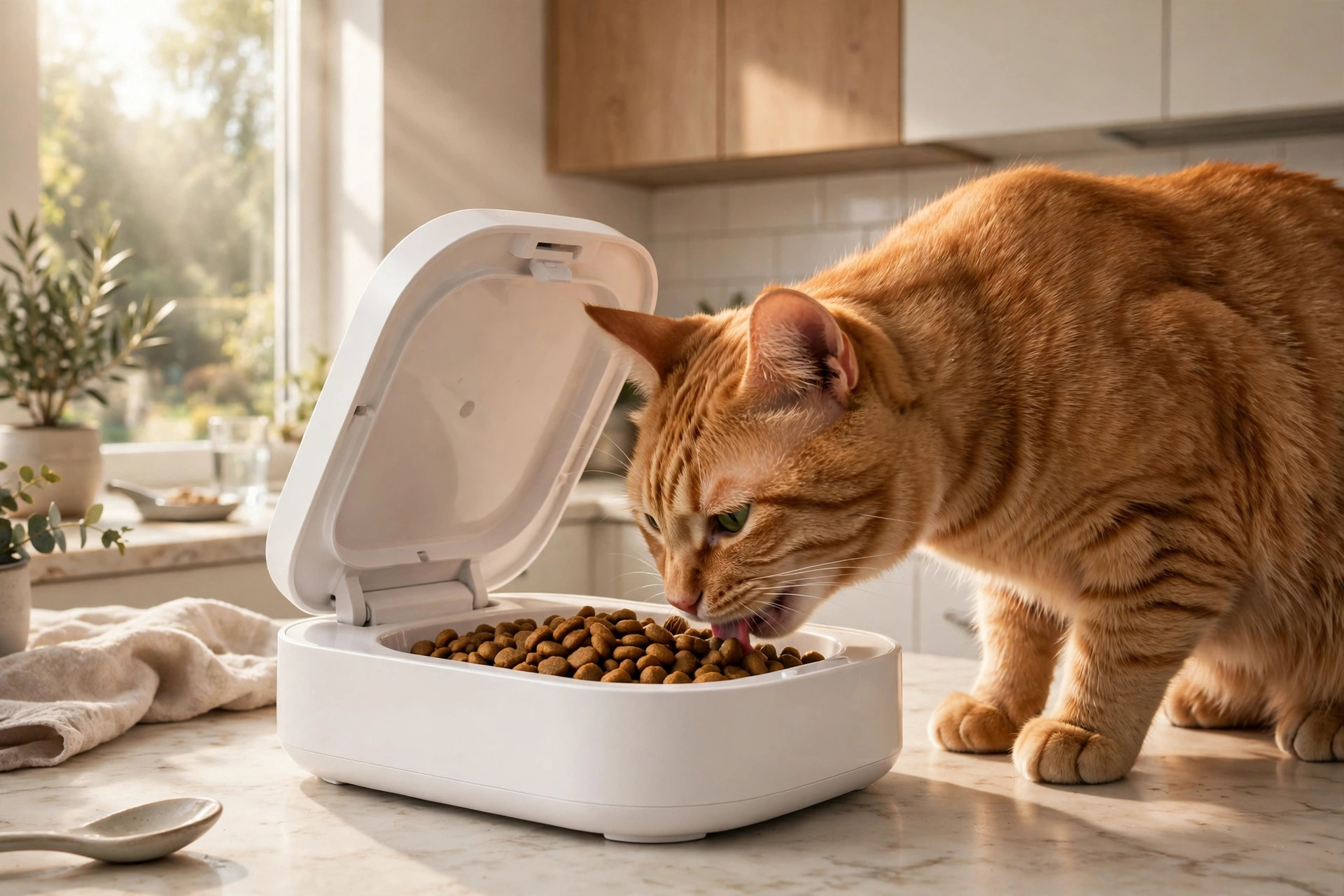
A microchip cat feeder is a selective feeding bowl: instead of dispensing food on a timer like a standard automatic feeder, it controls access. An RFID sensor in the feeder’s arch scans for your cat’s implanted microchip. When a registered chip is detected nearby, the lid opens silently. When the cat steps away, the lid closes — sealing the food inside so no other pet, fly, or curious paw can reach it.
The best-known model, the SureFeed Microchip Pet Feeder, is made by Sure Petcare (the same company behind SureFlap microchip cat doors). It can store up to 32 pets, works with the microchip your cat probably already has, and includes one RFID collar tag for a cat that isn’t chipped.
How Does a Microchip Feeder Work?
The technology is simpler than it sounds. Here’s the sequence at every meal:
- Registration: You press a button and the feeder stores your cat’s 15-digit microchip number. Models such as the SureFeed also support 10-digit and 9-digit chip formats; an RFID collar tag works as a backup if the chip has migrated under the skin or the cat was never chipped.
- Approach: When the registered cat leans in, the sensor detects the chip and the lid glides open — nearly silently.
- Eating: The cat eats at her own pace while the lid stays open.
- Departure: When the cat moves away, the lid closes automatically and the bowl stays sealed until the authorized cat returns.
Most models include a training mode that keeps the lid partially open at first so a suspicious cat isn’t startled by moving plastic near her face (more on training below). They typically run for months on batteries — the SureFeed uses four C-cell batteries, so there’s no cord for a cat to knock loose — and carry a 3-year manufacturer warranty.
Benefits of a Selective Cat Feeder
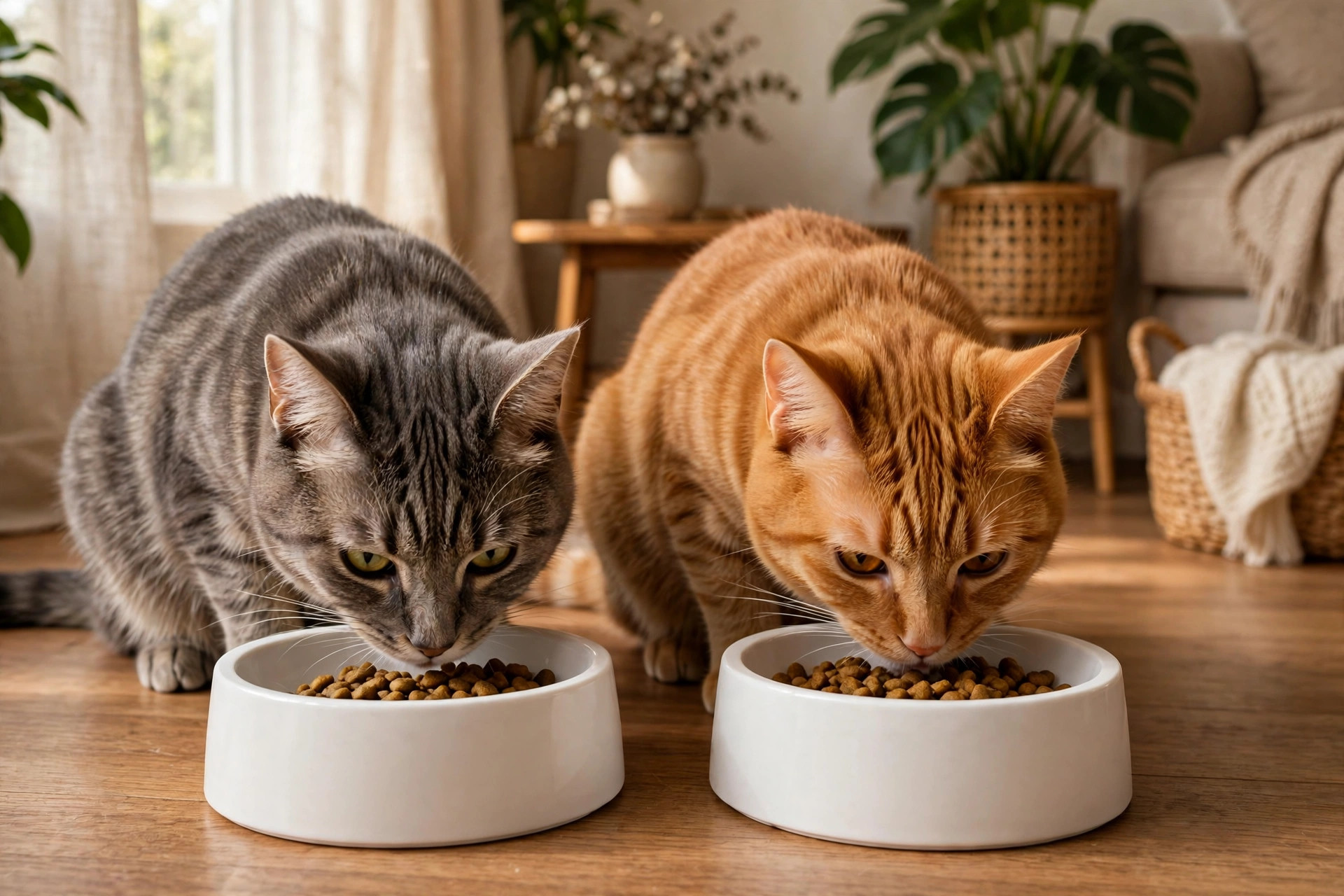
Why pay ~$165–210 for a “smart bowl”? Because in multi-pet homes, selective feeding solves problems that no schedule or bowl placement can.
1. It ends food theft completely
The fast eater can no longer Hoover up everyone else’s portions. Each feeder opens only for its registered cat — so the food you portioned for one cat actually stays for that cat.
2. It protects prescription diets
This is the number-one reason vets point owners toward selective feeders. If one cat is on a urinary, kidney, weight-loss, or allergy diet, even occasional “borrowing” of the wrong food can undo a treatment plan. A microchip feeder gives you certainty that the right food goes to the right cat.
3. It supports weight control
Overweight cats are often double-dippers, sneaking a second cat’s food on top of their own measured meals. Locking each cat to her own portion makes a vet’s weight-loss plan enforceable at home.
Also Read: Is My Cat Overweight? Body Condition Guide (2026)
4. It keeps wet food fresh
The sealed lid keeps wet food moist and odor-free for hours, blocks flies, and stops food from drying into an unappealing crust. Sealed selective bowls are arguably the best wet-food solution on the market for grazers.
5. It can restore grazing habits
Some cats gulp all their food at once simply because they’re afraid another pet will steal it. Once a selective feeder guarantees exclusive access, many cats relax into grazing.
6. App versions monitor intake
Connected models like the SureFeed Connect weigh each meal and log it in an app, so you notice the day a cat’s appetite dips — one of the earliest health warning signs.
Also Read: Why Is My Cat Not Eating? Warning Signs & When to Worry (2026)
The 3 Types of Selective Feeders Compared
Not all “selective” feeders work the same way. Match the type to your household:
| Type | How It Works | Best For | Watch Out |
|---|---|---|---|
| Sealed selective bowl (e.g. SureFeed Microchip Pet Feeder, Closer Pets MiBowl) | Reads the implanted microchip or an RFID collar tag; lid opens for the registered pet only. Wet or dry food. | Multi-cat homes, prescription diets, wet food | ~$165–210 per unit; small 400 ml capacity; one unit per cat that needs protection |
| Hopper RFID feeder (e.g. PETLIBRO One RFID, PortionPro Rx) | RFID collar tag triggers scheduled dry-food dispensing. Dry food only. | Dry-food households wanting scheduled selective portions | Cat must wear a collar at every meal; won’t handle wet or prescription wet food; up to ~$240–290 |
| App-connected selective feeder (e.g. SureFeed Connect) | Selective bowl + built-in scale that logs portions in an app. | Cats with medical diets where you must track intake | Requires the maker’s hub; costs more; still a bowl, not a scheduler |
For most multi-cat homes, the sealed selective bowl is the sweet spot: it reads the chip your cat already has, handles wet food, and needs no collar.
Where Microchip Feeders Fall Short
Selective feeders are excellent at one job — controlling access — but they have honest limits:
1. One feeder per protected cat
The golden rule: one feeder per cat that eats a different diet. If two cats eat different foods, you need two feeders, each keyed to its own cat — a shared bowl can’t serve two different meals. (Two cats that eat the same food can safely share one feeder programmed for both, if you only need to keep a dog or a third cat out.)
2. It doesn’t portion or schedule meals
The SureFeed-style bowl is a selective lid, not a dispenser. If you need timed portions, pair it with a scheduled feeder — though hopper models are dry-food only.
3. The capacity is modest
At 13.5 fl oz (400 ml), the bowl holds one meal for a typical cat — not a weekend’s worth of food. Think selective access, not bulk storage.
4. Determined thieves can work around it
A persistent cat can try to reach in from the side while the lid is open for another cat. The fix is free: place the feeder against a wall so the bowl can only be approached head-on. A rear-cover accessory exists for truly stubborn food thieves.
5. Timid cats need training
Cats are naturally suspicious of motorized objects near their faces. Rushing a shy cat to a fully locking lid on day one can trigger food refusal. Budget 7–14 days for the staged training protocol below.
6. Cleaning can be fiddly
With wet food, the split bowl and seal need regular washing (the SureFeed’s bowl and mat are dishwasher-safe; the base wipes down only). Messy eaters make this a real chore — schedule it into your routine.
How to Train Your Cat to Use One
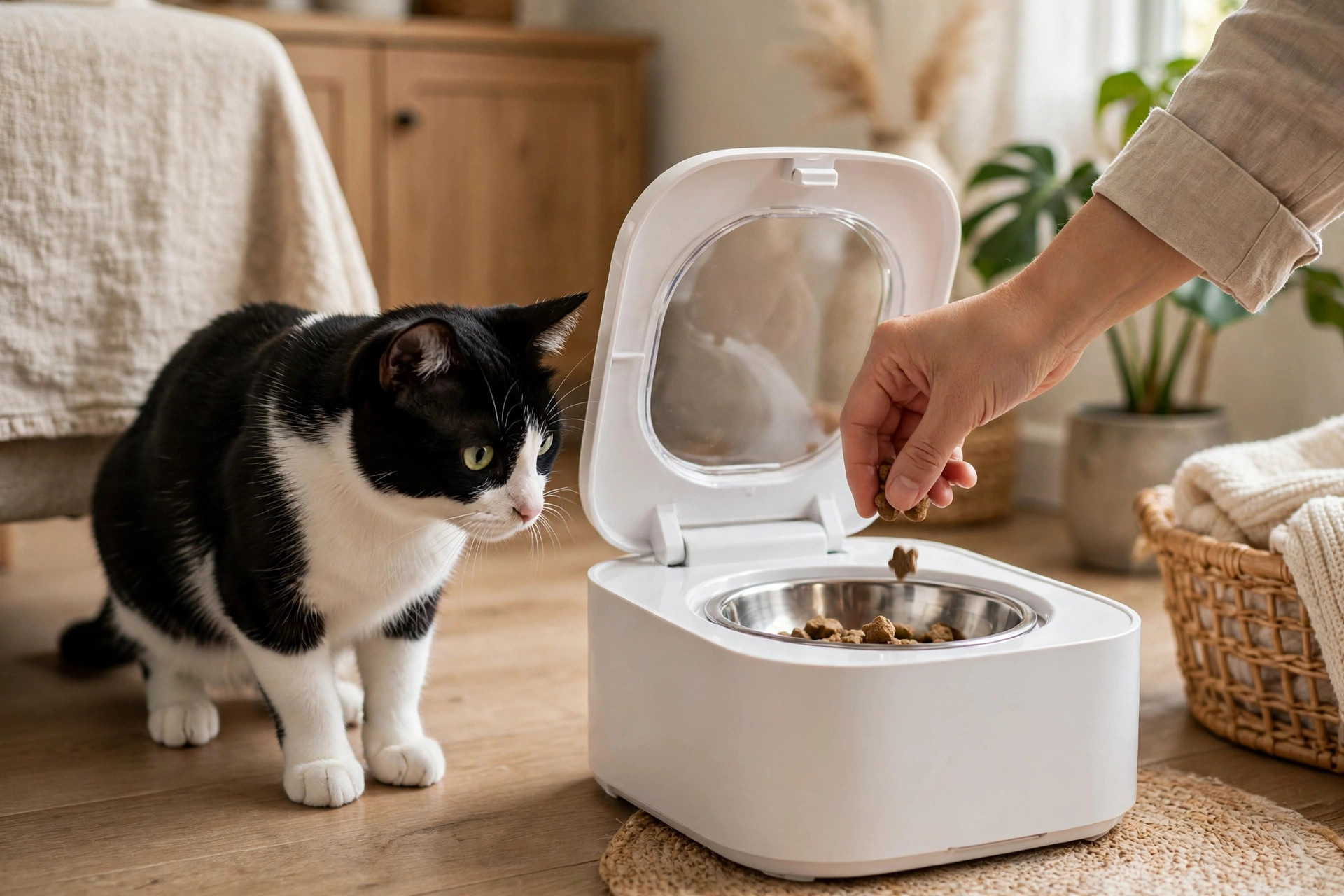
Don’t skip this step. A proven 7–14 day protocol makes the difference between a cat who loves her feeder and one who boycotts it:
- Days 1–3 — lid fully open. Turn on training mode so the lid stays locked open and the motor never moves. Let the cat eat from it as a normal bowl.
- Days 4–6 — slight movement. The lid moves a little on approach and exit. The cat acclimates to the hum of the motor.
- Days 7–9 — half-closed. The lid closes halfway with a delay after the cat leaves.
- Days 10–12 — nearly closed. The lid closes to about 80%, so the cat must lean in and accept the seal lifting away.
- Day 13+ — full lock. Turn training mode off. The feeder now opens only for the registered chip and closes fully when the cat steps away.
Throughout training, drop high-value treats into the bowl so the feeder earns positive associations. Before buying, try the free fixes: separate rooms at mealtimes or different feeding heights. If those fail — different diets, unsupervised meals, a dog raiding the bowl — a microchip feeder earns its price.
Also Read: First-Time Cat Owner Checklist: 12 Things to Buy & Do (2026)
Frequently Asked Questions
Do microchip cat feeders work with wet food?
Yes — and this is a major reason to buy one. Sealed selective bowls keep wet food fresh for hours and block flies and food thieves. Hopper-style RFID feeders, by contrast, are dry-food only.
Can two cats share one microchip feeder?
Yes, but only if they eat the same food — one feeder can be programmed to recognize several cats’ chips, keeping a dog or a third cat out. If two cats eat different foods, you need two feeders, one keyed to each cat.
Does my cat need to be microchipped?
No. Feeders that read implanted chips also include a lightweight RFID collar tag for cats that aren’t chipped — and the ASPCA notes that correct, measured feeding is the foundation of a healthy cat’s diet.
Do microchip feeders stop a dog from stealing cat food?
Yes, reliably. Since the dog has no registered chip or tag, the lid simply never opens for her — which is why these feeders are popular in mixed dog-and-cat households.
Are microchip cat feeders worth the money?
They are worth it when the problem is access, not scheduling: prescription diets, weight-loss plans, or food bullying. They are not worth it as a meal scheduler — a timed feeder costs far less for that job.
Final Thoughts
A microchip cat feeder won’t fix a cat who overeats from her own bowl, and it won’t replace measured portions. But for the multi-cat home’s classic headaches — the food thief, the prescription diet at risk, wet food drying out by noon — it is the most reliable solution available.
If your household runs smoothly on one shared food, you don’t need one. But if you’re portioning meals for two different cats and standing guard at mealtimes, a selective feeder buys back something no cheap gadget can: mealtimes you don’t have to supervise.
By Dr. Ayaz Ali