
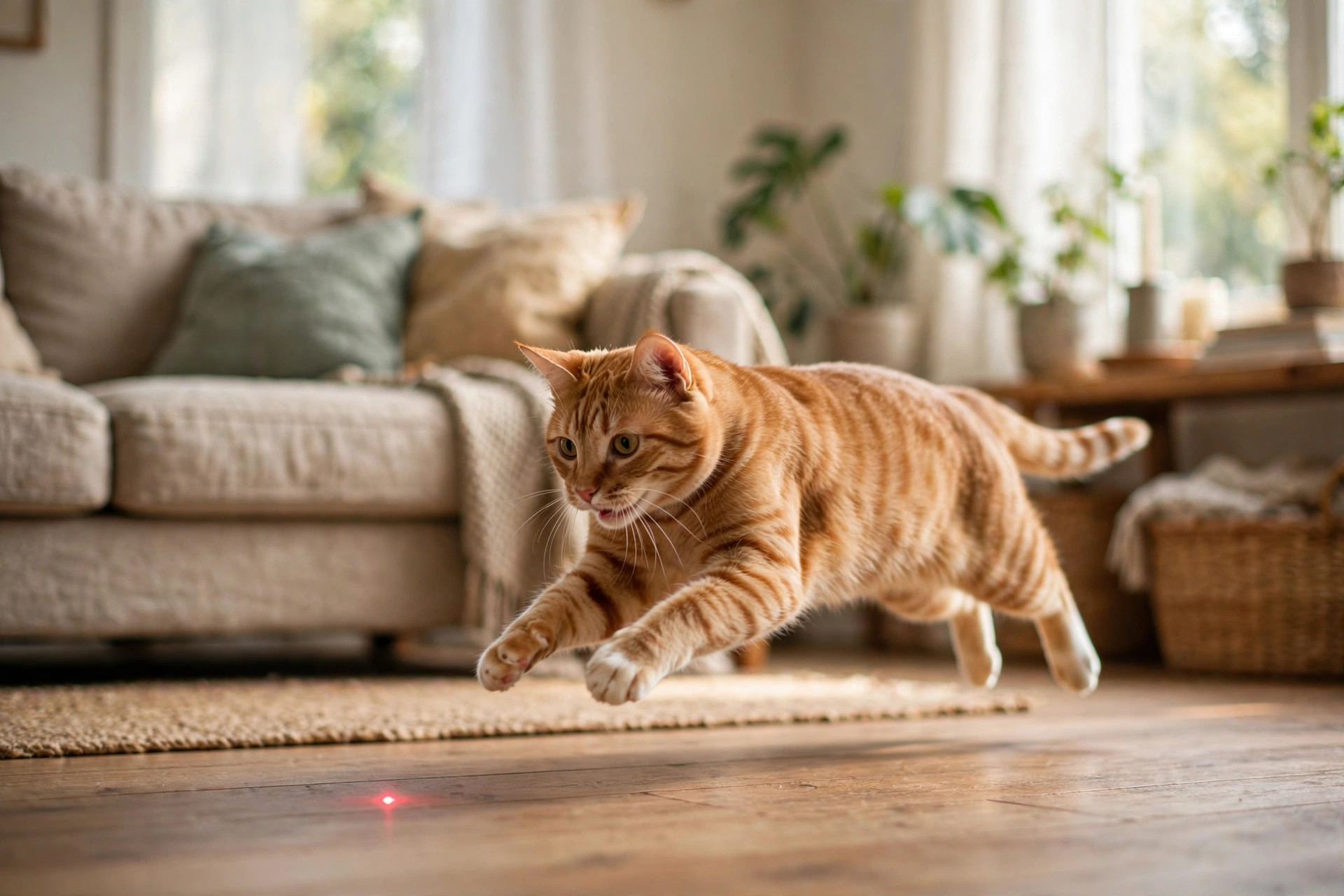
You know the scene: a tiny red dot dances across the floor, and your cat instantly becomes a focused hunter — eyes locked, body coiled, ready to strike. But every cat owner eventually asks: are laser pointers bad for cats, or is this harmless fun?
They are not inherently dangerous — but the way most people use them can cause real frustration, because your cat can never actually catch the dot. Veterinary behaviorists warn this “uncatchable prey” setup can cause stress and even compulsive behavior in some cats.
In this 2026 guide: why cats obsess over laser dots, the warning signs of laser frustration, 7 rules for safe play, eye-safety facts, and the best alternative toys that let your cat win the hunt.
Table of Contents
- Are Laser Pointers Bad for Cats? What Vets Say
- Why Cats Can’t Resist the Red Dot
- Are Laser Pointers Bad for Anxious Cats? The Frustration Problem
- 5 Signs Laser Play Is Stressing Your Cat
- How to Use Laser Pointers Safely: 7 Rules
- Can Laser Pointers Hurt a Cat’s Eyes?
- Better Alternatives to Laser Pointers
- Frequently Asked Questions
Are Laser Pointers Bad for Cats? What Vets Say
Veterinary sources including PetMD say that laser pointers can be a safe and effective way to give cats exercise and mental stimulation — when used properly. The moving dot triggers the chase instinct, burns energy, and engages your cat’s brain, which is genuinely valuable for indoor cats that need more activity.
The expert consensus is not “ban the laser” — it is that the laser is a tool, and the outcome depends on how you use it. Short, supervised sessions ending with a real reward are fine for most cats. Problems start when laser play becomes the default game, runs too long, or never gives the cat a satisfying ending: frustration builds and, in some cats, becomes lasting behavioral change.
Why Cats Can’t Resist the Red Dot
To understand the laser debate, you have to understand how cats hunt. Feline predatory behavior follows a fixed sequence: orient, stalk, chase, pounce, catch, and kill. Every step of that chain matters to your cat’s brain — especially the ending.
A laser dot is nearly irresistible to this system because it looks and moves like fleeing prey: small, fast, erratic. It nails the first four steps — stalk, chase, pounce — but physically cannot deliver the last two. There is nothing to catch, bite, or carry: no smell, no taste, no weight.
For most cats a few rounds are just fun. But the brain expects a payoff at the end of a hunt — and when the payoff never comes, the hunting sequence stays permanently “open.” That open loop is the core of the problem.
Are Laser Pointers Bad for Anxious Cats? The Frustration Problem
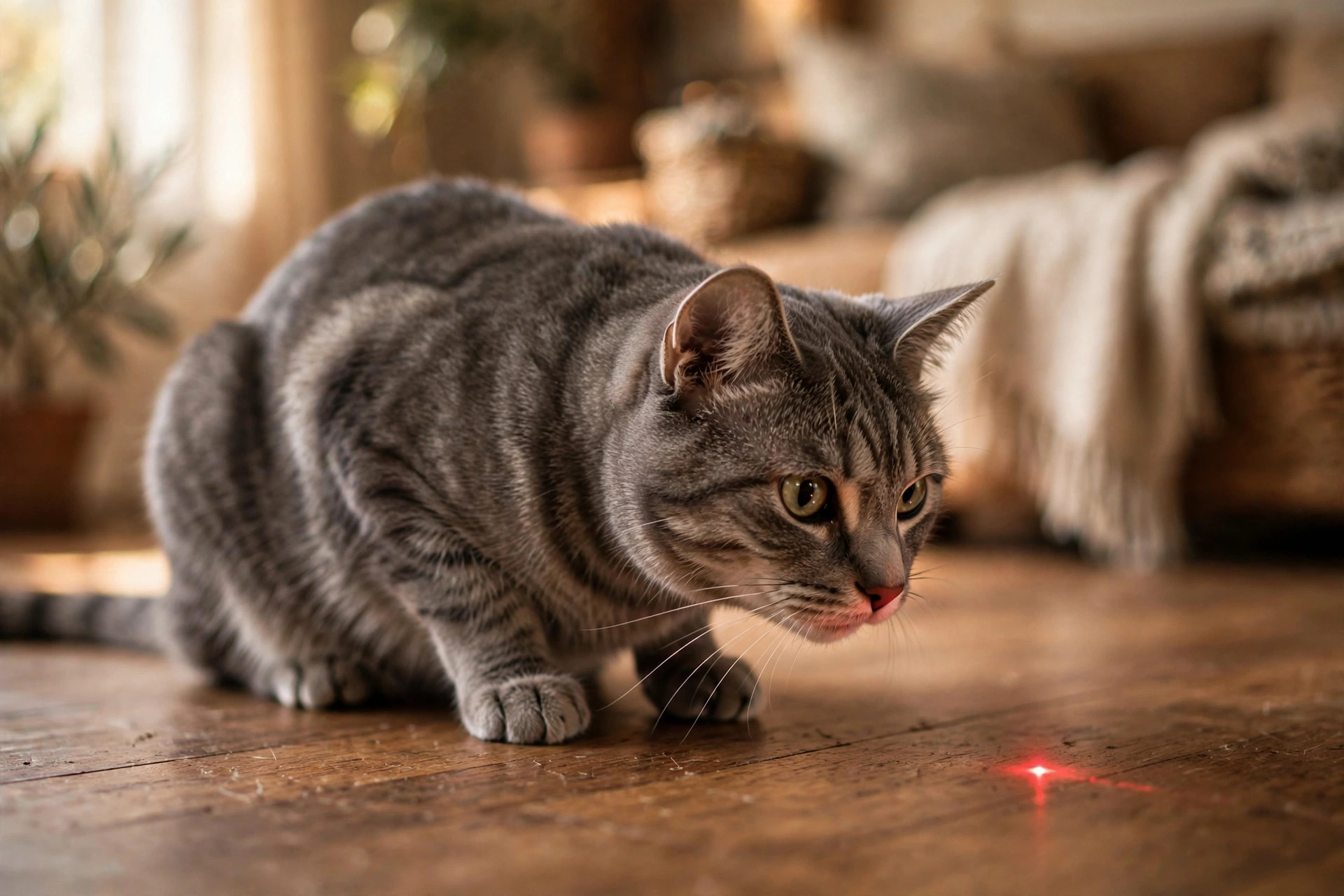
This is where the experts raise their real concern. Veterinary behaviorist Dr. John Ciribassi, DVM, DACVB, says the problem is that laser pointers lack an endpoint: nothing is ever physically caught, so even a “successful” chase ends with no reward — and this pointless play can push some cats toward compulsive behavior.
Affected cats stop eating, resting, and interacting normally, and instead spend large parts of the day chasing things that look like the laser dot — shadows, light reflections, dust motes. As Dr. Ciribassi puts it, it becomes “a quality of life issue.”
But he does not tell owners to ditch the laser — he still considers it great for exercise and predatory stimulation. His fix: add a clicker and treats. Train the cat to associate the click with a tangible reward, then periodically let the cat “catch” the dot — click, treat. Now catching the light has a concrete, satisfying result, and the hunting sequence gets its closure.
5 Signs Laser Play Is Stressing Your Cat
Many cats play with lasers their whole lives with zero issues — but watch your individual cat and stop laser play if you notice these signs:
- Wall staring after playtime. Your cat keeps gazing where the dot disappeared, as if the hunt is still running — the brain is stuck in chase mode.
- Shadow and reflection chasing. She hunts sunbeams, phone-screen glare, or wall shadows when the laser was never turned on — the classic sign of fixation spilling into daily life.
- Restlessness after sessions. Instead of settling down content, she paces or vocalizes — the hunt never ended in her mind.
- Excessive grooming. Some cats redirect post-hunt tension into over-grooming one spot repeatedly.
- Fixation replacing normal life. The serious one: your cat spends more time searching for the light than eating or interacting with you. Involve a vet or veterinary behaviorist at this point.
If you see mild signs, shorten sessions and always end with a physical catch (see the rules below). Many cats bounce back quickly once the game has a satisfying ending.
How to Use Laser Pointers Safely: 7 Rules
If your cat loves the laser, you do not need to banish it — follow these seven rules and it stays a healthy game:
- Keep sessions to 5–10 minutes. Plenty of exercise for most cats, and short play stays fun instead of obsessive.
- Let your cat “catch” the dot. Slow the dot, let your cat pounce on it under her paw — then reward the catch.
- Always end with a real reward. The golden rule: finish every session by guiding the dot onto a plush toy or treat your cat can grab and “kill.” This closes the hunting sequence — the difference between healthy and frustrating laser play.
- Keep it off faces. Beam on the floor and low walls only — never at your cat’s face, anyone else’s eyes, or mirrors that could reflect it upward.
- Do not make it the only game. Rotate in wand toys, balls, and puzzle feeders so your cat regularly wins real hunts too.
- Use a pet-safe laser. Pet-designed lasers use lower output power than presentation lasers; red is the common pick for indoor play.
- Read your cat. Calm and settled afterward means the game worked. Agitated or still searching means shorter sessions next time — or a switch to catchable toys.
Skip automatic, collar-mounted, or self-firing laser toys: a handheld laser has a human reading the cat and ending the game; an automatic one fires with no payoff and no off switch.
Also Read: Why Do Cats Love Boxes? Science Explained (2026) — boxes satisfy the ambush-hunting instinct in a completely frustration-free way.
Can Laser Pointers Hurt a Cat’s Eyes?
This is the other half of the safety question, and the answer is straightforward: a pet-safe laser is not dangerous unless it is shined directly into the eyes. Cat-toy lasers typically run at 1–5 milliwatts, far weaker than high-powered lasers (above Class 2), which can cause real retinal damage.
Still, no laser belongs near a cat’s face — direct exposure and reflections off mirrors, glass, or polished metal should always be avoided. Keep the dot low, on the floor or baseboards, and store laser toys where children cannot grab them unsupervised.
Better Alternatives to Laser Pointers
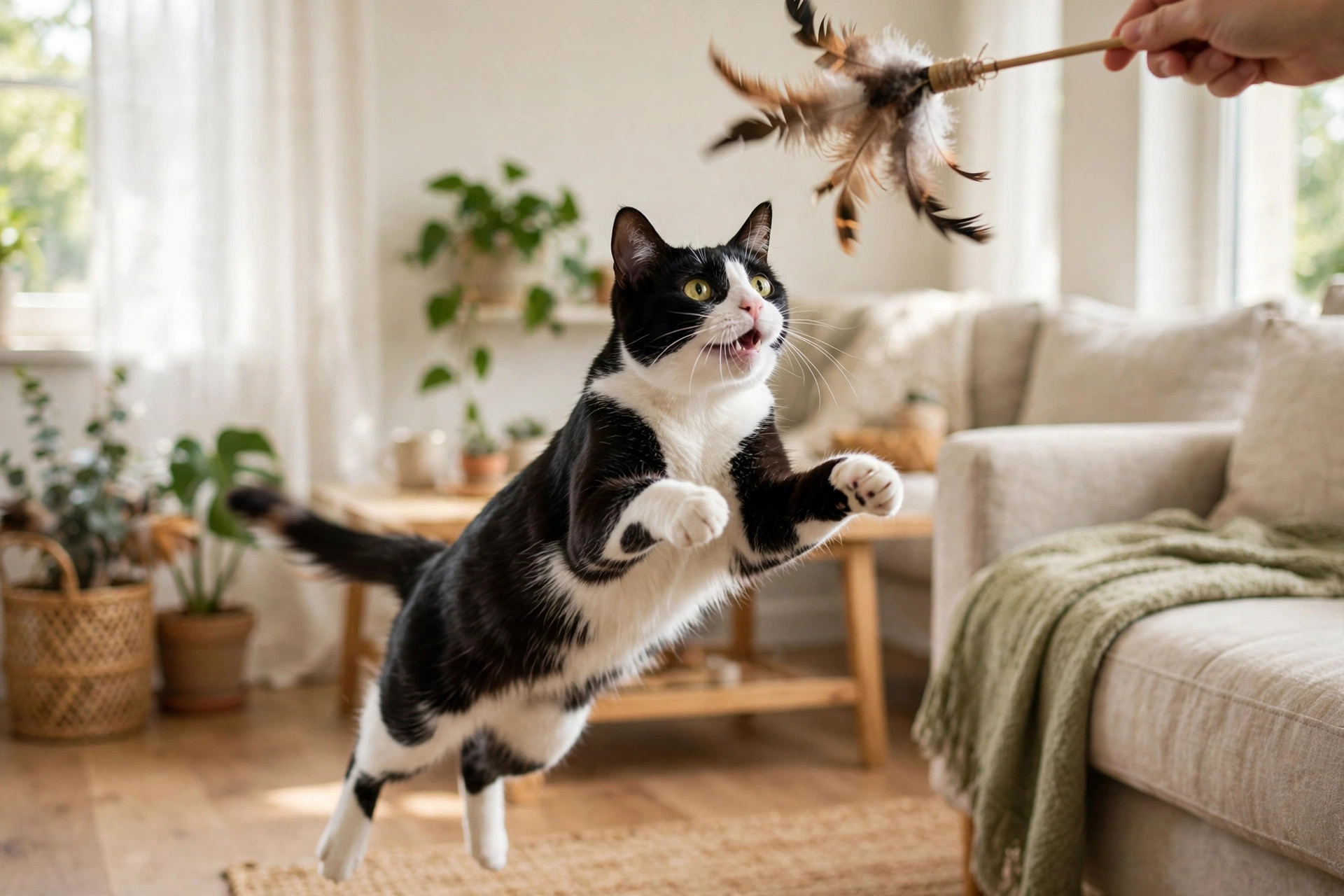
If you would rather skip the laser — or just rotate it with toys your cat can actually win — these deliver the same thrill with zero frustration risk:
- Feather wand teasers. The closest thing to a real hunt: stalk, chase, pounce, and — crucially — catch. Drag it like fleeing prey and let her grab it at the end.
- Kicker toys. Long stuffed toys for the front-paw grab and back-leg bunny kick — the full “kill” sequence in toy form.
- Crinkle balls and toss toys. Light, noisy, unpredictable — and eminently catchable. Great solo play between sessions with you.
- Puzzle feeders. Your cat “works” for her meal the way she would work for prey — one of the most satisfying enrichments for indoor cats.
- Motorized mice. Laser-like erratic movement, except this target is physical — your cat can pounce on it and win.
The best routine mixes several: the laser for a burst of chase, a wand toy for the satisfying catch, a puzzle feeder at mealtimes. Your cat gets the complete hunt, start to finish, every day.
Also Read: Why Does My Cat Bite Me? Love Bites Explained (2026) — under-played cats often “hunt” their owners; daily wand-toy sessions fix it. Also Read: Microchip Cat Feeder Guide: Do They Work? (2026) — pair active play with smarter feeding for a fully enriched indoor cat.
Frequently Asked Questions
Are laser pointers bad for cats?
Not inherently — they provide excellent exercise and mental stimulation. They become a problem when sessions run too long or never end with a physical catch. Short sessions ending with a real toy keep laser play healthy.
Can laser pointers cause anxiety in cats?
They can in sensitive cats, especially when overused. The uncatchable dot leaves the hunting sequence unfinished, which can build into restlessness, wall-staring, and shadow chasing. Ending every session with a catchable toy or treat prevents this in most cats.
Why does my cat stare at the wall after laser play?
Lingering frustration — your cat’s brain is still in hunt mode, searching for the prey it never caught. End sessions with a deliberate toy catch, shorten future sessions, and if wall-staring becomes obsessive, take a break from the laser for a few weeks.
Can laser pointers blind cats?
Pet-safe lasers (1–5 milliwatts) will not blind a cat during normal play, but no laser should ever be shined directly into a cat’s eyes — high-powered lasers above Class 2 can damage retinas. Keep the beam on the floor, away from faces.
What is the best alternative to a laser pointer for cats?
Feather wand teasers: they mimic bird movement, complete the full stalk-chase-pounce-catch sequence, and end with a real “kill” she can bite and kick.
Final Thoughts
So, are laser pointers bad for cats? No — but they are only as good as the way you use them. A laser is a fantastic chase trigger and a legitimate workout for an indoor cat. The danger was never the light; it was the hunt that never ends.
Keep sessions short, keep the beam off faces, and always finish with something your cat can catch — a plush toy, a treat, a feather wand. Close the hunting sequence every time, watch for fixation, and rotate in toys she can truly win. Do that, and the red dot stays exactly what it should be: five minutes of pure, joyful hunting, with a happy ending.
By Dr. Ayaz Ali