
If your sofa arms are starting to look shredded, you are not alone — and the fix is not a stricter cat. It is a better scratching post. In this guide to the best cat scratching posts for 2026, we compare tall sisal posts and cardboard scratchers, and show you how to choose one your cat will actually use instead of your furniture.
Table of Contents
- Why Do Cats Scratch in the First Place?
- Types of Cat Scratching Posts
- The Best Cat Scratching Posts of 2026
- How Tall Should a Cat Scratching Post Be?
- Sisal, Cardboard, or Carpet?
- Stability and Placement
- How to Get Your Cat to Use the New Post
- Mistakes to Avoid
- Frequently Asked Questions
Why Do Cats Scratch in the First Place?
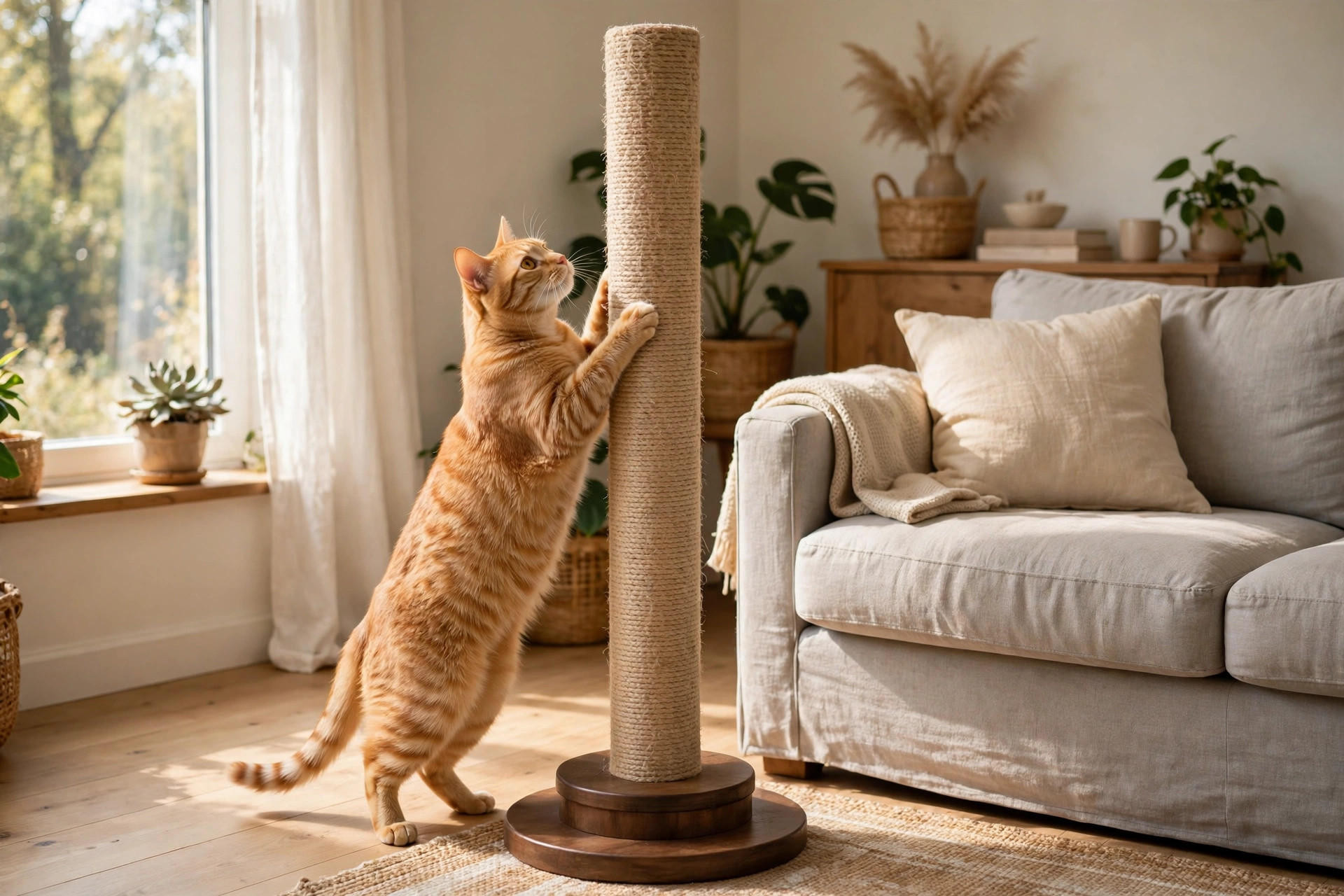
Before you buy, it helps to know what your cat gets out of scratching. First, claw maintenance: cats shed the dull outer sheath of each claw against a rough surface. Second, a full-body stretch — a cat reaching up a tall post extends her shoulders, back, and front legs, which is why short posts get ignored. Third, communication: scent glands in the paw pads leave a signature with every scratch.
That is why cats aim for the same spots again and again: prominent furniture near sleeping areas and room entrances. The winning strategy is to offer a better alternative — a taller, sturdier post placed exactly where your cat already scratches.
Types of Cat Scratching Posts
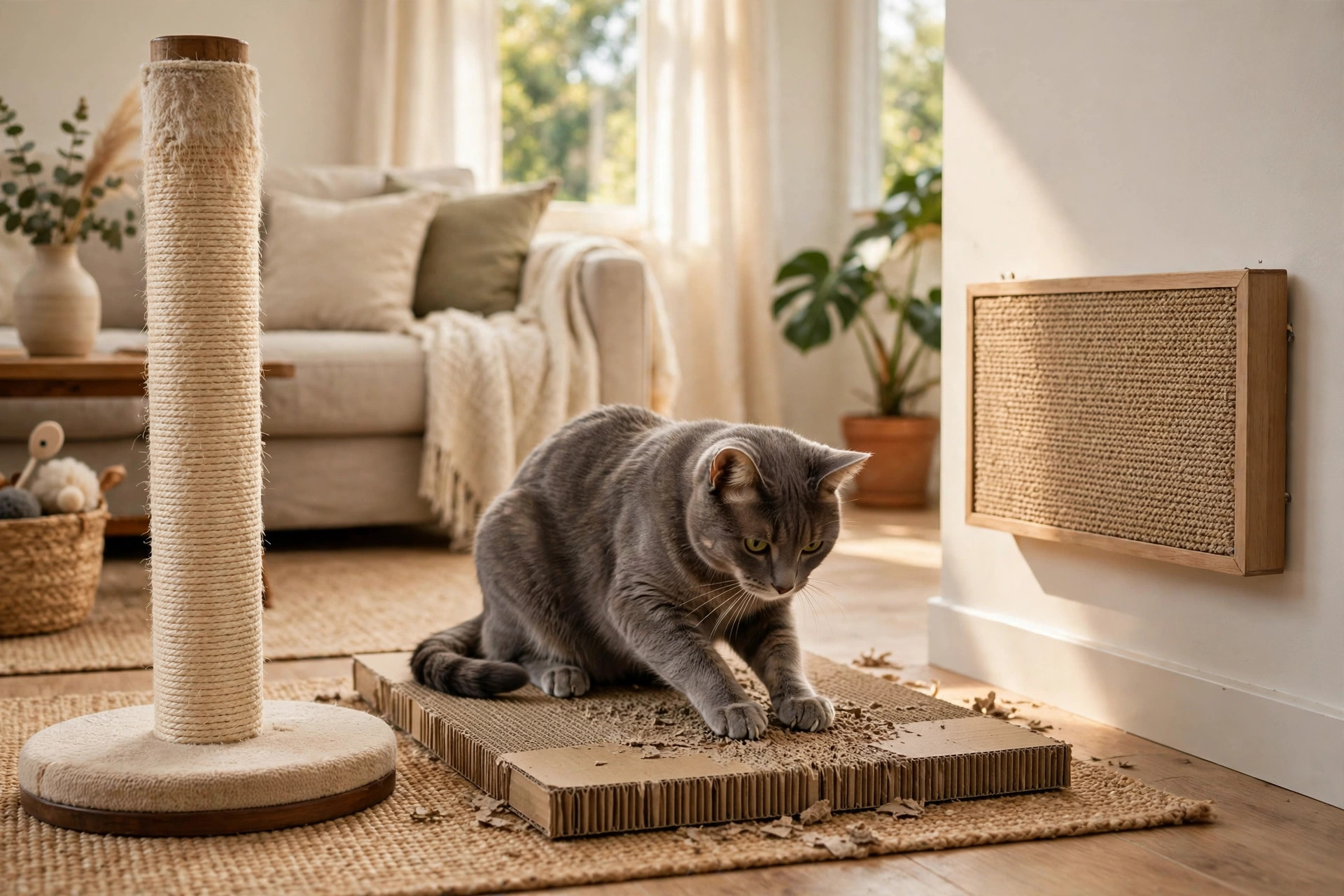
Not every cat scratches the same way. Watch your cat for a day before you buy: does she reach up the sofa arm, or rake across the rug?
Vertical Posts
The classic design — a tall column wrapped in sisal rope or sisal fabric, standing upright on a base. Vertical posts suit cats that scratch upward on furniture and love a full stretch, and they are the right default for most homes.
Horizontal and Flat Scratchers
Usually corrugated cardboard pads or low, flat boards. These suit cats that scratch sideways along rugs, carpet edges, or the floor. Cardboard scratchers are cheap, replaceable, and often come infused with catnip — and many cats that ignore a tall post will happily use one.
Also Read: How to Stop Your Cat Scratching the Furniture: Vet-Approved Tips (2026)
The Best Cat Scratching Posts of 2026
We compared the most consistently recommended models across 2026 buying guides, vet behavior advice, and owner reviews.
| Pick | Height | Material | Best For |
|---|---|---|---|
| SmartCat Ultimate Scratching Post | 32 inches | Woven sisal fabric | Best overall — most cats |
| MidWest Feline Nuvo Grand Forte | 41 inches | Sisal | Large cats (Maine Coon, Ragdoll) |
| Frisco 33-Inch Heavy Duty Sisal Post | 33 inches | Sisal rope | Best value tall post |
| The Original Scratch Lounge | Flat | Corrugated cardboard | Horizontal scratchers |
1. Best Overall: SmartCat Ultimate Scratching Post
The SmartCat Ultimate is the most consistently recommended of the best cat scratching posts in 2026. At 32 inches tall with woven sisal fabric — not rope — it lets most adult cats stretch fully, and the fabric does not unravel the way wrapped rope can. Expect to pay roughly $35–$55.
2. Best for Large Cats: MidWest Feline Nuvo Grand Forte
Big cats need big posts. At 41 inches tall with a wide, heavy base, the Grand Forte is the go-to pick for Maine Coons, Ragdolls, and Norwegian Forest Cats, whose full stretch can top 36 inches.
3. Best Value: Frisco 33-Inch Heavy Duty Sisal Post
The Frisco 33-inch post delivers the two things that matter most — height and stability — at a budget price. The sisal-rope wrapping gives claws a satisfying grip, and the heavy base keeps it planted.
4. Best for Horizontal Scratchers: The Original Scratch Lounge
Some cats simply will not scratch vertically, no matter how good the post is. For them, a flat corrugated cardboard scratcher is the answer. The Scratch Lounge is a sturdy, replaceable cardboard lounger that doubles as a resting spot.
How Tall Should a Cat Scratching Post Be?
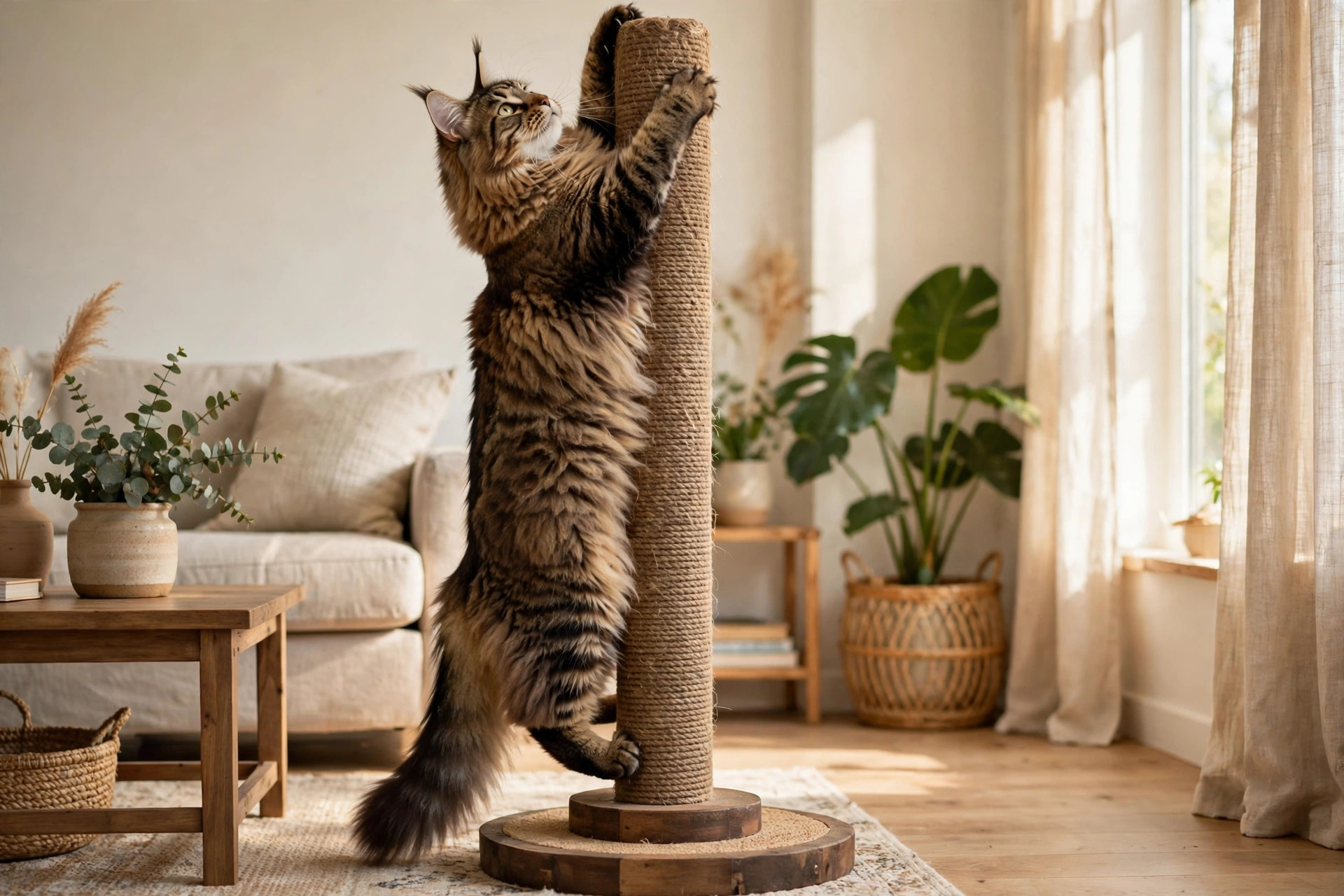
Height is the single most important buying decision, and the one most owners get wrong. The Cornell Feline Health Center advises that a scratching post should be sturdy enough not to topple, and at least as tall as your cat standing on her hind legs with her front legs stretched out. The Cornell Feline Health Center’s guide to destructive behavior explains why redirecting scratching to a proper post works better than punishment.
- Average adult cat: at least 28–32 inches (70–80 cm) tall.
- Large breeds (Maine Coon, Ragdoll, Norwegian Forest Cat): at least 36–41 inches (90–105 cm) tall.
- Kittens: any height over 16 inches works at first, but they will outgrow a short post within months — buying tall from the start is cheaper.
- Horizontal scratchers: height does not matter; length does. The pad should be long enough for a full front-leg reach, roughly 18 inches or more.
If you are unsure, go taller. A post that is too tall is almost never a problem; a post that is too short is the most common reason cats ignore a brand-new scratcher and go straight back to the sofa.
Sisal, Cardboard, or Carpet?
The covering decides whether your cat finds the post satisfying — and how long it lasts.
Sisal Rope and Sisal Fabric
Sisal is the most recommended material for the best cat scratching posts: it is tough, its rough texture closely mimics tree bark, and claws hook into it satisfyingly. Sisal fabric (a woven sheet) lasts longer than sisal rope because it cannot unravel in long strands, though both work well.
Corrugated Cardboard
Cardboard is the favorite for horizontal scratchers and for cats that like a softer shred. It is cheap, replaceable, and most cats love the sound and feel of tearing it. Treat it as a consumable and keep spares.
Carpet
Carpet-covered posts are softer and quieter, but they wear out faster than sisal, and there is a real confusion risk: a cat taught that carpet is for scratching may decide your actual carpet is fair game too.
Also Read: Indoor Cat Enrichment for Winter: 10 Ideas (2026)
Stability and Placement
A post that wobbles or topples will be abandoned after a single use — and a cat startled by a falling post may avoid it for weeks. Look for a wide, heavy base (at least 16 inches square for a 32-inch post, wider for taller models) and a post firmly bolted to the base.
Placement matters just as much. Cats scratch near where they sleep and near room entrances, and they return to spots that already carry their scent. Put the new post directly in front of the furniture your cat currently scratches — not across the room, and not hidden in a spare bedroom. In multi-cat homes, provide one post per cat in different rooms.
How to Get Your Cat to Use the New Post
Even the best cat scratching post needs a proper introduction:
- Place it at the crime scene. Put the post right beside the sofa arm or rug edge your cat already scratches.
- Make it smell good. Sprinkle dried catnip on the post or rub a catnip toy across the surface.
- Play around it. Dangle a feather wand near the post so your cat discovers it during play.
- Reward every use. The moment she scratches the post, offer a treat or praise.
- Make the furniture boring. While the post earns its place, cover the sofa’s scratched corners with double-sided sticky tape, foil, or a throw.
- Be patient. Most cats switch over within one to three weeks.
Mistakes to Avoid
- Buying too short. A post under 28 inches cannot give an adult cat a full stretch.
- Choosing a wobbly base. If the post rocks when you push it, your cat will not trust it either.
- Hiding it in a spare room. Cats scratch where they live and sleep. A post nobody walks past is a post nobody uses.
- Picking carpet that matches your floor. Your cat cannot tell the “good” carpet from the “bad” carpet — choose sisal or a clearly different texture.
- Only one post for a multi-cat home. Cats are territorial about scratching spots — one post per cat, in different areas.
- Giving up after two days. A new post can take a week or more to earn trust — refresh the catnip and keep rewarding.
For more on the behavior side, see the vet-approved guide to stopping furniture scratching. And if you are setting up for a new arrival, the first-time cat owner checklist lists a tall, stable scratching post among the 12 essentials.
Frequently Asked Questions
How tall should a cat scratching post be?
At least 28–32 inches tall for most adult cats, so your cat can stretch fully. Large breeds such as Maine Coons and Ragdolls need 36–41 inches.
What is the best material for a cat scratching post?
Sisal rope and sisal fabric are the most recommended — durable, with a rough texture that mimics tree bark. Corrugated cardboard is best for horizontal scratchers; carpet wears out faster and can confuse cats into scratching your actual carpet.
Why won’t my cat use the scratching post?
Usually one of three things: the post is too short for a full stretch, it wobbles, or it is in the wrong place. Move it next to the furniture your cat scratches, upgrade to a taller model, and refresh it with catnip.
Do cats prefer vertical or horizontal scratchers?
It depends on the cat. Sofa-arm scratchers prefer vertical posts; rug-rakers prefer flat cardboard scratchers. Watch what your cat already scratches and match it.
How many scratching posts does a cat need?
At least one per cat, placed in different areas of the home — near sleeping spots and room entrances.
Final Thoughts
So, what are the best cat scratching posts in 2026? For most cats, a tall sisal post of at least 28–32 inches on a wide, heavy base — the SmartCat Ultimate is the most consistently recommended pick. Large cats need 36–41 inches, and sideways scratchers need a flat cardboard pad. But the post is only half the answer: place it where your cat already scratches, keep it rock-solid, and reward every use.
Get those three things right and your cat will choose the post over the sofa within a couple of weeks — your furniture survives, and your cat keeps her claws and her instincts.
By Dr. Ayaz Ali