
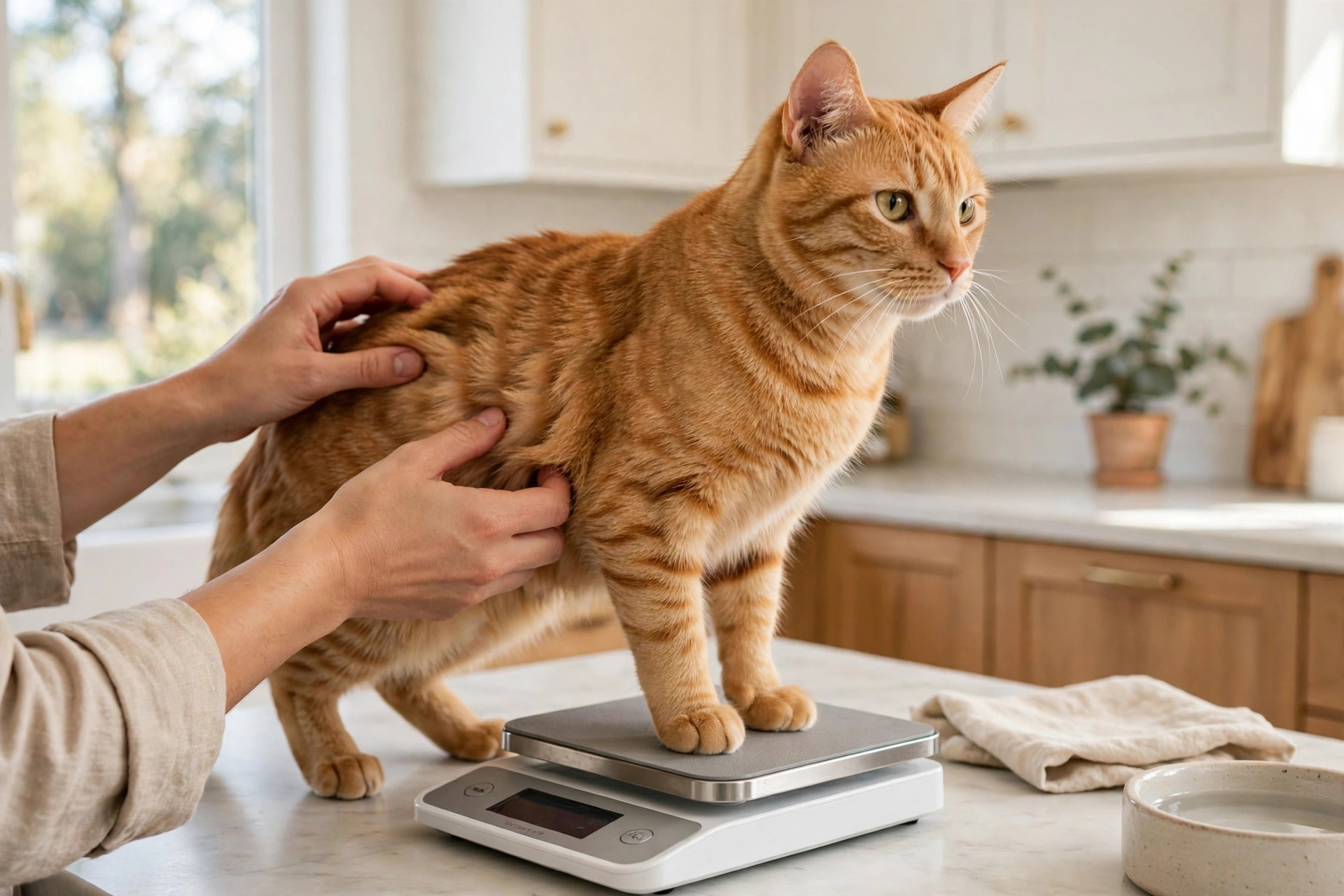
You’ve been giving your cat a few extra treats lately, the food bowl seems bottomless, and lately you’ve caught yourself wondering: is my cat overweight? You’re not alone — most cat owners genuinely can’t tell. Excess weight creeps on slowly, a few grams at a time, and a fluffy coat hides the evidence better than any diet plan.
The good news: October is World Pet Obesity Month, and 2026 brings fresh momentum to this exact question. The Association for Pet Obesity Prevention (APOP) is running its 2026 Pet Obesity Prevalence Survey through December 31 — and its last clinical survey found that 61% of cats assessed at U.S. veterinary clinics carried excess weight, while 32% of those owners described their pet as “normal” or “ideal.” That’s a recognition gap, not a lack of care.
In this complete guide, you’ll learn the vet-approved body condition score for cats, how to do a 3-minute weight check at home, why cats gain weight, the real health risks, and a safe step-by-step weight-loss plan.
Table of Contents
- World Pet Obesity Month: Why October Is the Perfect Time
- Is My Cat Overweight? The 3-Minute Home Check
- The 9-Point Body Condition Score for Cats
- Why Cats Gain Weight
- Health Risks of an Overweight Cat
- How to Help Your Cat Lose Weight Safely
- Is My Cat Overweight? When to Call the Vet
- Frequently Asked Questions
- Final Thoughts
World Pet Obesity Month: Why October Is the Perfect Time
Every October, the Association for Pet Obesity Prevention marks World Pet Obesity Month — and this year’s campaign feels different. For 2026, APOP released new Pet Obesity Communication Guidelines (published October 1, 2026) that reframe excess weight as a disease to treat with conversation, not blame. The organization even launched a fresh Pet Obesity Prevalence Survey, running October 1 through December 31, 2026, collecting veterinarian-assessed body condition scores alongside owners’ first impressions — precisely to measure the gap between perception and reality.
That gap is enormous. APOP’s most recent published clinical data found that 59% of dogs and 61% of cats assessed at participating U.S. veterinary clinics scored in the overweight or obesity ranges — yet among owners of those pets, 32% described their animal as “normal,” “ideal,” or even “thin.” The reason is simple psychology: we see our pets every day, so gradual weight gain never registers. You don’t notice 3% a year until a vet points it out.
Cats may be hit hardest of all. Only 18% of cat owners report ever receiving a veterinarian-provided body condition score for their cat — compared to 29% of dog owners — which means most cat owners have never been taught what to feel for. This guide fixes that.
Is My Cat Overweight? The 3-Minute Home Check
You don’t need a scale, a chart, or a vet appointment to get a reliable first answer. Veterinarians use a simple look-and-feel routine that takes about three minutes. Do these four checks on your cat today.
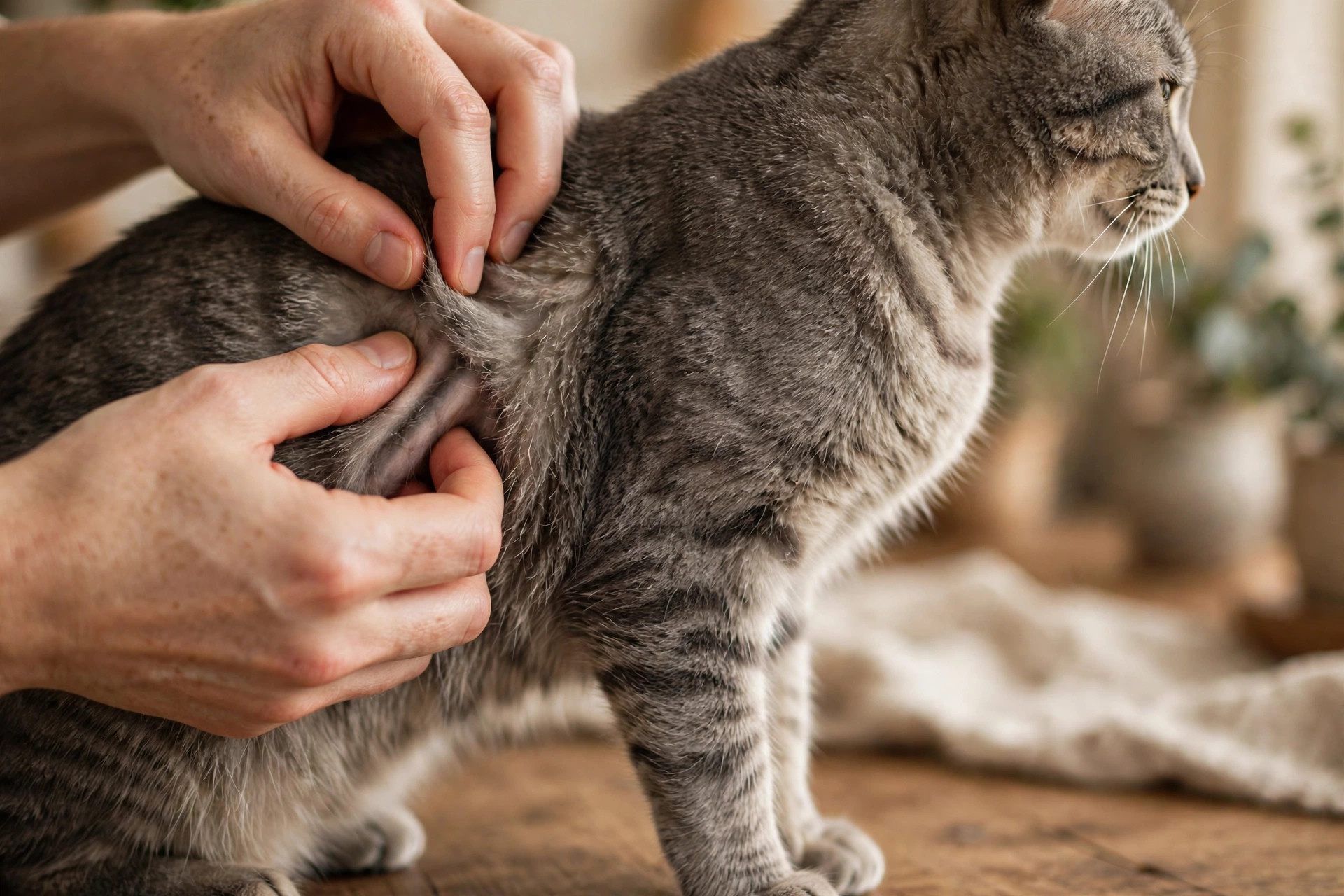
Step 1: Feel the ribs
Run your hands flat along both sides of your cat’s chest with light pressure — about the pressure you’d use on the back of your own hand. At a healthy weight, you should feel each rib easily beneath a thin layer of fat. If you have to press firmly through padding to find them, or can’t distinguish individual ribs, your cat is carrying excess weight.
Step 2: Look from above
Stand over your cat while it stands and look down. Between the rib cage and hips you should see a visible inward curve — a subtle hourglass waist. If the body runs straight from ribs to hips, or bulges outward, that’s excess fat.
Step 3: Look from the side
View your cat from the side. The abdomen should tuck up slightly behind the rib cage. A belly that hangs down level with the chest — or swings when the cat walks — signals overweight. Note: cats naturally have a small primordial pouch, a loose flap of skin near the hind legs. A pouch is normal; a fat, rounded, swinging belly is not. Judge the ribs, waist, and overall fat distribution together.
Step 4: Check the base of the tail and behavior
Excess fat accumulates around the lower back and tail base as body condition increases — run your hand there. Then watch how your cat moves: can it jump onto furniture without hesitation? Groom its lower back and hindquarters without difficulty? Cats that struggle to groom or jump are often carrying more than their joints appreciate.
If the ribs are easy to feel, the waist is visible, and the belly tucks up — congratulations, your cat is likely in great shape. If any check fails, read on to learn the formal scoring system.
The 9-Point Body Condition Score for Cats
A body condition score (BCS) is the veterinary world’s standard language for body fat — far more useful than a scale number, because a healthy weight looks completely different for a petite Singapura than for a burly Maine Coon. The most common system is the 9-point scale, validated against precise body-composition scanning technology. Veterinary teaching resources from the Ontario Veterinary College describe how each point above 5 represents roughly 10–15% additional body fat.
| Score (1–9) | Category | What You’ll Notice |
|---|---|---|
| 1–3 | Too thin | Ribs, spine, and hip bones easily visible; minimal fat cover; dramatic belly tuck |
| 4–5 | Ideal | Ribs easily felt under thin fat, waist visible from above, slight belly tuck from the side |
| 6–7 | Overweight | Ribs felt with effort, waist barely visible, rounded belly; roughly 10–20% over ideal weight |
| 8–9 | Obese | Ribs buried under fat, no waist, sagging belly, heavy fat on neck and limbs; 30–40%+ over ideal |
Also Read: Is My Dog Overweight? Body Condition Score & Weight Loss Plan (2026) — the dog-owner version of this guide, if your household has both species.
Why Cats Gain Weight
Understanding the why makes the fix stick. The usual culprits, in order of impact:
1. Indoor life burns almost nothing
Outdoor cats roam territories measured in acres. Indoor cats roam measured in rooms. An inactive indoor cat may burn a fraction of the calories its ancestors did — while the bowl stays just as full. This is the single biggest driver of the modern cat obesity epidemic.
2. Free-feeding and guessing portions
Keeping the bowl topped up all day sounds kind, but most owners vastly overestimate portions. Switching to measured meals with an actual measuring cup or kitchen scale routinely reveals 20–40% overfeeding.
3. Treats and toppers add up invisibly
Treats, dental chews, meal toppers, and table scraps should stay under 10% of daily calories — but a few treats per family member per day blows past that fast. Those “invisible calories” are exactly what the AAHA nutrition guidelines warn about.
4. Neutering slows the metabolism
Spayed and neutered cats burn roughly 20–30% fewer calories than intact cats — yet owners rarely reduce food after the procedure. The change is predictable; the weight gain isn’t inevitable if portions adjust.
5. Boredom and age
Bored cats eat for entertainment, and senior cats lose muscle while gaining fat. A cat can technically stay the same weight while becoming fatter and weaker — which is why body condition matters more than the scale number.
Health Risks of an Overweight Cat
A few extra pounds on a cat is not cosmetic — fat tissue releases inflammatory signals that strain nearly every organ system.
1. Diabetes
Obesity is a leading risk factor for feline diabetes, a disease requiring lifelong management and sometimes twice-daily insulin. Overweight cats are several times more likely to develop it than lean cats — and weight loss can sometimes put it into remission.
2. Hepatic lipidosis (fatty liver disease)
This is the cat-specific danger that makes overweight cats uniquely fragile: if an overweight cat stops eating for even 24–48 hours (from stress, illness, or a diet that’s too strict), the liver can become overwhelmed by mobilized fat — a potentially fatal emergency. Also Read: Why Is My Cat Not Eating? Warning Signs & When to Worry (2026) — the 24-hour rule every overweight cat owner must know.
3. Arthritis and mobility problems
Every extra ounce multiplies the force on hips, knees, elbows, and the spine. Overweight cats develop arthritis earlier — and the tell-tale signs (reluctance to jump, difficulty grooming the hindquarters) are often misread as “just getting old.”
4. Urinary tract disease
Overweight, inactive cats are overrepresented among cats with lower urinary tract disease — including the life-threatening urinary blockages male cats can develop. Less movement, more litter-box avoidance, worse outcomes.
5. Shorter, harder life
Across species, excess weight shortens lifespan and reduces its quality: harder breathing, poorer coat condition from inability to groom, and higher anesthesia and surgical risks for every procedure.
How to Help Your Cat Lose Weight Safely
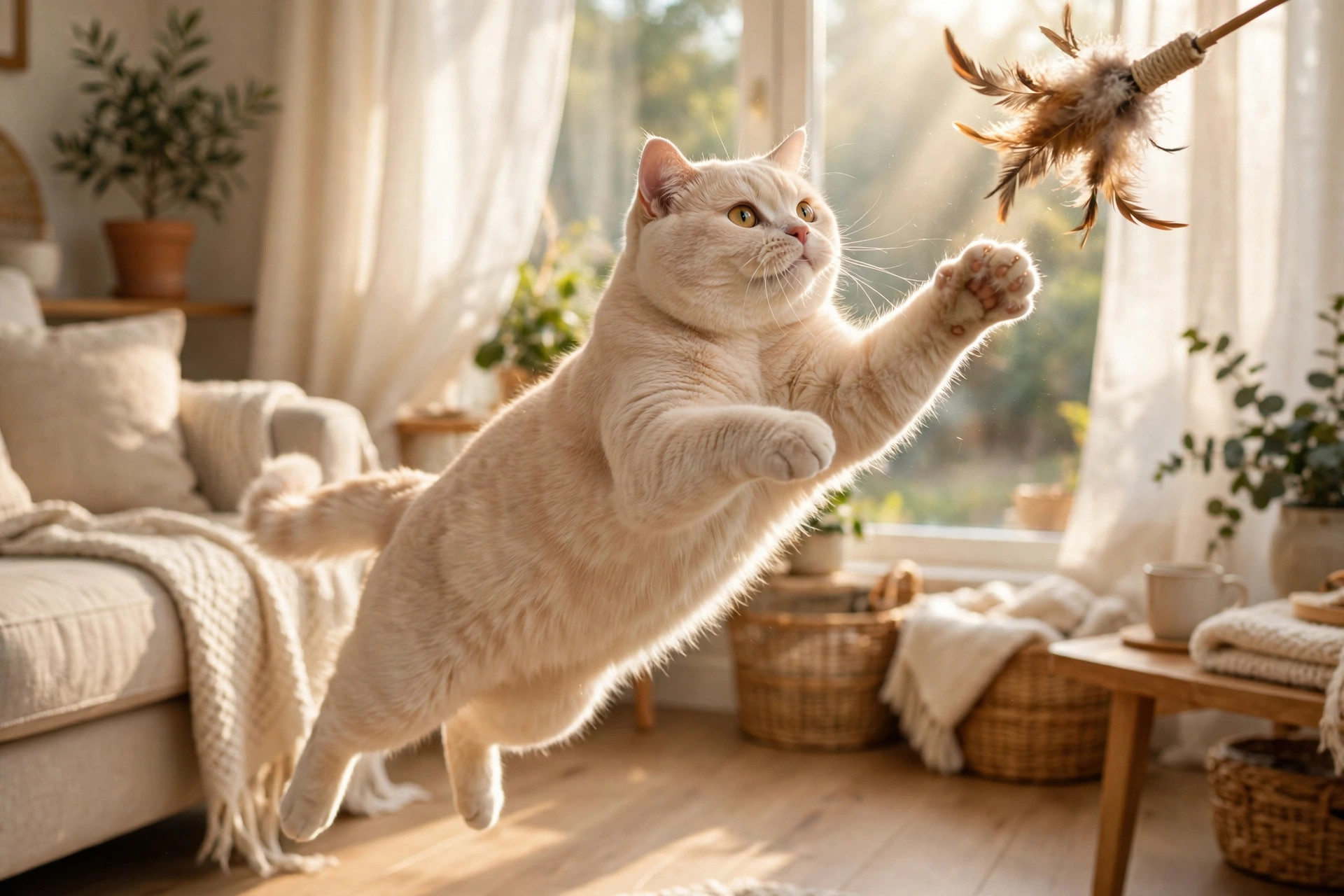
Cat weight loss is a marathon, not a sprint — and unlike dogs, cats must never be crash-dieted. Follow these steps in order.
Step 1: See your vet first
Before cutting a single calorie, get a vet visit. Your vet will rule out medical causes of weight gain, score body condition professionally, set a realistic target weight, and recommend whether a therapeutic weight-loss food is needed. Cats at BCS 8–9 should always have vet supervision.
Step 2: Feed for the ideal weight, not the current one
Vets base weight-loss feeding on the cat’s ideal weight. A common approach: feed roughly 80% of the resting energy requirement for the ideal weight. Example: a cat whose ideal weight is 4 kg (about 8.8 lbs) has a daily need of roughly 200–220 kcal — your vet can fine-tune this, and many weight-management foods print exact feeding guides on the bag.
Step 3: Measure every meal — end free-feeding
Buy a proper measuring cup or, better, a kitchen scale. Split the daily allowance into two or three meals. End the always-full bowl: food goes down for 15–20 minutes, then comes up. Exact measurement is the foundation everything else rests on.
Step 4: Apply the 10% treat rule
Treats, toppers, and table scraps combined must stay under 10% of daily calories. Get every family member on board — weight-loss plans fail most often because three people each give “one” treat. Swap calorie-dense treats for play sessions as the reward instead.
Step 5: Make your cat work for food and move more
Cats are built for short, intense hunts. Add two 5–10 minute play sessions daily (feather wands, laser pointers, crinkle balls) and build up gradually — overweight cats tire fast. Scatter part of the meal or use a food puzzle so eating takes effort; that slows intake and engages the hunting brain. Boredom is a major calorie source: Also Read: Do Calming Cat Beds Work? Vet-Approved Guide (2026) — a consistent, calm routine with real play beats boredom-snacking for many indoor cats.
Step 6: Track and adjust
Weigh your cat every 2–4 weeks and re-check the body condition score monthly. Safe loss for cats is roughly 0.5–2% of body weight per week — faster risks hepatic lipidosis. No progress after a month? Something uncounted is sneaking in: treats, a second feeder in the family, or a mis-measured scoop. Revisit your vet if the scale refuses to move.
Is My Cat Overweight? When to Call the Vet
Book a vet visit promptly if you notice rapid weight gain with heavy drinking and urination or a pot belly (possible diabetes or Cushing’s), breathing difficulty, sudden lethargy or inability to jump, or if your overweight cat stops eating for any reason — remember, appetite loss in an overweight cat is a same-day emergency because of fatty liver risk. Even without symptoms, any cat at BCS 8–9 deserves a vet-supervised plan before you change anything.
Frequently Asked Questions
How much should my cat weigh?
There is no single ideal number — a healthy weight depends on frame, breed, and muscle. Most domestic shorthairs land between 3.5 and 5.5 kg (8–12 lbs), but a large Maine Coon can be perfectly healthy at 8 kg while a petite Singapura shouldn’t exceed 3 kg. The body condition score is far more reliable than any chart number.
Is my cat fat or just fluffy?
This is the classic question — and why you must use your hands, not your eyes. Long hair hides fat beautifully. Feel the ribs: if they’re easy to find under a thin layer of fat, the cat is likely fine regardless of how fluffy it looks. If you have to dig through padding, the fluff is hiding real weight.
Is my cat overweight if it has a primordial pouch?
Not necessarily. All cats have a primordial pouch — a loose flap of skin near the hind legs that likely protects the abdomen during fights. A small, loose pouch is normal even in lean cats. What matters is the overall picture: ribs you can feel, a visible waist, and a belly that tucks up rather than swinging heavy and rounded.
Can indoor cats be overweight?
Absolutely — indoor cats are the most likely to be overweight. They burn far fewer calories than outdoor cats while often getting free-fed meals, and boredom eating compounds the problem. Indoor life doesn’t cause obesity; indoor habits do.
How fast should a cat lose weight?
Aim for roughly 0.5–2% of body weight per week. At that pace, a cat needing to lose 15% of its body weight needs about 3–5 months. Faster weight loss risks hepatic lipidosis (fatty liver disease) — slow and steady is a safety rule, not just advice.
Do overweight cats really live shorter lives?
Yes. Across studied species, excess weight is consistently linked to shorter lifespans and more disease years — from diabetes and arthritis to urinary problems and surgical complications. Every percentage point of excess fat your cat sheds buys back quality of life.
Final Thoughts
So, is my cat overweight? Run your hands over those ribs today, check the waist from above and the tuck from the side — and be honest about the answer. World Pet Obesity Month 2026 is the perfect nudge: the pounds that crept on over months can come off over months, and every one of them buys your cat more healthy, comfortable years with you.
As always, your veterinarian is your partner in this — not your judge. Ask them: “What is my cat’s body condition score, and what does it mean?” That one question starts the whole conversation.
By Dr. Ayaz Ali