
You wake up, stretch, and notice it again: fresh claw marks raking across the arm of your sofa. If you are searching for how to stop cat scratching furniture without ruining your relationship with your cat, you are in good company — destructive scratching is one of the most common complaints cat owners bring to veterinarians and behaviorists.
Here is the most important thing to understand first: scratching is not misbehavior. It is a normal, hard-wired feline instinct. Cats scratch to shed the dull outer layer of their claws, to stretch their back and shoulder muscles, to exercise, and to mark their territory — scent glands in their paw pads leave a signature every time they dig in. Your cat is not shredding the couch out of spite; she is doing exactly what nature programmed her to do.
The good news: with the right redirect, you really can stop cat scratching furniture damage. In this complete 2026 guide, we will show you why cats scratch the spots they do, how to choose scratching surfaces your cat will actually prefer, the safe deterrents that protect your furniture, nail-care habits that reduce damage, and the mistakes to avoid. No punishment, no shouting, no ruined sofas.
Table of Contents
- Why Do Cats Scratch Furniture?
- Choosing Scratching Surfaces Your Cat Will Love
- Safe Deterrents That Protect Your Furniture
- Nail Care: Trimming and Soft Nail Caps
- Play and Enrichment: Beating Boredom Scratching
- What NOT to Do (Declawing, Spray Bottles, Yelling)
- The 2-Week Redirect Plan
- Frequently Asked Questions
Why Do Cats Scratch Furniture?
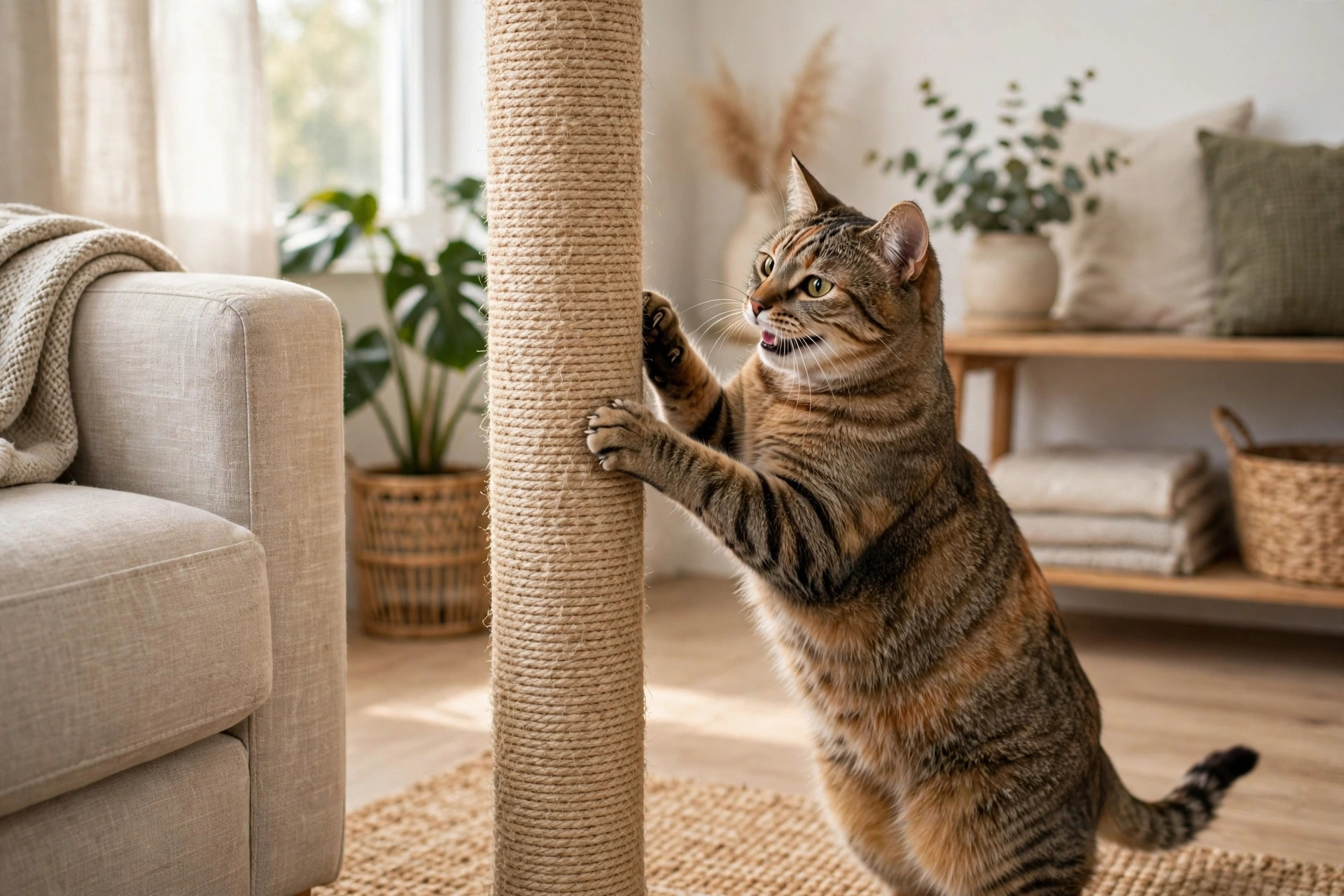
Before you can stop cat scratching furniture behavior, it helps to understand what is driving it. According to veterinary behavior resources including RSPCA Victoria, scratching serves four purposes at once, which is why it is so persistent.
1. Claw Maintenance
Cats shed the dull, dead outer sheath of each claw by working it against a rough surface. Without somewhere appropriate to do this, claws grow thick and uncomfortable — which actually makes your cat scratch harder and more often.
2. Territory Marking
Those scent glands in the paw pads are real. Every scratch leaves both a visual mark and a scent signature, which is exactly why cats gravitate toward prominent, heavily used furniture: the sofa arm in the living room is prime “advertising space” in feline terms. Cats also tend to scratch near where they sleep and near room entrances.
3. Stretching and Exercise
A good scratch is a full-body stretch: paws planted, back arched, shoulders extended. Cats that scratch vertically are often just working out their upper body, which is why short scratching posts frequently get ignored — they do not allow a proper stretch.
4. Stress and Boredom Relief
Scratching burns off nervous energy. Bored indoor cats, under-stimulated cats, and cats stressed by household changes (new pets, moving house, rearranged furniture) often scratch more. Also Read: Why Is My Cat Not Eating? Warning Signs & When to Worry (2026) — stress shows up in appetite too.
The takeaway: you will never train the instinct out of your cat, so the winning strategy is always redirection — give her something better to scratch, in the right place, and make the sofa the boring option.
Choosing Scratching Surfaces Your Cat Will Love
Most “failed” scratching posts fail for predictable reasons: they are too short, wobbly, placed in a corner nobody visits, or made of a material your cat finds unsatisfying. Here is how to get it right.
Match Her Preferences First
Watch what your cat already scratches and copy its qualities. Does she go for vertical sofa arms or horizontal rug edges? Coarse fabrics or nubby upholstery? Tall furniture (full-stretch scratches) or low surfaces? Common winning materials include:
- Sisal rope or sisal fabric — the classic favorite; loosely woven so claws can hook in
- Corrugated cardboard — loved by many cats, especially as flat horizontal pads; cheap and replaceable
- Natural wood or logs — excellent for cats that shred wooden furniture legs
- Carpet — can work, but pick a texture different from your actual carpet to avoid confusion
The Perfect Post Checklist
- Tall enough for a full stretch — look for posts at least 28–32 inches (70–80 cm) high for an adult cat
- Rock-solid stable — a post that wobbles or topples will be abandoned after one use
- Placed right by the sofa — put the new post directly in front of the currently scratched spot, not across the room
- One per key area — cats like options near sleeping spots and room entrances; multiple cats need multiple posts
Make the Post Irresistible
Sprinkle dried catnip on it or rub a catnip toy across the surface. Dangle a feather wand around it so your cat “discovers” it during play — play near the post, then end the game with a scratch on it. Every time your cat uses the post voluntarily, reward her immediately with a treat or praise. Positive reinforcement is what turns a novelty into a habit.
Move the post only gradually (a few inches a day) once your cat is hooked — a sudden relocation can send her straight back to the sofa.
Also Read: Catio Ideas: Safe Outdoor Cat Enclosure Guide (2026) — more territory and enrichment means less destructive scratching indoors.
Safe Deterrents That Protect Your Furniture
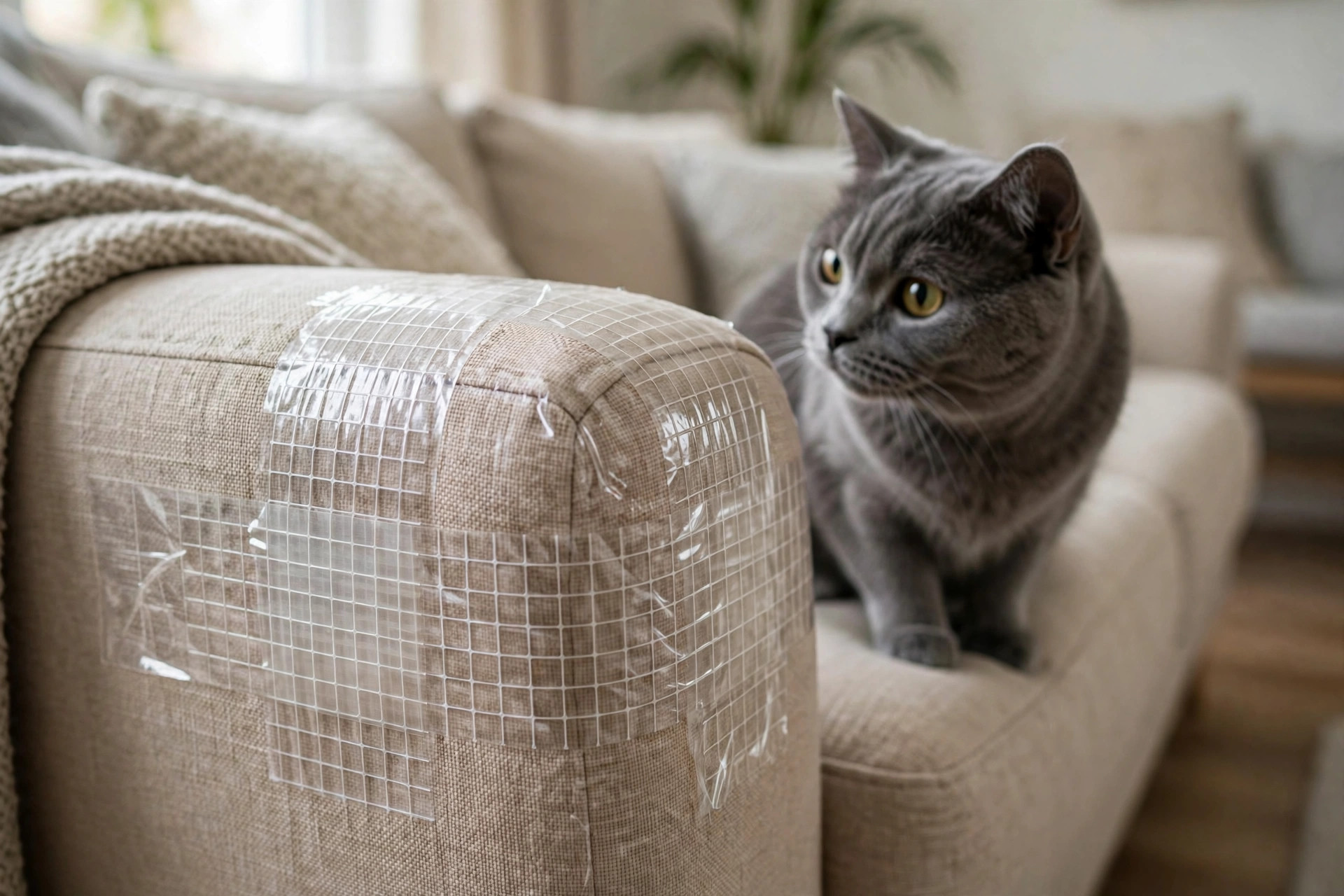
While the new post earns its place, make the furniture temporarily unappealing. The principle is simple: make the sofa boring at the same time you make the post exciting.
- Double-sided sticky tape — purpose-made products (like Sticky Paws strips) or plain double-sided tape on the scratched corners; cats hate the tacky feeling on their paws
- Aluminum foil — draped over the favored spot; the texture and crinkle put most cats off
- Furniture covers or throws — a smooth, tightly tucked cover removes the satisfying grip; it also protects while training is underway
- Vinyl or plastic furniture guards — clear stick-on panels for the exact scratching zones
- Citrus or mint scents — cats dislike citrus and mint smells; a fabric-safe citrus spray can help (test a hidden spot for staining first). Never use essential oils directly — many are toxic to cats
Keep deterrents in place until your cat has consistently used the new post for several weeks, then remove them gradually — not all at once. If scratching returns, the deterrent went away too soon.
One caution from behaviorists: do not scent the furniture and the new post with aversive smells — keep the pleasant associations (catnip, treats, play) exclusively with the approved surfaces.
Nail Care: Trimming and Soft Nail Caps
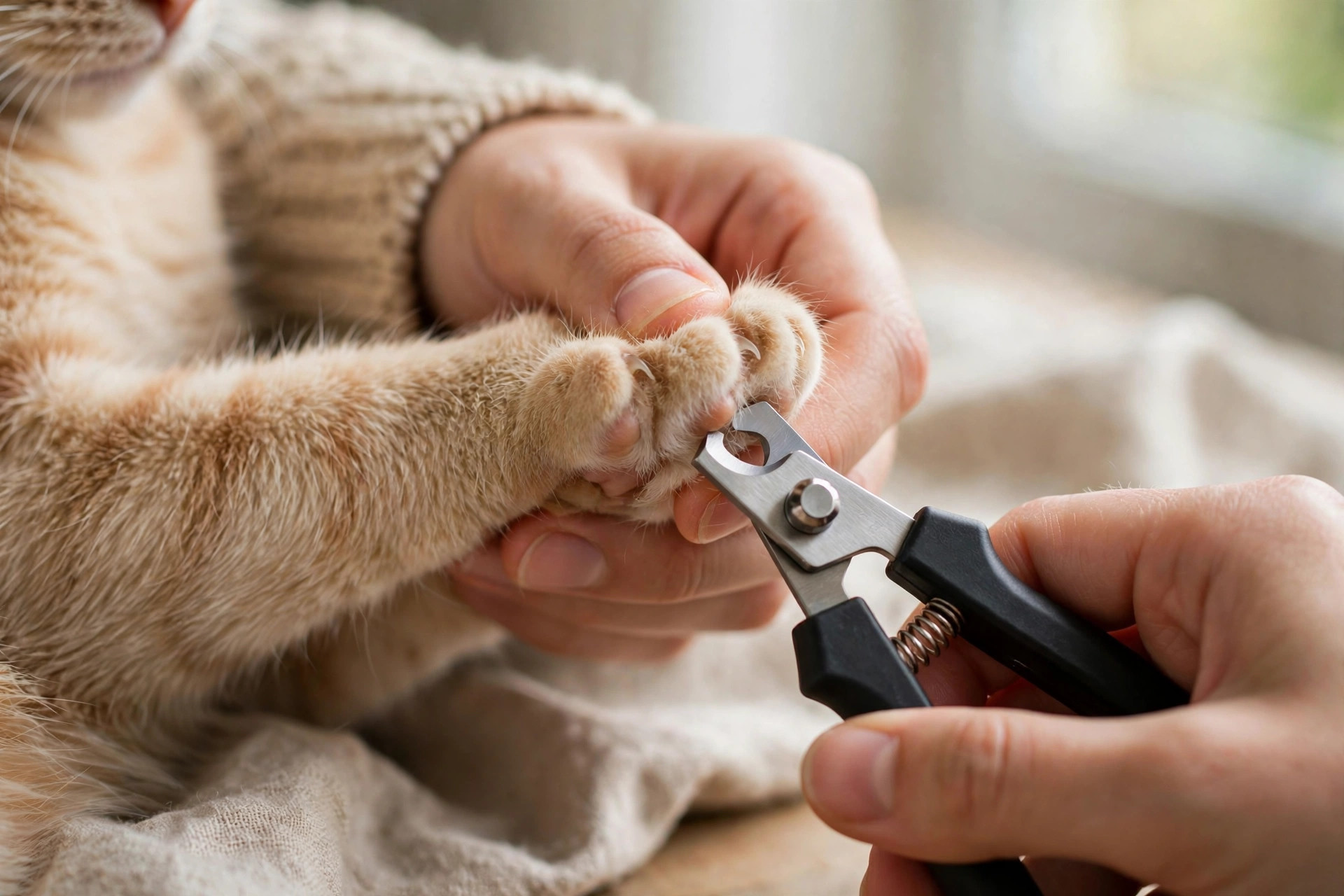
Regular nail care does not remove the urge to scratch, but it sharply reduces the damage each scratch does. Well-kept claws are less sharp, less likely to snag fabric, and more comfortable for your cat.
How to Trim Safely
- Use clippers designed for pets — they cut cleanly without crushing the claw.
- Gently press the paw pad so the claw extends fully.
- Trim only the sharp, translucent tip — the “hook.” The pink “quick” inside the nail contains blood and nerves; cutting it is painful and bleeds.
- Work in short sessions: one or two paws a day is plenty until both of you are comfortable.
- End every session with a treat so nail time predicts good things.
Aim to trim front claws every 2–3 weeks. If you are nervous, ask your vet or groomer to demonstrate once — most will happily show you the technique.
Soft Nail Caps
Vinyl nail caps (such as Soft Paws) glue over each claw and stay on for 4–6 weeks as the nail grows. They are safe when applied correctly, let your cat scratch normally, and nearly eliminate furniture damage. They do require periodic replacement and some cats need a few days to adjust — supervise the first set and keep a spare kit handy.
Play and Enrichment: Beating Boredom Scratching
Cats that scratch everything in sight are often simply understimulated. Indoor cats without hunting outlets invent their own entertainment — and your armchair is fair game. Build in daily outlets for the scratch-and-pounce drive:
- 10–15 minutes of interactive play daily — feather wands, crinkle toys, and chase games that end with a “catch” satisfy the hunting sequence
- Window perches and bird-watching spots — visual stimulation that burns mental energy
- Puzzle feeders and treat balls — make meals a job, not a bowl-filling
- Vertical space — shelves, cat trees, and high perches give cats territory to claim instead of the sofa
- Calming pheromone products — Feliway-style diffusers or sprays in scratch-prone areas can reduce stress-driven scratching for anxious cats
For multi-cat homes, tension is a major scratching driver. Make sure there are enough resources (posts, litter boxes, resting spots) that no cat has to compete for them.
What NOT to Do (Declawing, Spray Bottles, Yelling)
Some popular “fixes” make the problem worse — or are outright harmful. Here is what to avoid when trying to stop cat scratching furniture:
Never Declaw
Declawing is not a nail trim — it is the amputation of the last bone of each toe. Veterinary bodies worldwide oppose it except for rare medical necessity: it causes chronic pain, changes how cats walk, and is linked to increased biting, litter-box avoidance, and long-term behavior problems. It is already banned in dozens of countries. Nail caps and regular trims achieve the goal without the suffering.
Skip the Spray Bottle
Spritzing water or yelling may interrupt a scratch in the moment, but it teaches your cat to fear you — not to love the post. The usual result: she scratches the sofa when you are not around. Behaviorists are blunt about this: punishment without an alternative does not resolve scratching problems.
Do Not Punish After the Fact
Cats do not connect scolding with damage done hours ago. All after-the-fact punishment does is damage trust and raise stress — which, as we covered, increases scratching. Redirect calmly in the moment instead: lift her to the post, reward the right choice, move on.
The 2-Week Redirect Plan
Put it all together with this simple schedule. Consistency is what makes it work:
| Timeframe | What to Do |
|---|---|
| Days 1–3 | Place a tall, stable post right at the scratched spot. Add catnip. Cover the furniture with tape, foil, or a throw. Trim claws. |
| Days 4–7 | Play near the post daily. Reward every use with a treat. Keep deterrents on the furniture. Do not punish slips — redirect. |
| Week 2 | Catnip refresh, keep rewarding. If the post is being used daily, start edging it a few inches toward its permanent spot. |
| Week 3+ | Remove deterrents gradually once the post has been the go-to for several weeks. Keep treats and nail trims as routine. |
If scratching spikes suddenly in an older cat, or comes with other behavior changes, talk to your vet — new-onset scratching can occasionally signal pain, cognitive changes, or anxiety worth investigating.
Frequently Asked Questions
Why does my cat scratch furniture even though she has a scratching post?
Usually it is one of three things: the post is too short for a full stretch, it wobbles, or it is in the wrong place. Move the post right next to the scratched furniture, upgrade to a taller, sturdier model, and refresh it with catnip.
Can I train an older cat to stop scratching furniture?
Yes. Older cats learn new preferences too — it just takes a little longer. A comfortable, stable post (plus arthritis-friendly nail care) is the key. Many seniors switch within a few weeks when the alternative is genuinely appealing.
Are nail caps safe for cats?
Yes, soft vinyl nail caps are safe when applied correctly and replaced every 4–6 weeks. They let cats scratch naturally without damaging furniture. Always follow the package instructions and supervise the first wearing.
Does declawing stop scratching problems?
It removes the claw but not the behavior — declawed cats still “scratch,” and often develop worse problems like biting and litter-box avoidance. Veterinary organizations oppose declawing; training, deterrents, and nail caps are the humane alternatives.
How long does it take to stop a cat scratching furniture?
With consistent redirection, most cats noticeably switch to a scratching post within 1–2 weeks and fully convert within 3–4 weeks. Patience and rewards speed the process; punishment slows it.
What scents deter cats from scratching?
Cats dislike citrus and mint scents. A fabric-safe citrus spray on the furniture can help, but test for staining first — and never use concentrated essential oils, which can be toxic to cats.
Final Thoughts
So, can you stop cat scratching furniture without punishing your cat or resorting to surgery? Absolutely — because you are not fighting the scratching instinct, you are simply relocating it. Give your cat a tall, stable, well-placed scratching post she genuinely likes, make the sofa temporarily boring with safe deterrents, keep claws trimmed, and reward every good choice with treats and play.
Most owners see real change within two weeks and a full switch within a month. Your cat keeps her claws, her instincts, and her dignity — and your furniture survives. That is a win for everyone in the house.