
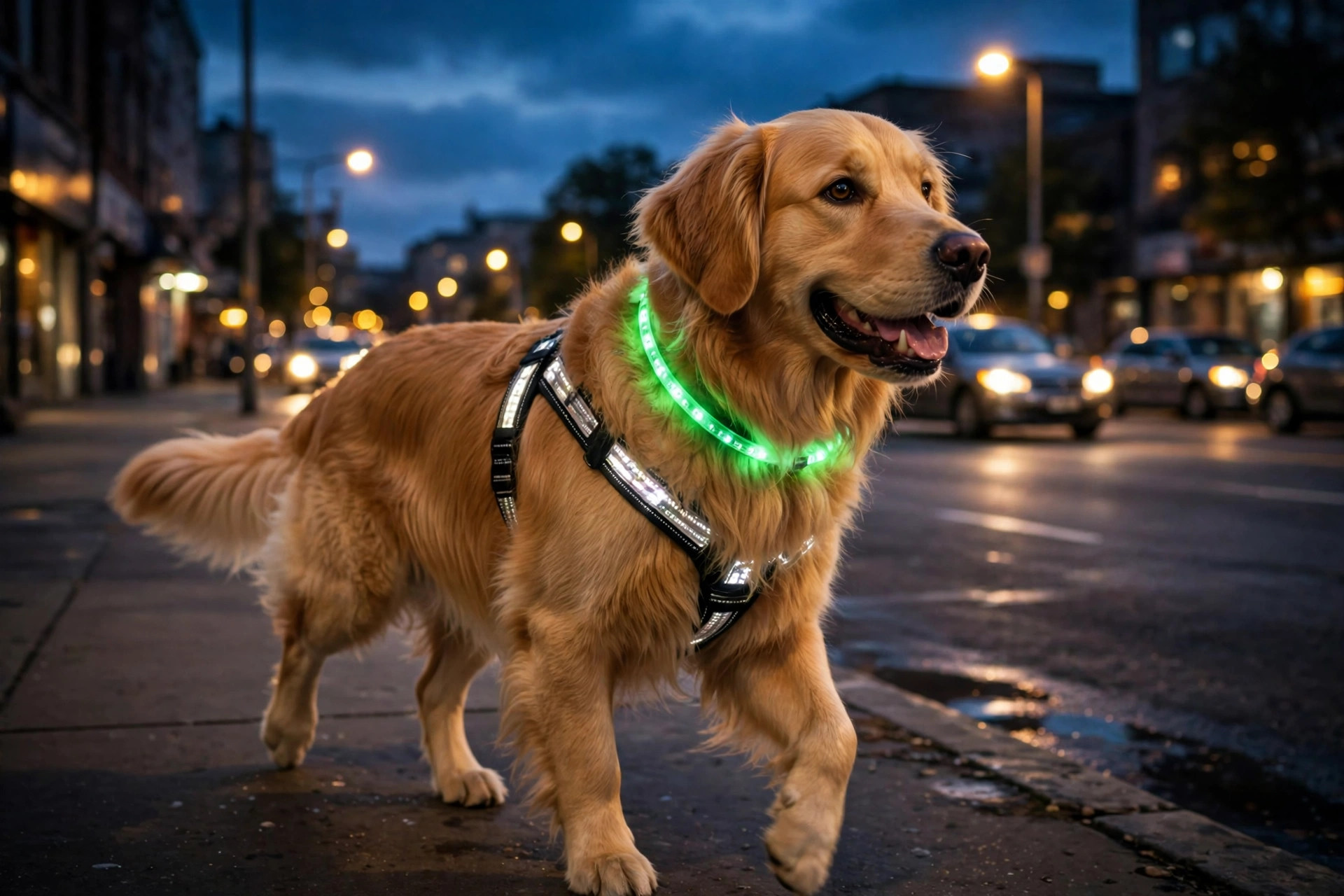
As the evenings draw in, your dog’s after-work walk increasingly happens in the dark — and that changes the safety equation completely. A dog that is perfectly visible at 6 p.m. in summer can all but vanish into the shadows by November, and drivers, cyclists, and joggers simply cannot react to what they cannot see. That is exactly why LED dog walking gear has become essential kit for autumn and winter dog owners, not a novelty extra.
The good news is that staying visible after dark is cheap and simple: a light-up collar, a reflective harness, or a clip-on light can make your dog visible from hundreds of feet away. In this guide, we will compare LED vs. reflective gear, walk through every type of light-up walking gear, and show you how to size it, combine it, and use it safely — so every dark-evening walk ends the way it should.
Table of Contents
- Why Dark-Evening Walks Are Risky
- LED vs. Reflective Gear: How Each One Works
- Types of LED Dog Walking Gear
- How to Choose the Right Gear for Your Dog
- Your Dark-Walk Safety Checklist
- 5 Mistakes That Undo Your Visibility Gear
- Frequently Asked Questions
Why Dark-Evening Walks Are Risky
Darkness is not just “less light” — it changes how every road user perceives your dog. On dipped headlights, a driver may only spot an unlit pedestrian from 25 to 30 meters away, while reflective gear stretches that distance to around 140 meters, giving the driver roughly ten seconds to react instead of two. Dogs are at even greater risk than people: they are lower to the ground, they move unpredictably, and dark-coated dogs blend into asphalt almost completely.
The danger is worst at the times most owners actually walk: the pre-dawn and post-dusk hours, when commuter traffic is heaviest and light is lowest. Add autumn rain, fog, and wet roads that scatter headlight beams, and a dog in a plain collar becomes genuinely hard to spot. Pedestrians are at least three times more likely to be hit by a car when it is dark, according to the U.S. National Highway Traffic Safety Administration — and dogs, unlike people, do not understand traffic at all.
The fix is straightforward. Visibility gear works by giving drivers two chances to see your dog: active light they can spot from any direction, and reflective material that fires headlights straight back at them. Used together, the two cover each other’s weaknesses.
LED vs. Reflective Gear: How Each One Works
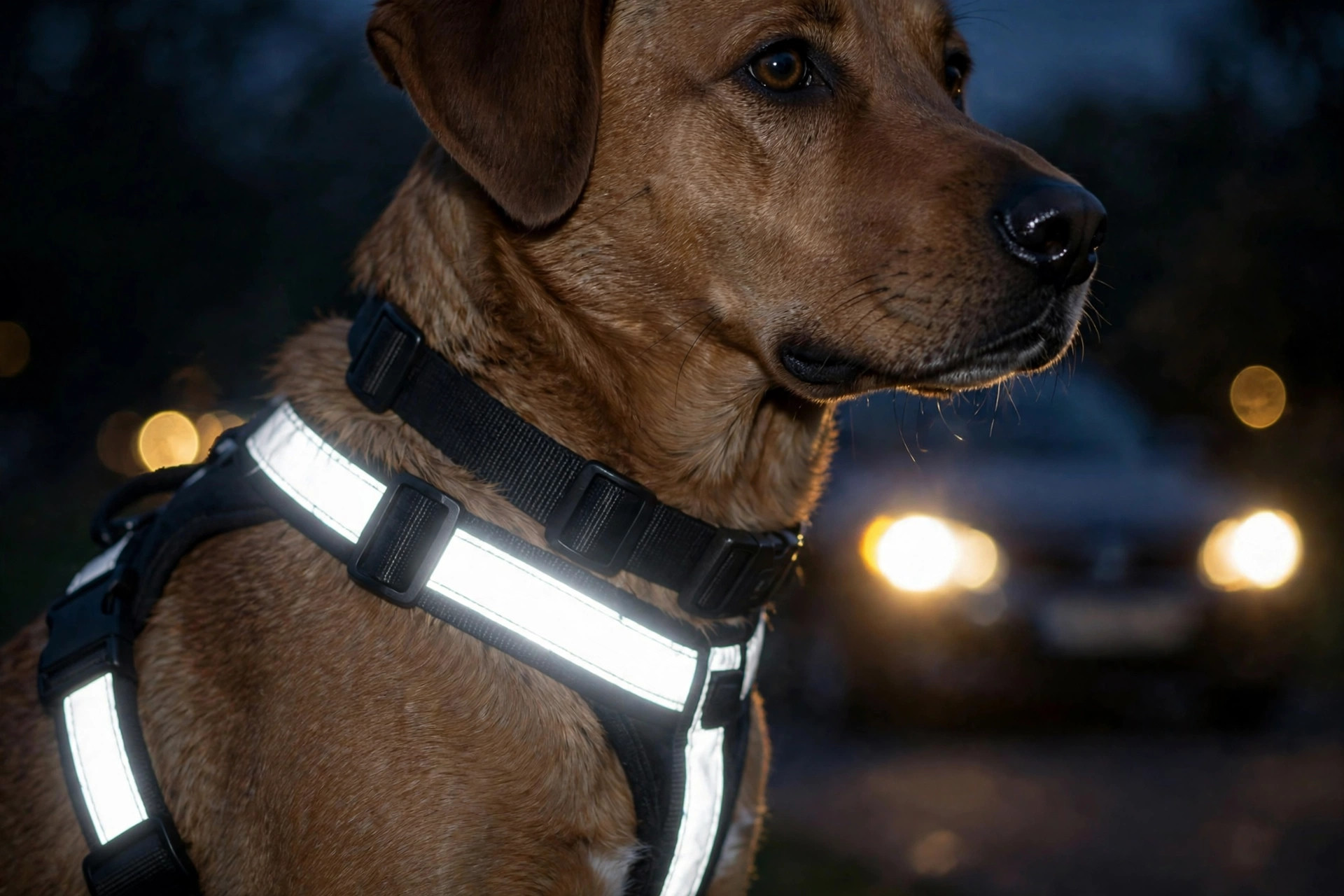
Understanding the difference between the two technologies is the key to choosing well — because neither one alone is enough.
LED gear: light your dog up
LED collars, harnesses, and clip-on lights contain small light-emitting diodes powered by a rechargeable battery. They produce their own light, so they work in total darkness — on unlit country lanes, in parks, and on trails where there are no headlights to reflect. Most offer steady glow, slow flash, and fast flash modes, and USB-rechargeable models typically run 5 to 12 hours per charge depending on brightness. Green and cyan LEDs are generally the most visible to the human eye against a dark background; white is brightest but can blend with streetlights.
Reflective gear: bounce light back
Reflective collars, harnesses, and leashes use retroreflective material — usually 3M Scotchlite strips or embedded glass beads — that returns incoming light directly to its source. When headlights hit a reflective harness, it flares brightly, making a dog visible from several hundred feet away. The catch: reflective gear needs an external light source. On a pitch-black path with no cars, streetlights, or torches around, it does almost nothing.
| Feature | LED gear | Reflective gear |
|---|---|---|
| Works in total darkness | Yes — produces its own light | No — needs headlights or streetlights |
| Visible from | All angles, up to 500 meters | Wherever light hits it, several hundred feet |
| Power needed | Yes — USB recharge or batteries | None — always “on” |
| Best for | Rural walks, parks, unlit paths | City streets, roadside walking |
| Weakness | Battery can die; needs charging | Useless without a light source |
The winning combination is both. An LED collar makes your dog glow where no light reaches, and reflective trim makes the same dog flare brilliantly the moment headlights arrive. Most of the best products now build in both: LED collars with reflective stitching, and reflective harnesses with LED strips.
Types of LED Dog Walking Gear
1. LED collars
The simplest upgrade. A full LED collar is a flexible tube of light that wraps the whole neck, visible from 360 degrees — a big advantage over a single blinking tag, since a dog is seen from the side, front, and behind. Look for USB rechargeability, at least three light modes, and a cut-to-fit or adjustable design so the glowing section sits snugly without dangling. Some light-up collars are bright enough to be seen from 1,000 feet away.
2. LED harnesses
A harness spreads light and reflection across the chest, back, and sides — a much larger visible area than a collar, which matters for long-coated dogs whose fur can hide a collar completely. LED harnesses with 3M Scotchlite trim give you both technologies in one piece of kit, and they double as your normal walking harness, so there is nothing extra to remember. They are the best single purchase for most owners.
3. Clip-on LED lights and tags
Small, cheap, and brilliantly practical: a clip-on light attaches to any collar or harness in seconds. Keep one on every collar you own, and you never face a dark walk unlit. They are also the easiest backup — if your main LED collar runs flat, a clip-on tag keeps your dog visible. Choose a model with a secure clip (not a flimsy carabiner that bounces off on a run) and a battery you can actually replace or recharge.
4. Reflective and LED leashes
The leash is the visible line that connects you to your dog — and it is often the first thing a driver sees. A reflective leash extends the reflective area all the way back to your hand, and LED leashes light the whole line. If you walk near roads, a reflective leash is one of the cheapest upgrades you can make, and it also makes you more visible, since drivers track the glowing line back to the person holding it.
5. Hi-vis vests and jackets
For small dogs, puppies, and dogs with dark coats, a hi-vis vest or jacket gives the biggest visible surface of all. Fluorescent yellow or orange fabric stands out in low light even before headlights hit it, and reflective strips add the night-time flare. In cold weather, a hi-vis jacket doubles as warmth — a genuine two-for-one for winter evening walks.
Also Read: Winter Paw Care for Dogs: Salt & Ice Guide (2026) — visibility is only half the winter-walk story; salt and ice are the other half.
How to Choose the Right Gear for Your Dog
Fit matters more than brand. An LED collar that is too loose slides around and can snag; one that is too tight is uncomfortable and your dog will hate wearing it. Use the two-finger rule: you should be able to slide two fingers flat between the collar or harness and your dog’s body. Measure your dog’s neck and chest with a soft tape before ordering, and check the manufacturer’s size chart — sizes vary wildly between brands.
- Small dogs (under 20 lbs): a lightweight LED collar or clip-on light — heavy harnesses with big battery packs will bother them. Keep the total added weight minimal.
- Medium dogs (20–50 lbs): an LED harness with reflective trim is the sweet spot — big enough area to be seen, comfortable for daily walks.
- Large and strong dogs (over 50 lbs): a wide reflective harness with metal hardware plus an LED collar — the harness handles the pulling, the collar handles the glow.
- Long-coated dogs: skip collar-only lights (fur hides them) and go for a harness or vest that sits on top of the coat.
- Dark-coated dogs: prioritize active LED light — reflective gear alone is less effective on a dog that absorbs light, and LED makes them glow regardless of coat color.
On batteries, prefer USB-rechargeable gear over disposable-battery models: it is cheaper over a winter of nightly walks, and you can top it up like your phone. Check the water-resistance rating too — autumn walks mean rain, and a light that dies in drizzle is useless. Finally, test the gear at home before the first real walk: charge it fully, check every mode, and let your dog wear it indoors for a few minutes so the novelty does not become a distraction on the street.
Your Dark-Walk Safety Checklist
Gear is only part of the picture. Run through this checklist before every dark-evening walk:
- Charge check: confirm the LED gear is charged — a dead collar is worse than no collar, because it gives false confidence.
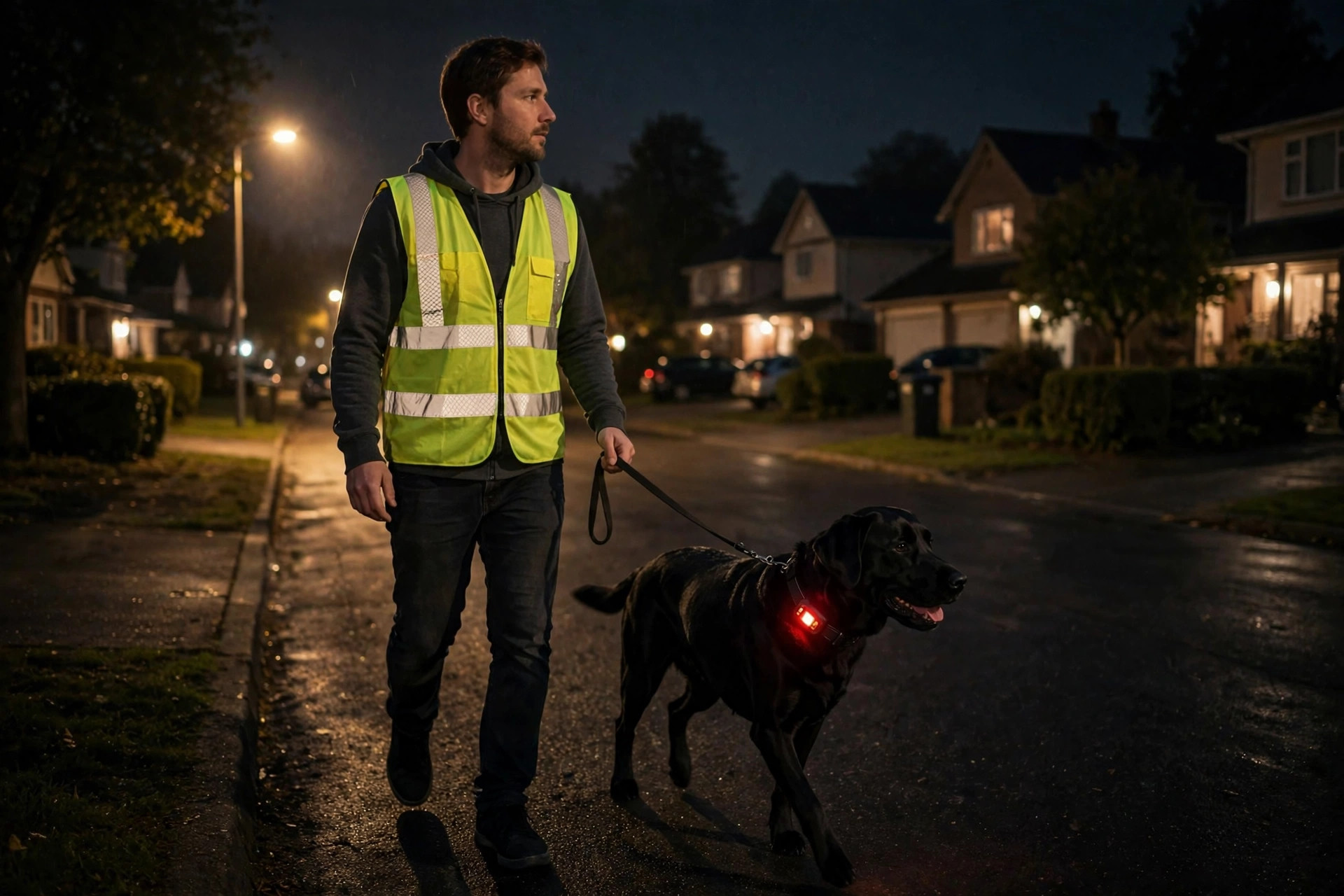
- Light yourself up too: wear light-colored or reflective clothing, a hi-vis vest, or a headtorch. You are your dog’s first line of defense, and drivers need to see both of you.
- Pick lit, familiar routes: stick to streets you know, with streetlights and sidewalks. Night is not the time to explore new trails.
- Keep the leash short: use a standard 6-foot leash, not a retractable one — you need your dog close and visible at all times in the dark.
- Carry a torch: a small flashlight or headtorch lights the path ahead and, shone at your dog’s reflective gear, makes them flare for drivers.
- Carry your phone: charged, for emergencies — and keep your dog’s ID tags and microchip details up to date in case they slip the leash.
- Watch the weather: rain and fog cut visibility further; on the worst nights, add an extra light rather than skipping the walk.
Also Read: Stop Your Dog Pulling on the Leash: 7 Trainer Tips (2026) — a dog that walks calmly beside you is far easier to keep visible (and safe) after dark.
5 Mistakes That Undo Your Visibility Gear
1. Relying on reflective gear alone on unlit paths. Reflective material needs light to reflect. On a dark park path with no cars or streetlights, a reflective-only harness is invisible — pair it with an LED light.
2. Letting the battery die. LED gear only works charged. Build charging into your routine: plug the collar in when you get home, the same way you charge your phone.
3. Hiding the light under fur or a coat. A glowing collar under a thick winter coat helps no one. If your dog wears a coat, put the light on the outside of it — use a clip-on light on the coat’s harness loop.
4. Forgetting yourself. A glowing dog next to an invisible owner in black clothing still confuses drivers. Light yourself up too — it is half the safety equation.
5. Skipping the leash light on “short” walks. Most accidents happen close to home, on familiar streets, on routine walks. The five-minute toilet walk at 9 p.m. needs the same gear as the hour-long hike.
Frequently Asked Questions
Are LED collars safe for dogs?
Yes, when used properly. LED lights produce minimal heat and are encased in protective tubing, and the small batteries add very little weight. Check the fit with the two-finger rule, remove light-up gear indoors so your dog cannot chew the battery unit, and never leave a flashing collar on an unsupervised dog.
Do reflective collars work without any light around?
No. Reflective material only returns light that hits it — it does not glow on its own. In complete darkness with no headlights, streetlights, or torches nearby, a reflective-only collar is effectively invisible, which is why pairing it with an LED light is the recommended setup.
What color LED light is most visible at night?
Green and cyan are typically the most visible LED colors against a dark background, with yellow and magenta also showing up well. White is the brightest but can blend into streetlights; blue tends to be the least visible from a distance. For maximum noticeability, a flashing mode beats a steady glow.
Can my dog wear LED gear in the rain?
Most quality LED collars and harnesses are water-resistant and handle rain fine, but check the product’s rating before buying — “water-resistant” is not “waterproof,” and fully submerging a light (swimming, deep puddles) can kill it. Dry the gear after wet walks and check the charging port cover is closed.
Do I still need reflective gear if my street is well lit?
Yes — streetlights help, but they do not replace reflection. Headlights are far brighter and more directional than streetlights, and reflective gear is what makes your dog flare in a driver’s beam from hundreds of feet away. On lit streets, reflective gear alone may be enough, but the LED-plus-reflective combination is still the safest setup.
Conclusion
Dark-evening walks do not have to be risky walks. The right LED dog walking gear — an LED collar or clip-on light for total darkness, plus reflective trim for headlight flare — turns your dog from a shadow into a beacon, and it costs less than a bag of premium dog food. Fit it properly, keep it charged, light yourself up too, and stick to familiar lit routes, and the evening walk goes back to being what it should be: the best part of your dog’s day.
For more on keeping your dog safe after dark, the AKC’s nighttime safety guide covers route choice, reflective clothing, and LED collars in more detail.
By Dr. Ayaz Ali