

When the cold sets in, most of us reach for a heating pad or an electric blanket — and our dogs and cats reach for the warmest spot in the house. It feels like kindness. But here is the question every pet owner should ask first: can a heating pad burn my dog?
The answer is yes. A heating pad, an electric blanket, or even a space heater can burn a dog or a cat — and the worst burns are often the ones you never see coming. They happen slowly, at temperatures that feel merely warm to your hand, while your pet sleeps deeply and cannot move away. In this guide, we explain the four hidden winter burn risks, which pets are most vulnerable, and the simple rules that keep your home warm and your pet safe.
Table of Contents
- Can a Heating Pad Burn My Dog?
- What Is a Low-Temperature Burn?
- The 4 Hidden Winter Burn Risks
- Which Pets Are Most at Risk?
- Safe Heating Rules: The 7-Point Checklist
- Safer Ways to Keep Your Pet Warm
- Signs Your Pet Has Been Burned or Overheated
- Frequently Asked Questions
Can a Heating Pad Burn My Dog?

Yes. A heating pad can burn your dog, and the same is true for cats. Veterinary guidance is clear on this point: heat applied to a pet’s skin for too long, at too high a temperature, or to a pet that cannot move away causes thermal burns — even when the surface never felt hot to you.
The danger comes in two forms. The first is obvious: a human heating pad on a high setting can reach 130–160°F (54–71°C), hot enough to cause serious burns in minutes. The second is quieter and more common: a mildly warm surface — around 44–50°C (111–122°F) — pressed against the same patch of skin for half an hour or more. That slow, steady heat injures tissue layer by layer, and because fur hides the early redness, owners often do not notice anything is wrong until days later, when a blister or a raw, painful patch appears.
Pet-specific heating pads are built very differently from human ones. A well-designed pet pad warms to roughly your pet’s own body temperature — about 102°F (38.8°C) — and only while your pet is lying on it. It also has a chew-resistant cord, an automatic shut-off, and a thermostat. Even so, no powered pad is risk-free. The safety of any heated bed depends on how you set it up and whether your pet can always choose to lie somewhere cool.
Also Read: Winter Household Dangers for Pets Guide (2026)
What Is a Low-Temperature Burn?
A low-temperature burn is the injury most owners have never heard of — and the one vets see most in winter. It happens when skin stays in contact with a heat source that is only moderately above body temperature for a long time. Veterinary sources put the danger zone at about 44–50°C held against the skin for 30 minutes or more. At that temperature, heat slowly works through the outer skin into the deeper tissue, and the damage can reach far below the surface before anything shows on top.
Three things make pets especially vulnerable to this kind of burn:
- Fur blocks the warning signal. A thick coat insulates the skin, so your pet feels less heat than is actually reaching the skin underneath.
- Deep sleep slows the reaction. Nerve signals travel more slowly when a pet is in deep winter sleep, so by the time the heat registers as pain, the skin may already be injured.
- Burns hide under fur. Early redness and tenderness are invisible under a coat. In one documented case, a dog that could not move off a heated bed had a burn that stayed hidden for about ten days before anyone saw it.
This is why “it only felt warm” is never a reliable safety test. A surface that feels pleasant to your hand for a few seconds can still injure skin over a full night’s sleep. The reliable safeguards are a thermostat-controlled pet product, the lowest setting, and a bed big enough that your pet can lie fully off the heated area.
The 4 Hidden Winter Burn Risks
Winter brings four distinct heat hazards into your home. Each one looks harmless on its own, and each one sends pets to emergency clinics every cold season.
1. Silent Skin Burns From Heating Pads and Electric Blankets
This is the most common winter burn. A human electric blanket or heating pad is designed for a person who will notice the heat and move — not for a sleeping animal that stays in one position for hours. Human pads lack pet-safe temperature limits and can climb to 130–160°F. Even on a low setting, an unregulated pad can get hotter over time. PetMD’s veterinary guidance on warm compresses makes the same point for all heat applied to dogs: never place a heating device directly on the skin, always keep a towel or cloth between the heat source and your dog, and only use heat under a veterinarian’s direction. You can read their guidance here: PetMD — Can I Use a Warm Compress on My Dog?
Electric blankets carry an extra trap: heat gets trapped when a pet burrows under layers or when objects are piled on top of a running blanket. Safety regulators warn against placing anything over an operating electric blanket, because trapped heat can overheat and become a fire hazard as well as a burn risk.
2. Chewed Cords: Electric Shock and Mouth Burns
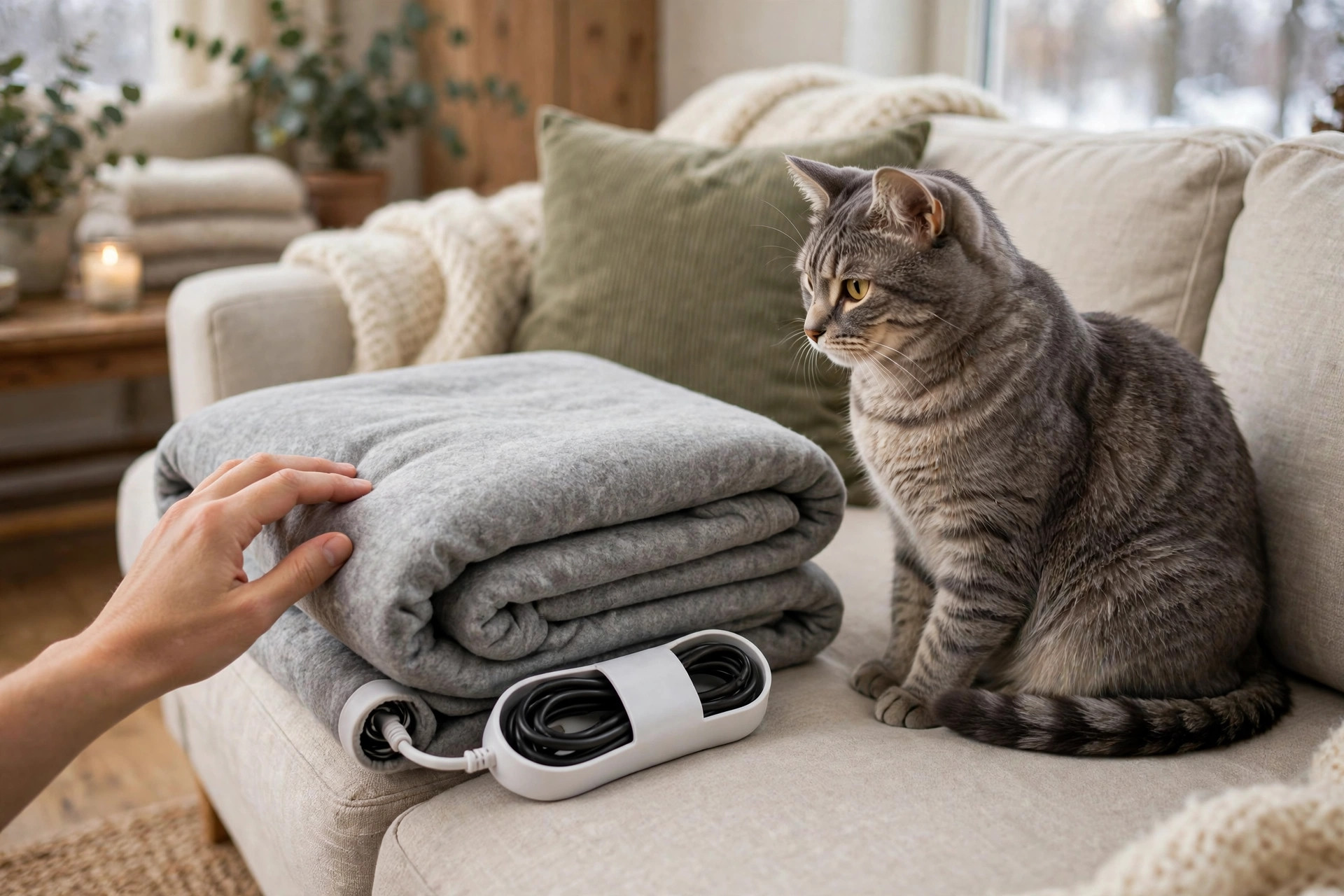
Curious puppies, teething pets, and bored cats treat exposed wires like toys. Once the insulation is bitten through, live current can cause third-degree electrical burns to the soft tissues of the mouth, and in severe cases fluid can build up in the lungs hours later — a condition called pulmonary edema. A chewed cord can also short-circuit and start a fire.
Never assume a chew-resistant cord is chew-proof. Keep every cord behind furniture or inside a rigid cord cover, unplug heated products when you leave the room, and inspect cords, controllers, and seams before each use. If a cord is frayed, scorched, buzzing, or sparking, unplug it if it is safe to do so and keep your pet away. Any pet that has bitten a live cord deserves a vet call the same day, even if it looks fine — lung fluid can appear hours after the shock.
3. Space Heaters and Fan Heaters Too Close
Dogs and cats love to press themselves against radiators and space heaters, and that is exactly the problem. A pet that sleeps touching a heater grille can pick up a contact burn on its belly or inner thighs, where the fur is thinnest. Fan heaters aimed at close range dry out eyes and airways: vets report cracked, irritated corneas and worsened respiratory sensitivity in pets that nap in the direct blast of a heater all day.
Keep space heaters at least 3 feet from pet beds, blankets, and curtains, and never leave one running unattended in a room with a pet. Choose models with tip-over protection, and make sure gas or kerosene heaters are properly vented — faulty heaters can leak carbon monoxide, which is dangerous to pets and people alike.
4. Thick Sweaters and Trapped Heat
It sounds backwards, but too much warmth can injure a pet too. A thick sweater worn all day, every day, traps heat against the skin and can cause heat rash and irritated, matted fur — especially in short-haired and senior dogs. Sweaters are useful for short outdoor trips in real cold, not as all-day indoor clothing. Take them off indoors, check the skin underneath regularly, and let the coat breathe.
Which Pets Are Most at Risk?
Any pet can be burned by a heat source, but some are far more vulnerable than others. If your pet is in one of these groups, skip powered heat entirely or use it only with your vet’s approval and direct supervision:
| At-risk pet | Why the risk is higher |
|---|---|
| Senior dogs and cats | Sleep more deeply, move more slowly, and may have arthritis that stops them getting up |
| Puppies and kittens | Thin skin, poor temperature regulation, and a habit of chewing cords |
| Pets with limited mobility | Cannot move off the heat at all — the single most dangerous situation |
| Pets recovering from surgery or sedation | Reduced sensation and grogginess mean they may not feel or escape the heat |
| Diabetic pets | Nerve damage can reduce their ability to feel heat on the skin |
| Flat-faced breeds | Overheat faster and cope poorly with warm, dry air from heaters |
| Pets with skin disease or wounds | Damaged skin burns more easily and heals more slowly |
The rule is simple: if your pet cannot get up and walk away from the heat on its own, do not use a heated bed or pad for it at all. Warm the room and thicken the bedding instead.
Safe Heating Rules: The 7-Point Checklist
If you do use a pet heating product, these seven rules are the difference between a cozy bed and a vet visit:
- Pet-specific only. Use products made for pets, thermostatically controlled and rated for continuous use. Never use a human heating pad or electric blanket as your pet’s bed.
- Lowest setting, always. Start low and stay low. A safe surface is barely warm to the back of your hand held against it for a full minute.
- Half the bed, never the whole bed. The heated pad should cover no more than 50–70% of the sleeping area, leaving a cool zone your pet can move to. If a pad fills a crate floor completely, the pet is trapped on the heat.
- A barrier between pad and skin. Always keep a thick towel or the pad’s own cover between the heating surface and your pet. Never place a pad directly against bare skin.
- Supervised use only. Never leave a powered pad running overnight or while nobody is home. Automatic shut-off is a backup, not permission to walk away.
- Short sessions for heat therapy. For therapeutic heat, vets typically recommend 10–15 minutes at a time, with the skin checked afterwards — and only under veterinary direction.
- Check before every use. Inspect the cord, controller, seams, and surface for damage, and check your pet’s skin under the fur for redness or tenderness at least once a day during the cold season.
Also Read: Pet Emergency First Aid: Vet Guide (2026)
Safer Ways to Keep Your Pet Warm
Most pets do not need powered heat at all. These options keep your dog or cat comfortable with no burn risk:
- Self-warming pads. These use a reflective layer to bounce your pet’s own body heat back to them. They cannot generate heat beyond about 102°F, so overheating is nearly impossible — and there is no cord to chew.
- Thick, insulated bedding. A deep bed with a fleece blanket, placed off cold tiles and away from drafts, is enough for most healthy adult pets indoors.
- A warmer room. Raising the room temperature a few degrees helps every pet in the house at once, including the ones that cannot move away from a pad.
- Warm water, not a hot bottle. A microwavable heat pack can overheat and hold that heat for a long time. If your vet recommends warmth for stiff joints, use a warm compress for 10–15 minutes while you stay with your pet.
- Winter coats for outdoor trips only. A well-fitted coat for short-haired, small, or senior dogs on cold walks — removed as soon as you are back inside.
Also Read: Fall Pet Wellness Checkup Guide (2026)
Signs Your Pet Has Been Burned or Overheated
Burns and overheating do not always announce themselves. Watch for these warning signs during the cold season, and act the same day if you see them:
- Red, painful, or tender patches of skin, especially on the belly or inner thighs
- Blistering, hair loss, or skin that smells scorched
- A sudden reluctance to lie down, or flinching when touched in one spot
- Persistent panting, drooling, restlessness, or repeatedly trying to leave the warm area
- Weakness, wobbliness, confusion, or collapse
- Burns around the mouth, drooling, or breathing changes after chewing a cord
What to do: move your pet away from the heat source and switch off any electrical device before touching the animal. Flush a skin burn with cool (not cold) running water for several minutes. Do not apply ice, ointments, creams, or home remedies — ice worsens tissue damage and ointments trap heat. Then call your veterinarian promptly. Minor-looking burns can deepen over hours, and electrical burns around the mouth can signal hidden lung injury that only a vet can check.
Frequently Asked Questions
Can a heating pad burn my dog?
Yes. Human heating pads reach 130–160°F and can burn a dog in minutes, and even a mildly warm surface around 44–50°C can cause deep burns after 30 minutes of contact. Use only a pet-specific pad on the lowest setting, covering half the bed, and never leave it running unsupervised.
Are electric blankets safe for cats?
Human electric blankets are not recommended for cats. Cats sleep for long periods, curl into warm spots, and chew cords — all of which raise the risk of burns, electric shock, and fire. A self-warming cat blanket or a thick insulated bed is a safer everyday option.
Can my dog sleep on a heating pad overnight?
No. Never leave a heating pad on overnight or while nobody is home. Long, unsupervised exposure is exactly how low-temperature burns happen, because a sleeping dog may not wake or move away before the skin is injured.
What temperature is safe for a pet heating pad?
Aim for close to your pet’s normal body temperature, about 38–40°C (100–102°F), on the lowest setting, with a towel or cover between the pad and your pet. If a surface feels more than barely warm to the back of your hand held against it for a full minute, it is too hot for a pet that cannot move away.
Can I use a human heating pad on my dog for arthritis?
Only if your veterinarian specifically tells you to, and only for short, supervised sessions of 10–15 minutes with a towel barrier. Heat is not a treatment for arthritis on its own, and a human pad is the wrong tool for it. Ask your vet about pet-specific options and a proper pain plan instead.
What should I do if my cat chewed an electric blanket cord?
Unplug the blanket if it is safe to do so, keep your cat away from the cord, and call your vet the same day — even if your cat looks fine. Electrical burns around the mouth can cause fluid to build up in the lungs hours later, and that needs veterinary care.
Final Thoughts
So, can a heating pad burn my dog? Yes — and the burn you need to worry about most is not the one that feels hot. It is the slow, silent low-temperature burn from a mildly warm pad, blanket, or heater that a sleeping pet cannot escape. The fix is simple: use only pet-specific heated products, keep them on the lowest setting, cover no more than half the bed, keep cords out of reach, and never run powered heat unsupervised or overnight.
Warmth should comfort your pet, not endanger it. Set up the bed the safe way now, check the skin under the fur once a day, and you can enjoy the cozy months knowing your dog or cat is warm for the right reasons. And if you ever spot redness, blistering, or a pet that suddenly will not lie down, call your veterinarian right away — fast action is what turns a scare into a story with a happy ending.
By Dr. Ayaz Ali