
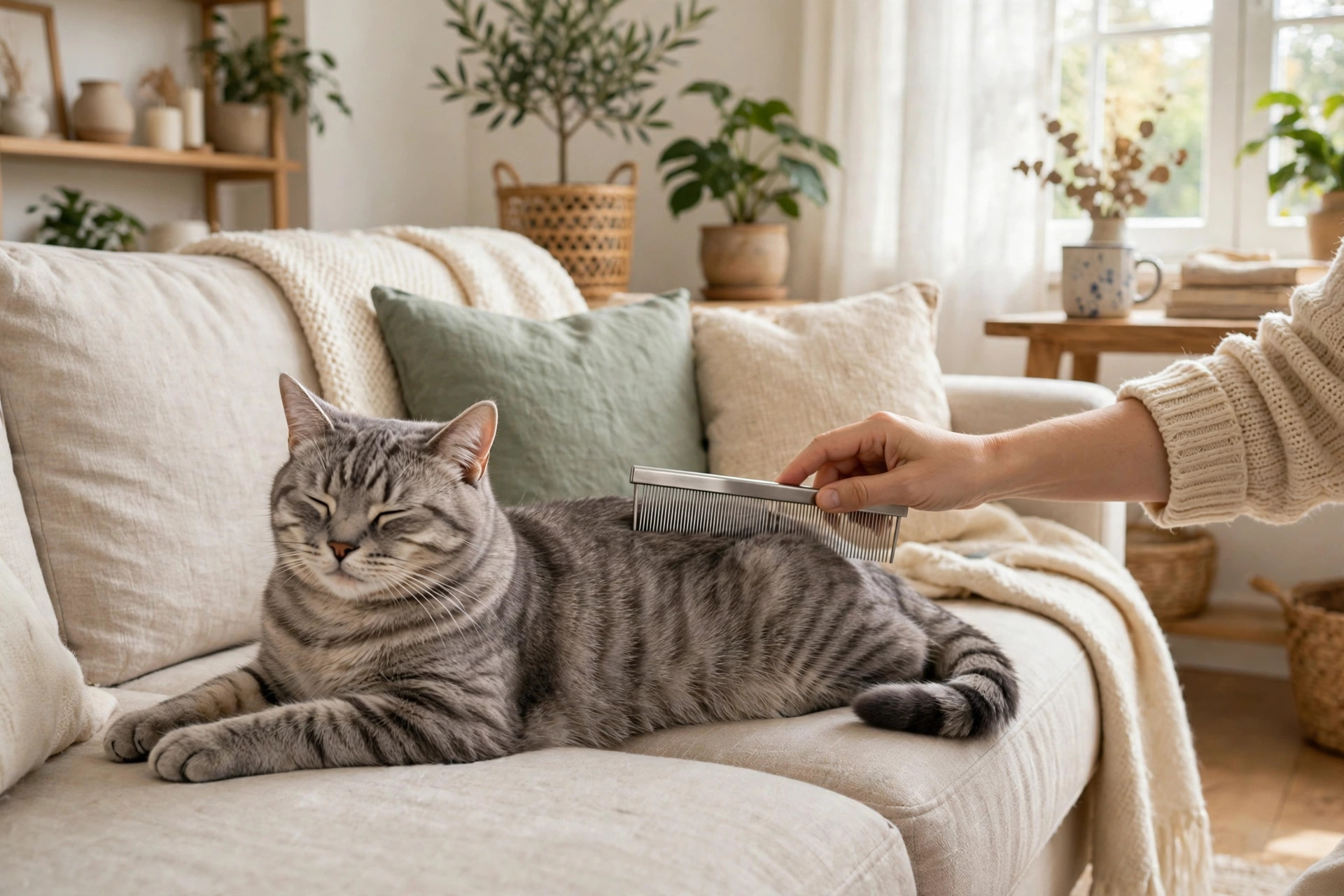
If your sofa, your clothes, and your black jeans are all covered in cat hair, the problem is probably not your cat — it is your brush. The best cat comb for your cat depends on her coat type, and the wrong tool can pull, scratch, or simply do nothing at all. A steel comb that glides through a short coat will snag on a long one, and a deshedding tool used every day can damage the very fur it is meant to save.
In this 2026 buying guide, we compare the five tools that actually work — steel combs, slicker brushes, deshedding tools, rubber brushes, and bristle brushes — explain which one suits each coat type, and show you how to brush your cat safely, even if she hates being groomed.
Table of Contents
- Why Brushing Your Cat Matters
- The 5 Cat Grooming Tools Compared
- Best Cat Comb by Coat Type
- How to Brush Your Cat (Step by Step)
- Deshedding Tool Safety: The 1–2 Times a Week Rule
- How Often Should You Brush Your Cat?
- 7 Brushing Mistakes to Avoid
- When Brushing Means a Vet Visit
- Frequently Asked Questions
Why Brushing Your Cat Matters
Cats groom themselves, so it is easy to assume they do not need your help. They do — especially as they age, gain weight, or grow a long coat. Regular brushing removes loose fur before it ends up on your furniture or in your cat’s stomach as a hairball, spreads the skin’s natural oils through the coat, and lets you spot lumps, sores, fleas, and mats early.
Brushing is also a health check you can do at home. A cat that suddenly stops grooming, or whose coat turns dull and flaky, may be telling you something is wrong. Overweight cats often cannot reach their own back and tail base, and older cats with stiff joints groom less — both end up with matted, flaky coats that only a comb can fix.
Also Read: Cat Dandruff: Causes, Treatment & Care (2026)
The 5 Cat Grooming Tools Compared
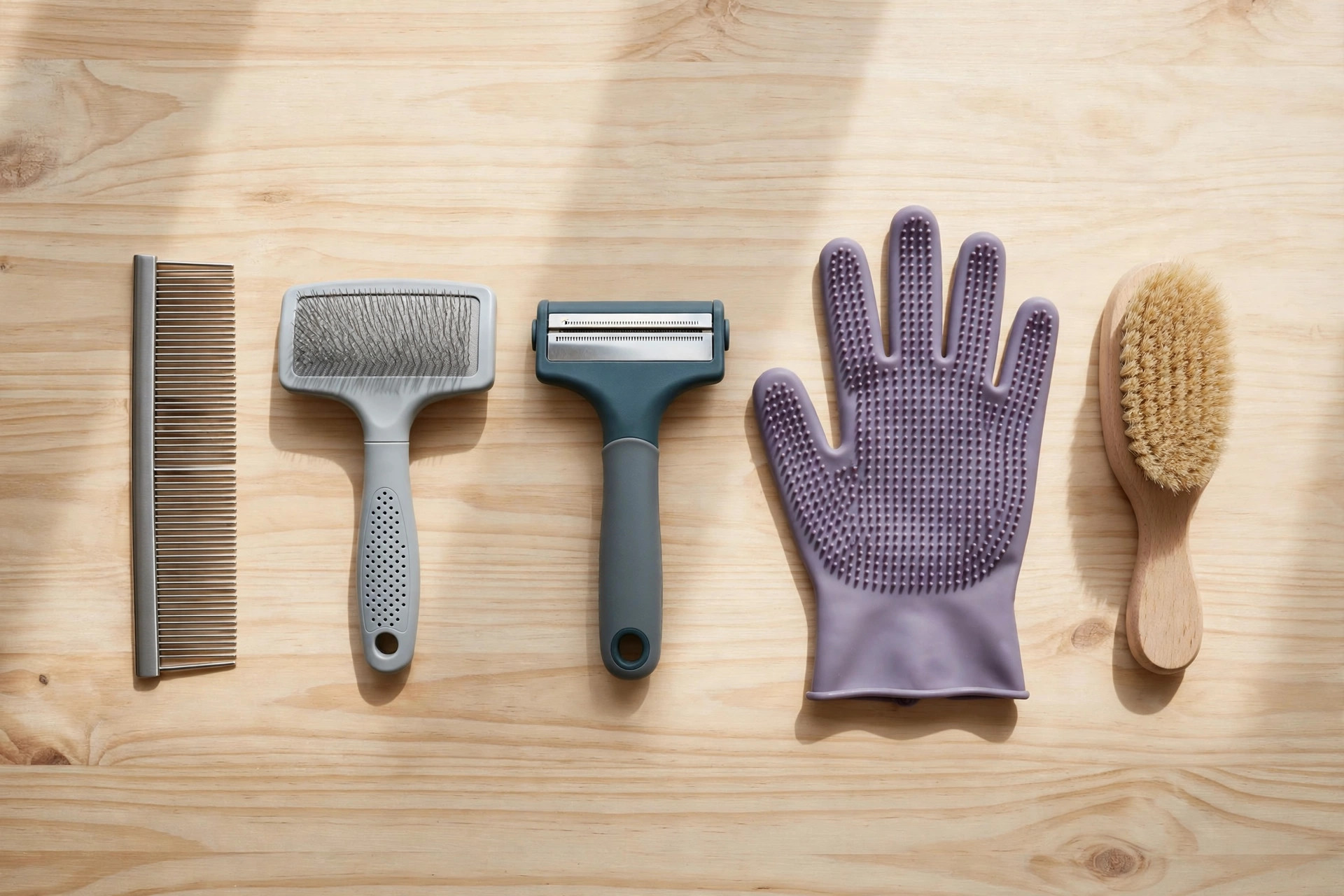
Every cat comb and brush does a different job. Here is how the five main types compare:
| Tool | Best For | What It Does | Watch Out For |
|---|---|---|---|
| Stainless steel comb | All coat types | Reaches the skin, finds mats and tangles early, checks for flea dirt | Forcing it through a tangle pulls skin — work tangles apart with fingers first |
| Slicker brush | Daily topcoat care | Fine bent wires lift loose fur and surface tangles from the topcoat | Pressing too hard scratches thin skin; it cannot reach packed undercoat |
| Deshedding tool | Heavy shedders | Fine metal edge pulls loose undercoat out without cutting the topcoat | Overuse causes brush burn and bald spots — 1–2 times a week maximum |
| Rubber brush / grooming glove | Nervous or short-haired cats | Soft nubs massage the coat and collect loose fur like a magnet | Too gentle for mats or thick undercoat |
| Bristle brush | Finishing and shine | Smooths the topcoat and spreads natural oils for a glossy finish | Removes almost no loose undercoat on its own |
1. Stainless Steel Comb — The One Tool Every Cat Owner Needs
If you buy only one grooming tool, buy a steel comb. Groomers call it the “mat detector”: it is the only tool that reaches all the way to the skin and reports back honestly. If the comb glides through, the coat is fine. If it snags, a tangle is forming — and you have caught it before it becomes a mat. Choose one with fine teeth on one half and coarse teeth on the other, so a single tool covers detail work and longer fur.
2. Slicker Brush — Best for Daily Use
A slicker brush has a pad of fine, bent wire bristles that gather loose fur from the topcoat. It is the best daily brush for most cats, and the self-cleaning versions (with a button that pushes the collected fur off the pad) make the job far less messy. Use light pressure and short strokes — the wires should skim the coat, not scrape the skin.
3. Deshedding Tool — Powerful, So Use It Sparingly
A deshedding tool, such as the FURminator for cats, has a stainless steel edge that reaches deep into the undercoat and pulls out loose fur, cutting shedding dramatically during spring and autumn coat changes. But it is the most aggressive tool in the kit: used too often or pressed too hard, it can thin the guard hairs, irritate the skin, and even create the matting it is meant to prevent. Never use it on a matted coat, and never use it daily.
4. Rubber Brush and Grooming Glove — Best for Cats That Hate Brushing
For a cat that runs at the sight of a brush, a rubber brush or grooming glove is the way in. The soft nubs feel like petting, so most cats tolerate — even enjoy — it. It will not fix mats or thin a heavy undercoat, but it removes a surprising amount of loose surface fur, and it is the best first tool for kittens and nervous cats.
5. Bristle Brush — The Finishing Touch
A natural-bristle brush removes little fur, but it smooths the topcoat and spreads skin oils, giving the coat its shine. Use it as the last step after combing, especially on short-haired cats.
Best Cat Comb by Coat Type
The best cat comb is the one that matches your cat’s coat. Use this guide to pick your kit:
- Short-haired cats: A rubber brush or grooming glove for daily use, plus a steel comb once a week to check for tangles and flea dirt. A deshedding tool 1–2 times a week during heavy shedding seasons is enough.
- Medium-haired cats: A steel comb twice a week and a slicker brush for daily topcoat care. Add a deshedding tool in spring and autumn when the coat blows.
- Long-haired cats (Persian, Maine Coon, Ragdoll, Norwegian Forest Cat): A steel comb every day — it is the only tool that reaches the skin through a long coat — plus an undercoat rake for the packed layer underneath and a slicker brush to finish. A deshedding tool can help, but only after the comb glides through freely.
- Heavy shedders and double-coated cats: A deshedding tool 1–2 times a week, a slicker brush between sessions, and a steel comb to check the friction zones — armpits, behind the ears, the belly, and the base of the tail — where mats always start.
- Senior or arthritic cats: A soft rubber brush or a slicker brush with gentle pressure. Senior cats groom less and their skin is thinner, so skip the deshedding tool unless your vet advises it.
Also Read: Senior Cat Checkups: 7 Vet Screenings for Cats Over 7 (2026)
How to Brush Your Cat (Step by Step)
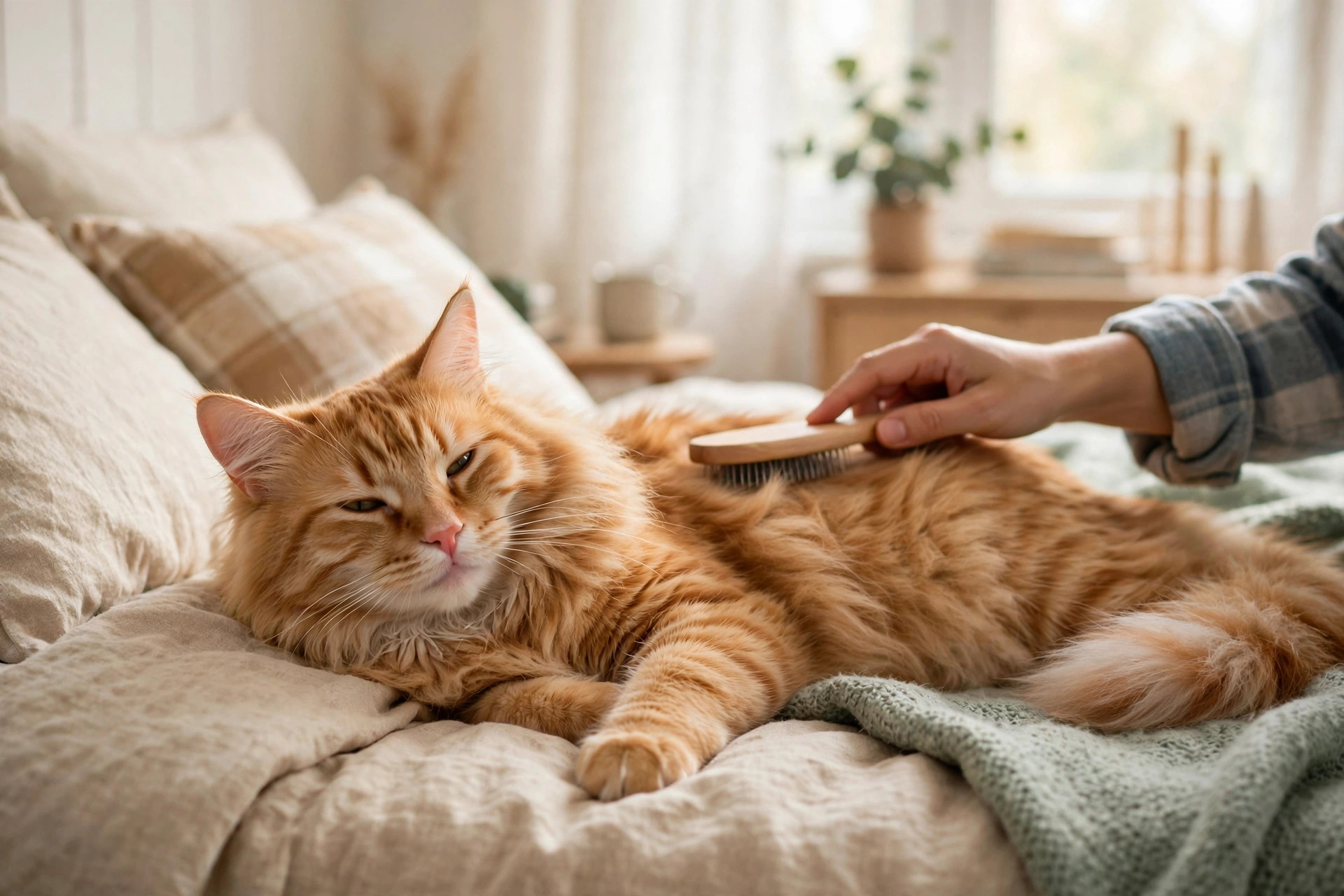
Technique matters more than the tool. Veterinary sources including PetMD recommend the same calm, reward-based approach for every cat:
- Pick a calm moment. Brush when your cat is relaxed — after a meal or a nap — not when she is wound up and ready to play.
- Let her sniff the brush first. Put the tool down, let her investigate it, and stroke her with your hand before the first brushstroke.
- Start where she likes being touched. Most cats enjoy the head, neck, and shoulders. Save the belly, tail, and back legs for later — many cats dislike being brushed there.
- Brush in the direction the fur grows. Use slow, gentle strokes with light pressure. If the bristles are bending, you are pressing too hard.
- Comb before you deshed. Run the steel comb through first. If it snags, work the tangle apart with your fingertips — never drag a comb or deshedding tool through a knot.
- Keep sessions short. Two to five minutes is plenty at first. End with a treat while she is still happy, and build up slowly over days.
- Stop when she asks you to stop. A swishing tail, flattened ears, or skin rippling means the session is over. Forcing it teaches her that brushing is something to fear.
For long-haired cats, work in small sections and always finish by running the steel comb through each section — if the comb passes cleanly to the skin, the section is done.
Deshedding Tool Safety: The 1–2 Times a Week Rule
Deshedding tools are the most misunderstood item in the grooming kit. Used correctly, they remove a remarkable amount of loose undercoat. Used too often, they damage the coat and irritate the skin. Follow these rules:
- Maximum 1–2 times per week — even during peak shedding season. Daily deshedding is never better.
- One pass per area. Do not go over the same spot repeatedly; the edge cuts as well as combs.
- Light pressure only. Let the tool do the work. Pressing harder does not remove more fur — it removes skin.
- Never on mats, wet fur, wounds, or irritated skin. A deshedding tool cannot untangle a mat, and dragging it through one will hurt. Detangle with a comb and your fingers first, or see a groomer.
- Pick the right size. Deshedding tools come in short-hair and long-hair versions — using the wrong one is a common cause of skin irritation.
How Often Should You Brush Your Cat?
| Coat Type | Steel Comb | Slicker / Rubber Brush | Deshedding Tool |
|---|---|---|---|
| Short hair | Once a week | 2–3 times a week | 1–2 times a week in shedding season |
| Medium hair | 2–3 times a week | Every other day | 1–2 times a week in shedding season |
| Long hair | Daily | Daily | 1–2 times a week, only after combing |
| Senior cats | 2–3 times a week, gently | Daily, soft pressure | Only if your vet advises it |
Shedding peaks in spring and autumn, when cats blow their coats. During those weeks, add one extra session rather than pressing harder or deshedding daily — more pressure is never the answer.
7 Brushing Mistakes to Avoid
- Starting with a deshedding tool. Always comb first. A deshedding tool on a tangled coat causes pain and matting.
- Brushing against the fur. It pulls, hurts, and frightens the cat. Always brush with the lie of the coat.
- Using a dog brush on a cat. Dog brushes are stiffer and larger, and cat skin is far thinner and easier to injure.
- Cutting out mats with scissors. Cat skin is paper-thin and folds under mats — it is frighteningly easy to cut. Leave mat removal to a groomer or vet.
- Brushing a wet cat. Wet fur tangles more easily, and deshedding tools should never be used on a wet coat.
- Ignoring the friction zones. Mats start in the armpits, behind the ears, under the collar, on the belly, and at the base of the tail. Check these spots every session.
- Skipping brushing in winter. Indoor heating dries the skin and coat, and cats shed year-round indoors. Winter is when flakes and tangles get worse, not better.
When Brushing Means a Vet Visit
Brushing is a great early-warning system. Book a vet visit if you notice bald patches, red or broken skin, scabs, sores, or flaky patches that do not improve after a few weeks of regular brushing. A sudden change — a cat that used to groom happily and now will not let you near her coat, or a coat that turns dull and greasy — can be the first sign of pain, dental disease, kidney trouble, or thyroid problems. Mats that are tight against the skin, or a cat that cries when you touch a spot, need a professional groomer or vet, not a stronger brush.
Also Read: First-Time Cat Owner Checklist: 12 Essentials (2026)
Frequently Asked Questions
What is the best cat comb for long-haired cats?
A stainless steel comb with fine and coarse teeth is the best cat comb for long-haired cats. It is the only tool that reaches the skin through a long coat and finds mats before they tighten. Pair it with an undercoat rake and a slicker brush for daily care.
Are deshedding tools safe for cats?
Yes, when used correctly — at most 1–2 times a week, with light pressure, on a dry, tangle-free coat. Overuse can cause brush burn, bald spots, and skin irritation. Never use a deshedding tool on mats, wet fur, or irritated skin.
How often should I brush my cat?
Short-haired cats need brushing 2–3 times a week; medium-haired cats every other day; long-haired cats daily. Deshedding tools are limited to 1–2 times a week in every case.
What is the best brush for a cat that hates being brushed?
A rubber brush or grooming glove is the best choice for cats that hate brushing, because it feels like petting. Start with very short sessions, offer treats, and only move to a comb or slicker brush once your cat is comfortable.
Can I use a FURminator on my cat every day?
No. The FURminator and other deshedding tools should be used at most 1–2 times a week. Daily use can thin the guard hairs, irritate the skin, and cause bald spots.
Do cats need to be brushed in winter?
Yes — arguably more so. Indoor heating dries the skin and coat, cats shed year-round indoors, and long-haired cats mat faster in winter when they move less. Keep the regular routine going through the cold months.
Final Thoughts
So, what is the best cat comb? For most cats, it is a simple stainless steel comb — cheap, gentle, and the only tool that tells you the truth about what is happening under the fur. Add a slicker brush for daily care and a deshedding tool for shedding season, and you have everything a cat’s coat needs.
The real secret is not the tool, though — it is the routine. A few calm minutes, a few times a week, keeps the coat glossy, the hairballs down, and the furniture fur-free. Start slow, let your cat set the pace, and if the coat ever changes suddenly, let your vet take a look.
By Dr. Ayaz Ali