

It happens in seconds: a child drops a chocolate bar, a bag of Halloween candy slides off the counter, or your dog counter-surfs a baking tray. Suddenly you are asking the question every dog owner dreads: what to do if your dog eats chocolate?
Stay calm, but act fast. Chocolate is toxic to dogs because it contains theobromine and caffeine, two stimulants that dogs break down far more slowly than people do. A small amount may cause only stomach upset, while a larger amount — especially dark or baking chocolate eaten by a small dog — can become a genuine emergency. What you do in the first hour matters more than anything else.
In this guide, we walk through the exact first steps, how dangerous each type of chocolate is, the symptoms to watch for, what treatment at the vet looks like, and how to make sure it never happens again.
By Dr. Ayaz Ali
Table of Contents
- First Steps: What to Do in the First Hour
- Why Chocolate Is Toxic to Dogs
- How Much Chocolate Is Dangerous?
- Symptoms of Chocolate Poisoning in Dogs
- What NOT to Do After Your Dog Eats Chocolate
- What Happens at the Vet?
- Special Cases: Puppies, Small Dogs, and Sugar-Free Chocolate
- How to Prevent Chocolate Poisoning
- Frequently Asked Questions
First Steps: What to Do in the First Hour
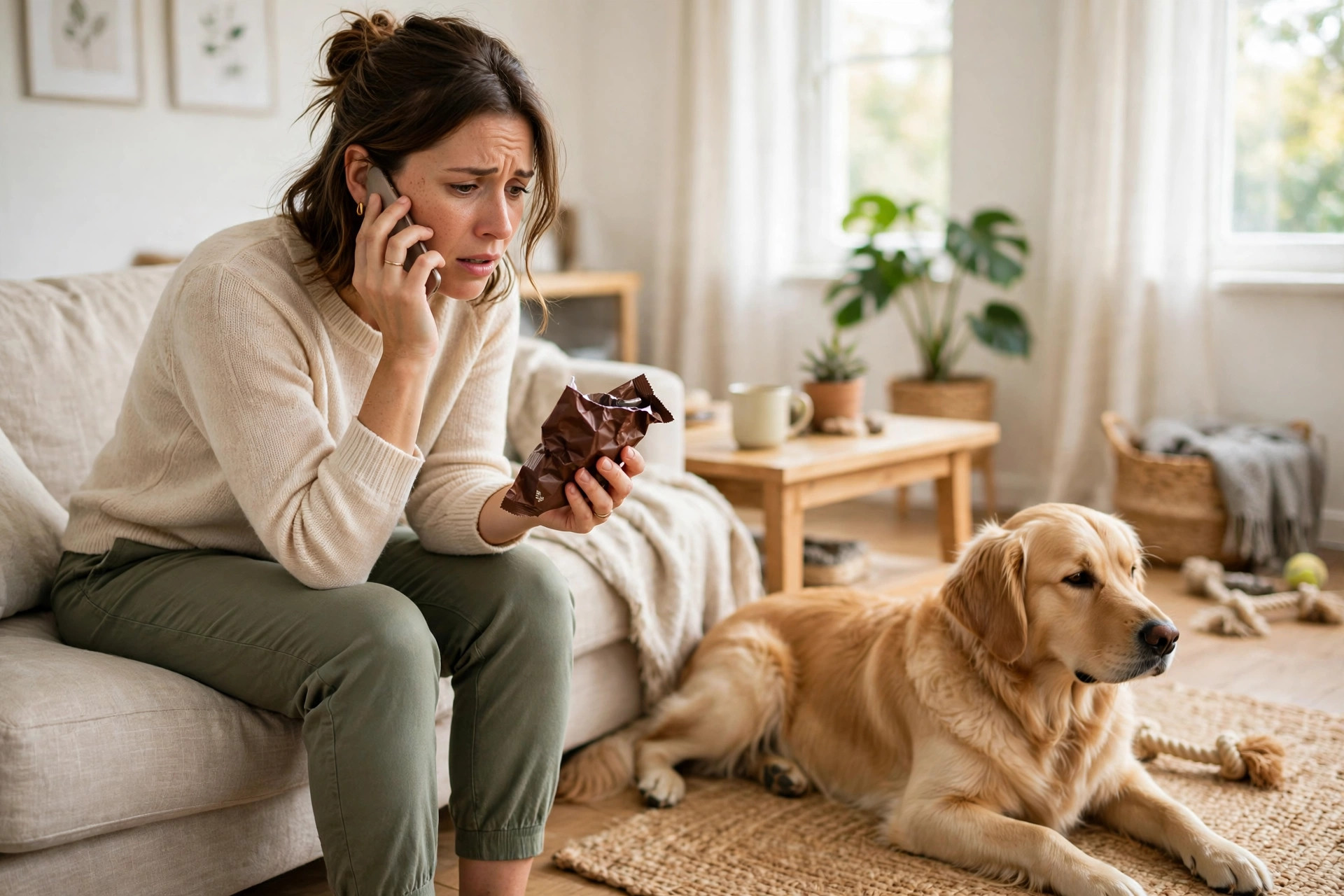
Speed matters because the sooner a vet can act, the more chocolate can be kept from being absorbed. Follow these steps in order:
- Stay calm and secure your dog. Move any remaining chocolate out of reach so your dog cannot eat more, and keep your dog in one room where you can watch them.
- Save the evidence. Keep the wrapper, box, or recipe. The type of chocolate and the amount eaten are the two facts your vet needs most to judge the risk.
- Work out what was eaten. Note the type of chocolate (baking, dark, milk, or white), roughly how much, and when it happened. Weigh your dog if you can, or use their most recent vet-record weight.
- Call for help immediately. Phone your vet, the nearest emergency clinic, or a poison hotline — the ASPCA Animal Poison Control Center at (888) 426-4435 or Pet Poison Helpline at (855) 764-7661. Do not wait to see if symptoms appear; by the time they do, more theobromine has already been absorbed.
- Follow their instructions exactly. They may tell you to come in straight away, to monitor at home for a very small exposure, or to bring your dog in for treatment. If they advise inducing vomiting, they will explain how and when — only do this on professional advice.
Also Read: Pet Emergency First Aid: Vet Guide (2026)
Why Chocolate Is Toxic to Dogs
Chocolate is made from cacao, which contains theobromine, a compound closely related to caffeine. People process theobromine quickly, but dogs process it very slowly, so it builds up in their system and overstimulates the heart, nervous system, and gut. Chocolate also contains caffeine itself, which adds to the same stimulating effect.
That slow breakdown is why timing is so important. Veterinary references including Cornell University College of Veterinary Medicine note that signs of chocolate toxicity usually appear within 2 to 12 hours of eating it and can last 12 to 36 hours, sometimes longer in severe cases. Theobromine also has a long half-life in dogs — roughly 17 to 18 hours — which is why vets often monitor affected dogs for a full day or more.
There is no home antidote for theobromine. Treatment works by limiting how much is absorbed and supporting the heart and nervous system while the body clears it.
How Much Chocolate Is Dangerous?
There is no single safe amount, because risk depends on three things together: the type of chocolate, the amount eaten, and your dog’s size. A large dog that eats one small milk-chocolate square is in a very different position from a small dog that eats a whole dark-chocolate bar.
| Chocolate Type | Theobromine Level | Risk |
|---|---|---|
| Cocoa powder and unsweetened baking chocolate | Highest | Most dangerous per gram — even a small amount can be serious |
| Dark chocolate | High | Dangerous, especially for small dogs |
| Milk chocolate | Moderate | Lower per gram, but a large amount is still toxic |
| White chocolate | Very low | Rarely causes theobromine poisoning, but fat and sugar can still cause stomach upset or pancreatitis |
As a rough guide, unsweetened baking chocolate contains about ten times the theobromine of milk chocolate, and dark chocolate sits well above milk chocolate too. That is why a few squares of baking chocolate used for a cake can be far more serious than a whole milk-chocolate bar. Never try to calculate the dose yourself from an online calculator alone — give your vet the type, amount, and your dog’s weight, and let them judge the risk.
Symptoms of Chocolate Poisoning in Dogs
Symptoms depend on the dose, but they usually follow a pattern: stomach upset first, then restlessness and a racing heart, then — in serious cases — tremors and seizures. Watch for:
- Vomiting and diarrhea
- Increased thirst and urination
- Restlessness, pacing, panting, and hyperactivity
- A fast or irregular heartbeat
- Muscle tremors or twitching
- Incoordination, collapse, or seizures
Mild cases may show only vomiting or diarrhea a few hours after eating chocolate. Serious cases can progress to seizures, heart rhythm problems, and collapse. Any tremor, seizure, collapse, or continuous vomiting is an emergency — go to the nearest emergency vet immediately, do not phone around first. Even if your dog seems fine, keep watching for at least 24 hours, since signs can be delayed.
Also Read: Halloween Pet Safety Tips for Dogs and Cats (2026)
What NOT to Do After Your Dog Eats Chocolate
Well-meaning home remedies can make things worse. Avoid these mistakes:
- Do not induce vomiting on your own. Hydrogen peroxide, salt water, mustard, and other internet remedies can burn the stomach, cause aspiration into the lungs, or be given at the wrong time. Vomiting is only useful in the first couple of hours and only when a vet judges it safe — for example, it is dangerous if your dog is already seizuring, unconscious, or has eaten something sharp.
- Do not give milk, oil, or “soothing” foods to try to dilute the chocolate. They do not reduce theobromine absorption and fatty foods can worsen stomach upset.
- Do not wait for symptoms. Early treatment is far more effective than treatment after tremors or seizures begin.
- Do not give human medicines for vomiting, diarrhea, or heart rate unless your vet specifically directs it.
- Do not leave your dog unsupervised while you search for advice online. Call the vet first, then keep watching your dog.
What Happens at the Vet?

Your vet will start with the history — what was eaten, how much, and when — plus a physical exam and, if needed, blood work or heart monitoring. Treatment depends on timing and severity, and may include:
- Induced vomiting in the clinic, if the chocolate was eaten recently and your dog is stable enough for it.
- Activated charcoal by mouth to bind theobromine in the gut and limit further absorption. Because theobromine cycles back through the gut, vets sometimes give more than one dose.
- IV fluids to support hydration, protect the kidneys, and help flush the system.
- Heart monitoring and medication if the heart rate is fast or irregular.
- Medication for tremors or seizures in serious cases.
- Hospital monitoring for 24 hours or more in moderate to severe cases, since theobromine lingers in the body.
Dogs treated early usually recover fully. The outlook becomes more guarded when seizures, collapse, or serious heart rhythm problems are involved — which is exactly why speed matters. After discharge, expect bland meals for a day or two, plenty of fresh water, and a quiet place to rest, and call your vet if vomiting, restlessness, or lethargy returns.
Special Cases: Puppies, Small Dogs, and Sugar-Free Chocolate
Small dogs and puppies are at higher risk. The same piece of chocolate delivers a much larger dose per kilogram of body weight to a 2 kg puppy than to a 30 kg adult dog, and puppies’ systems are less able to cope. Treat any chocolate eaten by a puppy or toy breed as urgent, even if the amount looks tiny.
Sugar-free chocolate is a double danger. Many sugar-free chocolates, candies, and gums contain xylitol (also listed as birch sugar), which is extremely poisonous to dogs in its own right — even a small amount can cause a sudden, life-threatening drop in blood sugar within an hour, and larger doses can cause liver failure. If the product is sugar-free, tell your vet immediately and mention xylitol by name.
Chocolate-covered foods add other risks. Raisins and macadamia nuts, often found in chocolate-covered treats, are toxic to dogs themselves, and foil wrappers can cause choking or intestinal blockage if swallowed. Mention everything your dog ate, not just the chocolate.
Also Read: Taking Your Dog Trick-or-Treating: Guide (2026)
How to Prevent Chocolate Poisoning
- Store all chocolate — bars, baking supplies, advent calendars, gift boxes — in a closed, high cabinet or the fridge, never on a low table or open counter.
- Keep candy bowls, trick-or-treat buckets, and baking trays out of reach, especially at Halloween, Christmas, and Easter.
- Tell children and guests firmly: never share chocolate or dessert with the dog.
- Clean up wrappers straight away — dogs will lick and swallow foil and plastic.
- Do not use cocoa-shell mulch in garden beds your dog can reach.
- Keep your vet’s number, the nearest emergency clinic, and a poison hotline saved in your phone before you ever need them.
Frequently Asked Questions
My dog ate chocolate but is acting fine — do I still need to call the vet?
Yes. Symptoms can take 2 to 12 hours to appear, and early treatment is far more effective than waiting. Call your vet with the type, amount, and time eaten, and let them decide whether your dog needs to come in or can be monitored at home.
How long should I watch my dog after eating chocolate?
Watch closely for at least 24 hours, and up to 36 hours for larger or darker-chocolate exposures. Signs can be delayed, and theobromine stays in a dog’s system for a long time.
Can I make my dog vomit at home with hydrogen peroxide?
No, not on your own. Home vomiting remedies can cause aspiration, stomach burns, and other injuries, and they only help in the first couple of hours. Only induce vomiting if a veterinarian specifically instructs you to, with the exact dose and timing.
Is white chocolate safe for dogs?
White chocolate contains very little theobromine, so it rarely causes theobromine poisoning — but it is still not safe as a treat. Its fat and sugar can cause vomiting, diarrhea, or pancreatitis, especially in large amounts.
What if my dog ate sugar-free chocolate?
Treat it as an emergency and tell your vet immediately. Sugar-free products may contain xylitol, which can cause a life-threatening blood-sugar crash in dogs within an hour.
Will my dog be okay after eating chocolate?
Most dogs treated early make a full recovery. The outcome depends on the type and amount of chocolate, your dog’s size, and how quickly treatment starts — which is why calling right away gives your dog the best chance.
Final Thoughts
So, what to do if your dog eats chocolate? Stay calm, save the wrapper, note what and how much was eaten, and call your vet or a poison hotline right away — before symptoms appear. Do not try home remedies, do not wait to see if your dog seems fine, and get to an emergency vet immediately for tremors, seizures, or collapse.
Chocolate emergencies are frightening, but they are also largely preventable. A closed cabinet, a quick tidy-up after baking, and a firm no-sharing rule for guests will keep most dogs safe — and knowing these steps in advance means that if it ever happens, you will act in minutes, not hours.