
If your new puppy treats your hands like a chew toy, you are not alone — learning how to stop puppy biting is one of the first lessons every new dog owner searches for. Those needle-sharp puppy teeth hurt, and the nipping can feel endless, especially during playtime or when your puppy gets excited.
The good news is that puppy biting is almost always normal. Puppies explore the world with their mouths, and biting is how they play with their littermates and learn bite control. With a consistent plan, most puppies learn to stop biting within a few weeks.
In this guide, we will walk you through why puppies bite, how to teach bite inhibition step by step, what to do about teething, and a simple 4-week training plan you can start today.
Table of Contents
- Why Do Puppies Bite?
- What Is Bite Inhibition?
- The Ouch-and-Pause Method (Step by Step)
- Redirect Biting to Toys and Chews
- Teething Relief: Soothing Sore Puppy Gums
- The 4-Week Stop Puppy Biting Plan
- 7 Mistakes That Make Puppy Biting Worse
- When Puppy Biting Needs Professional Help
- Frequently Asked Questions
Why Do Puppies Bite?
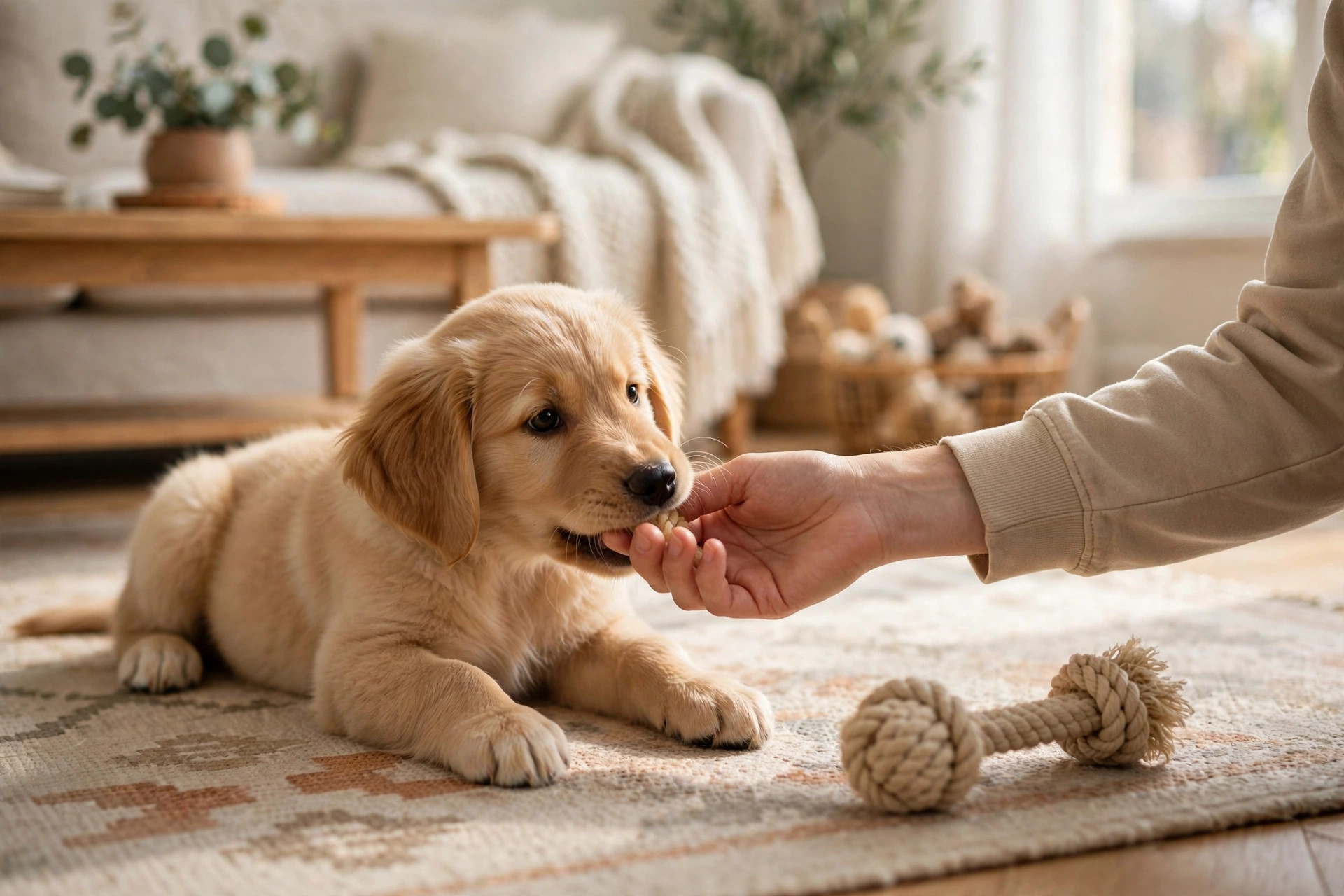
Puppy biting is not bad behavior — it is communication, exploration, and learning rolled into one. The most common reasons are:
1. Play and exploration
Puppies play with their littermates by wrestling and mouthing. When they come home, you become their new playmate — and hands, sleeves, and shoelaces are the nearest targets. Mouthing during play is the number one cause of puppy nipping.
2. Teething
Between roughly 3 and 6 months of age, puppies lose their baby teeth and grow adult teeth. Sore, itchy gums make them chew everything in sight — including you.
3. Overtiredness and overstimulation
Just like overtired toddlers, overtired puppies lose self-control. If your puppy turns into a biting machine after a long play session or late in the evening, tiredness is usually the trigger. Puppies need 18 to 20 hours of sleep a day.
4. Attention-seeking
Biting works: it reliably makes humans react, talk, and move. Even scolding is attention. If biting consistently earns a big reaction, your puppy will keep doing it.
Also Read: Puppy Socialization Checklist: First 16 Weeks (2026)
What Is Bite Inhibition?
Bite inhibition is the single most important lesson a puppy learns: how to control the force of their mouth. In the litter, puppies teach each other — when one bites too hard, the bitten puppy yelps and stops playing. The biter quickly learns that hard bites end the fun.
Your job is to continue that lesson at home. You are not trying to teach your puppy never to put their mouth on anything — you are teaching them to be gentle. A dog with good bite inhibition that mouths in fear or pain as an adult is far less likely to cause injury than a dog that never learned to moderate its bite. The American Kennel Club recommends exactly this approach: teach your puppy that biting ends play, and reward gentle mouthing.
The Ouch-and-Pause Method (Step by Step)
This is the core technique for stopping puppy biting. It works because it copies what littermates do — and it is simple enough for every family member to use the same way.
- Let out a high-pitched “ouch!” the moment teeth touch skin too hard. Keep it sharp and brief, not angry.
- Stop all play immediately. Go still, tuck your hands away, turn slightly aside, and ignore your puppy for 20 to 30 seconds. No eye contact, no talking, no petting.
- Resume calmly. When your puppy has settled, restart play at a lower energy level.
- If they bite hard again, repeat. After the third hard bite in one session, end play completely — calmly put your puppy in their crate or pen with a chew toy for a nap or quiet time.
- Reward the gentle moments. When your puppy mouths softly or licks instead of biting, praise warmly and offer a treat. You are paying for the behavior you want.
Consistency matters more than perfection. If one person allows rough mouthing while another corrects it, your puppy gets mixed messages and the biting drags on. Get the whole household using the same “ouch and pause” response.
Redirect Biting to Toys and Chews
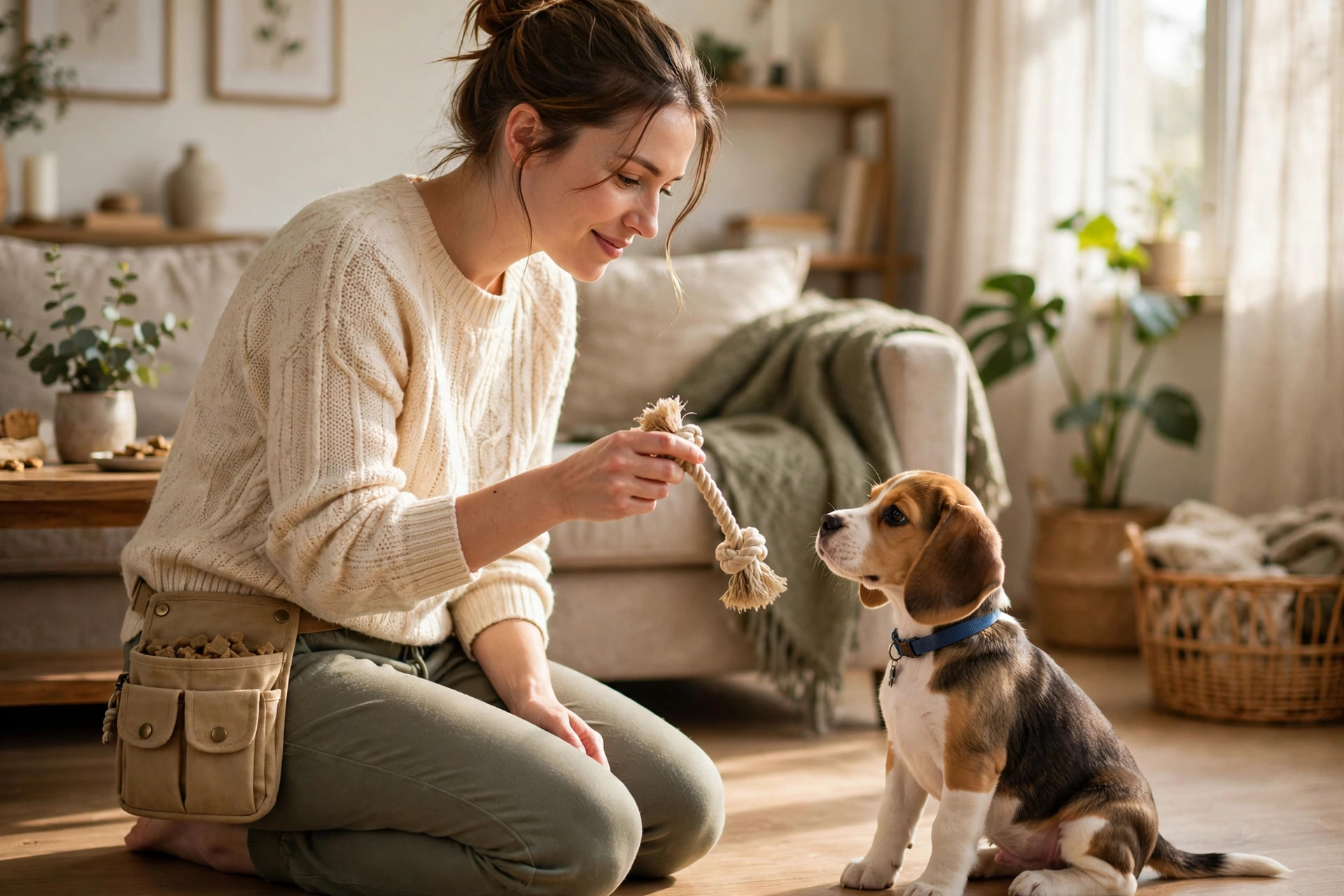
Stopping the bite is only half the lesson — your puppy also needs to learn what they can bite. Keep a toy within arm’s reach whenever you play with your puppy, so you can swap it in the moment teeth head for your hand.
- Anticipate the bite. When play gets wild, offer the toy before the teeth land. Praise your puppy the instant they take the toy instead.
- Make toys more exciting than hands. Wiggle the toy, drag it along the ground, and let your puppy “win” it. A boring toy lying on the floor cannot compete with your moving hand.
- Rotate toys. Puppies get bored fast. Keep a small stash and rotate a few each day to keep them novel.
- Use food puzzles and long-lasting chews. A stuffed Kong, a lick mat, or a snuffle mat gives a busy mouth a legal outlet and tires your puppy out mentally.
Also Read: Crate Training Your Puppy: Step-by-Step Guide (2026)
Teething Relief: Soothing Sore Puppy Gums
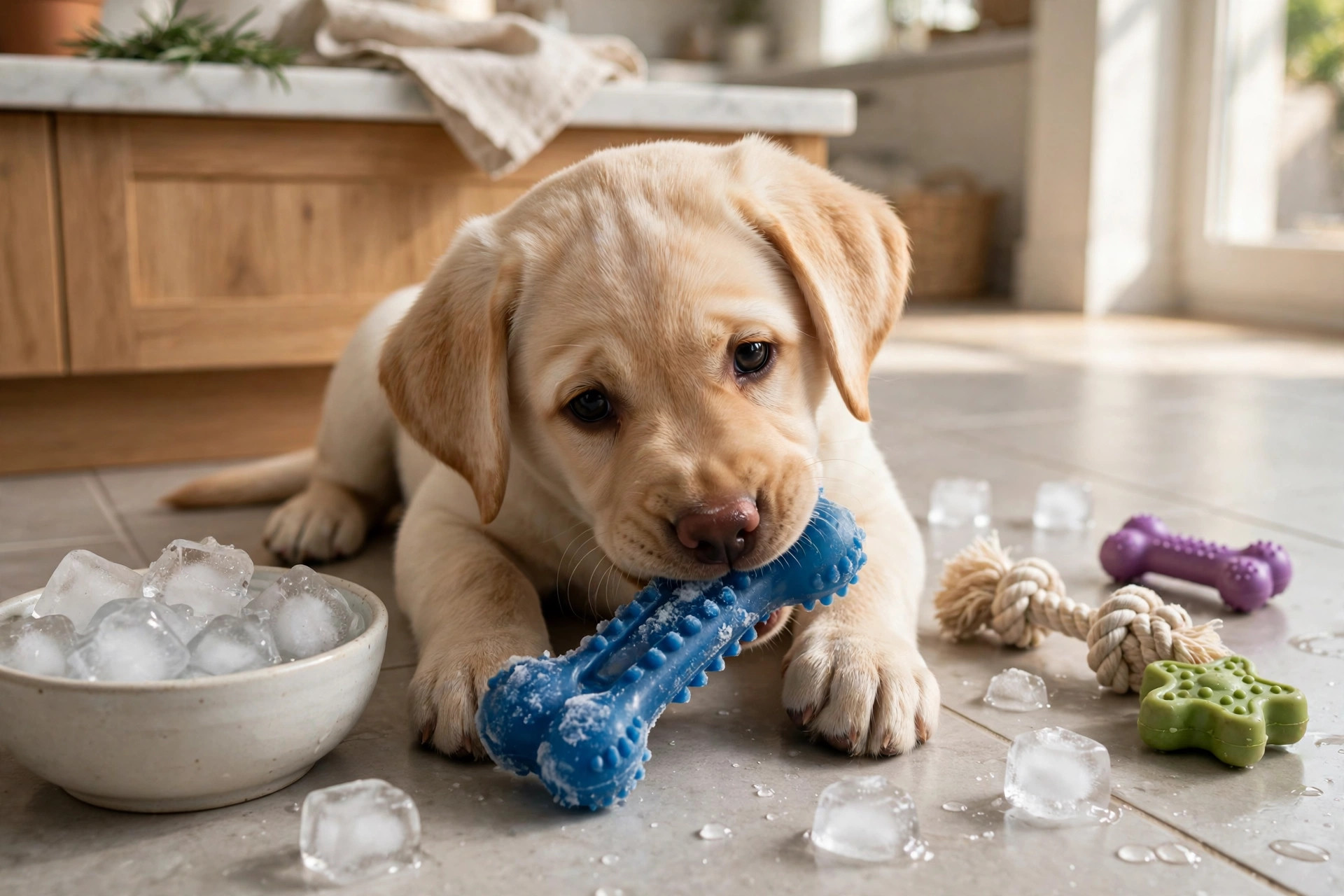
During teething, your puppy is not being naughty — their gums hurt. Giving them the right things to chew reduces biting dramatically. Safe teething options include:
- Frozen chew toys — soak a rope toy or stuff a rubber toy with wet food and freeze it overnight. The cold numbs sore gums.
- Frozen carrots or apple slices — a crunchy, cold, edible chew (always supervise and remove small pieces).
- Puppy-specific rubber toys — sized for puppy jaws, softer than adult chews.
- Wet washcloth, twisted and frozen — a cheap, effective teething toy for supervised chewing.
Avoid cooked bones, antlers, and hard nylon chews for young puppies — they can crack fragile puppy teeth. And always supervise chewing: remove any toy that starts breaking apart.
The 4-Week Stop Puppy Biting Plan
Progress is rarely linear — expect good days and bad days — but most puppies improve noticeably within 2 to 4 weeks of consistent work. Use this plan as your roadmap:
| Week | Focus | What Success Looks Like |
|---|---|---|
| Week 1 | Ouch-and-pause on every hard bite; toy always in reach | Bite force softens; puppy pauses after “ouch” |
| Week 2 | Reward all gentle mouthing; add teething chews daily | Fewer hard bites; puppy chooses toys more often |
| Week 3 | Enforce naps (18-20 hrs sleep); calm play only | Evening “witching hour” biting fades |
| Week 4 | Practice with visitors and kids; keep rules consistent | Gentle play is the default, even when excited |
Keep training sessions short — 5 to 10 minutes, several times a day. Short, successful sessions beat one long, frustrating one.
7 Mistakes That Make Puppy Biting Worse
1. Yanking your hand away
Pulling away fast turns your hand into a prey object and can tear your skin. Go still instead, then withdraw calmly.
2. Shouting, smacking, or alpha-rolling
Physical punishment frightens puppies and can turn playful mouthing into fear-based biting later. It also teaches your puppy that hands are scary — the opposite of what you want.
3. Rough wrestling games
Wrestling with your hands teaches your puppy that hands are toys. Play with toys instead, and keep your hands for petting and treats.
4. Inconsistent rules
If biting is sometimes cute and sometimes corrected, your puppy cannot learn the rule. Everyone in the household must respond the same way, every time.
5. Skipping naps
An overtired puppy is a biting puppy. Enforce regular crate naps — most biting “meltdowns” are really tiredness.
6. Scolding after the fact
Correcting a bite minutes later means nothing to a puppy. The consequence must happen within seconds of the bite.
7. Ignoring the teething need
A teething puppy with nothing legal to chew will chew you. Stock up on frozen toys and chews before the biting peaks.
Also Read: Stop Your Dog Pulling on the Leash: 7 Trainer Tips (2026)
When Puppy Biting Needs Professional Help
Normal puppy biting fades with training. Seek help from your veterinarian or a certified professional trainer (CPDT-KA) if you see any of these red flags:
- Biting that gets harder, not softer, after 4 weeks of consistent training
- Biting paired with stiff body language, hard staring, growling, or snapping that does not stop when you freeze
- Biting that breaks skin regularly or is aimed at children
- Sudden biting in a previously gentle puppy — pain, illness, or fear could be the cause
- Biting driven by guarding food, toys, or resting spots (resource guarding)
A vet check first is wise: pain from teething complications, ear infections, or injuries can all make a puppy mouthy. Once medical causes are ruled out, a qualified trainer can build a tailored plan.
Frequently Asked Questions
At what age do puppies stop biting?
Most puppies bite less by 4 to 5 months and largely stop by 6 to 7 months, once teething ends and bite inhibition is learned. Without training, though, mouthing can continue into adolescence — so do not just wait it out.
Does yelping “ouch” really work?
Yes, for most puppies — it mimics how littermates teach bite control. If your puppy gets more excited by the yelp, switch to silently freezing and withdrawing attention instead; the withdrawal is the real lesson.
Should I punish my puppy for biting?
No. Hitting, shouting, or pinning a puppy down can increase fear and make biting worse. Calmly ending play and redirecting to a toy teaches the lesson without damaging trust.
Can puppies bite through teething toys?
They can destroy them, which is why supervision matters. Choose puppy-sized rubber toys, check them daily for damage, and replace any toy that starts breaking apart.
Is puppy biting a sign of aggression?
Almost never. True aggression in young puppies is rare and looks very different: stiff posture, hard eye contact, and bites that do not stop. Normal puppy biting is loose, wiggly, and play-driven.
What if my puppy only bites children?
Children move fast, squeal, and wave their hands — all of which excite puppies. Supervise every interaction, teach kids to “be a tree” (stand still, arms crossed, look away) when nipped, and keep play sessions short and toy-based.
Final Thoughts
So, how do you stop puppy biting? Teach bite inhibition with the ouch-and-pause method, redirect every bite to a legal chew, soothe teething gums with frozen toys, enforce naps, and stay consistent for a few weeks. Most puppies go from tiny shark to gentle companion faster than owners expect.
The biting phase feels endless in the moment, but it is one of the shortest chapters of puppyhood — and the patience you show now builds a dog that is gentle with hands for life.
By Dr. Ayaz Ali