
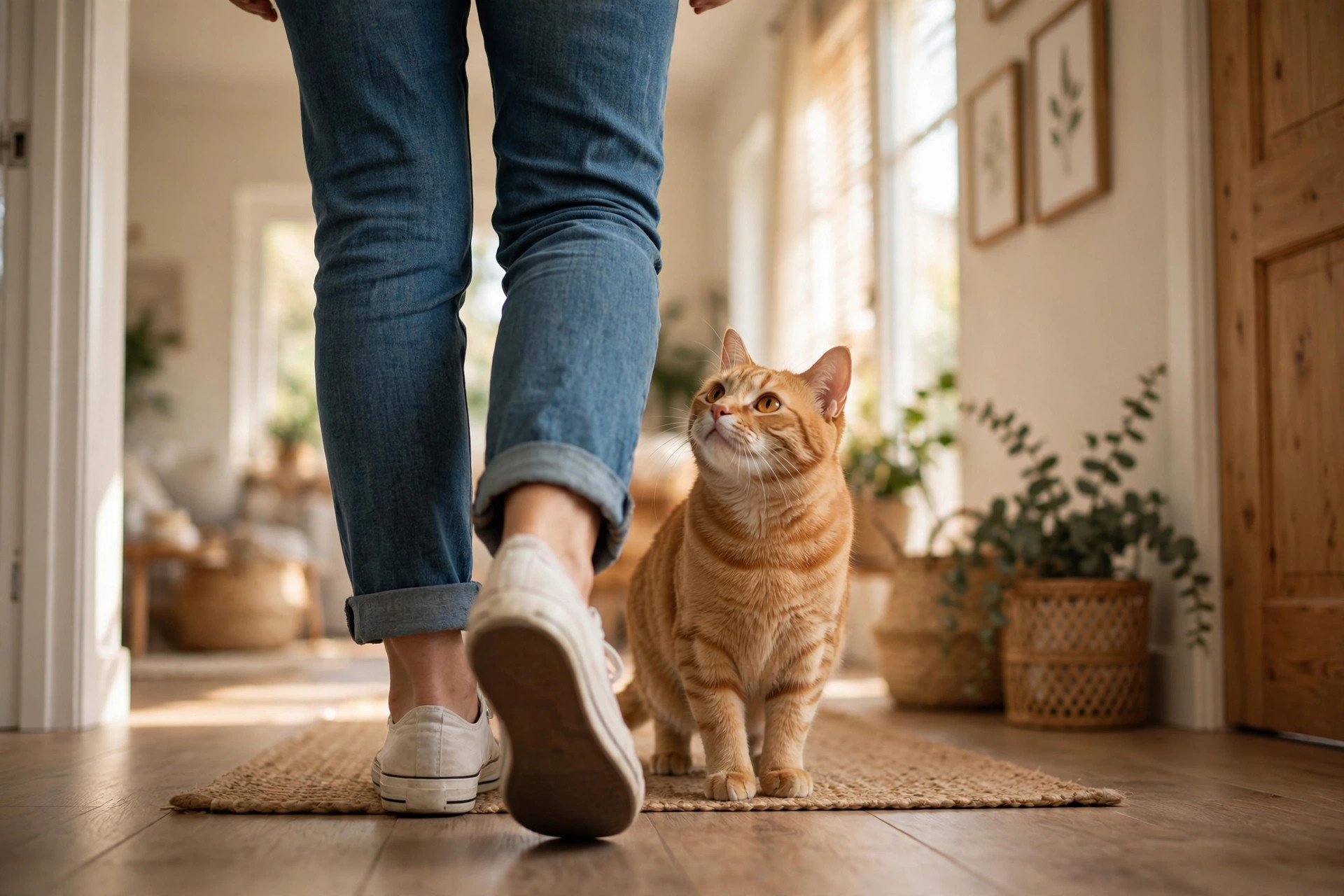
You sit down to work — and your cat appears on the keyboard. You head to the kitchen — and a small furry shadow pads along behind you. You close the bathroom door — and an audience of one gathers outside, meowing for entry. If you keep asking yourself why does my cat follow me everywhere, you are far from alone: shadowing is one of the most common — and most misunderstood — behaviors in cats.
Here is the short version: most of the time, a cat that follows you everywhere is doing it out of affection, curiosity, habit, or simple opportunism. It is normal, it is usually healthy, and it is often a compliment. But there are times when sudden or obsessive following means something else — stress, pain, or illness — and knowing the difference matters.
In this complete 2026 guide, we break down the 8 real reasons your cat follows you everywhere, why the bathroom has such a powerful draw, which breeds are the biggest “velcro cats,” how to tell affection from anxiety, and practical ways to give your cat more independence when you need a little space.
Table of Contents
- Is It Normal for Cats to Follow Their Owners?
- 8 Reasons Your Cat Follows You Everywhere
- Why Does My Cat Follow Me to the Bathroom?
- Which Cat Breeds Follow Owners the Most?
- When Following Means a Vet Visit
- How to Help a Clingy Cat Be More Independent
- Frequently Asked Questions
- Final Thoughts
Is It Normal for Cats to Follow Their Owners?
Yes — in the vast majority of cases, following behavior is completely normal. Despite the famous reputation for independence, research on feline attachment has shown that cats form genuine social bonds with their humans and often prefer proximity to their favorite person. You are the center of your cat’s world: the keeper of food, warmth, territory, and routine. It makes sense that she keeps track of you.
Context is everything, though. A cat that has always been a little shadow is simply being herself. A cat that suddenly starts following you everywhere — when she never did before — is telling you something changed. Changes in behavior are the way cats communicate, and sudden clinginess deserves a closer look.
8 Reasons Your Cat Follows You Everywhere
There is rarely just one reason. Most shadowing cats are motivated by a mix of the following — and several can be true at the same time.
1. Affection and Secure Attachment
The number-one reason is the simplest: your cat likes you. Cats that trust their humans stay close because your presence feels safe and good. Following can be your cat’s way of staying near the person she prefers most in the house — a compliment, delivered in pawsteps.
2. Curiosity
Cats are born investigators. Every door you open, every object you pick up, every room you enter is potentially interesting — and your movements are the most predictable show in the house. Many cats follow simply to see what happens next, because something interesting usually does.
3. Hunger and Learned Routine
Cats are exceptional pattern-recognizers. If you going to the kitchen reliably predicts food, your cat will follow you to the kitchen — and hover at a respectful distance in case this trip counts. This is why the following often intensifies right before regular mealtimes.
4. Boredom and Understimulation
An indoor cat with little to do will manufacture entertainment — and you are the most interactive object in the house. Younger, more active cats are especially likely to follow out of boredom, sometimes with lively energy, swatting at shoelaces or darting ahead of you. A cat with a full enrichment schedule follows much less.
5. Attention-Seeking
Sometimes the following is the request. Your cat has learned that trailing you from room to room eventually produces what she wants: a head scratch, a play session, or simply your gaze turning toward her. If you reward proximity with attention, she will repeat it — which is not a problem unless it is driving you crazy.
6. Territorial Instinct
Your cat’s territory includes you. Cats spread their scent — and yours — around the home as they move, and keeping track of the household’s central figure is part of how they monitor their domain. Following you is partly your cat making sure everything in her territory, including you, stays where it belongs.
7. Anxiety and Insecurity
A cat that feels uncertain — after a move, a new pet, a change in your work schedule, or a disruption to routine — may cling as a coping strategy. Your presence is her stabilizer. This is the kind of following that tends to come with other signs: restlessness, vocalizing, or distress when you are out of sight.
8. Illness or Pain
Cats hide discomfort well, but a cat that feels unwell may become suddenly clingy — or, notably, may follow while also showing other changes like appetite loss, hiding, litter-box changes, or lethargy. Illness-driven following is almost always a change from the cat’s normal baseline, which is why sudden-onset clinginess deserves a vet visit.
Also Read: Why Does My Cat Bite Me? Love Bites Explained (2026) — another behavior that shifts between affection and warning depending on context.
Why Does My Cat Follow Me to the Bathroom?
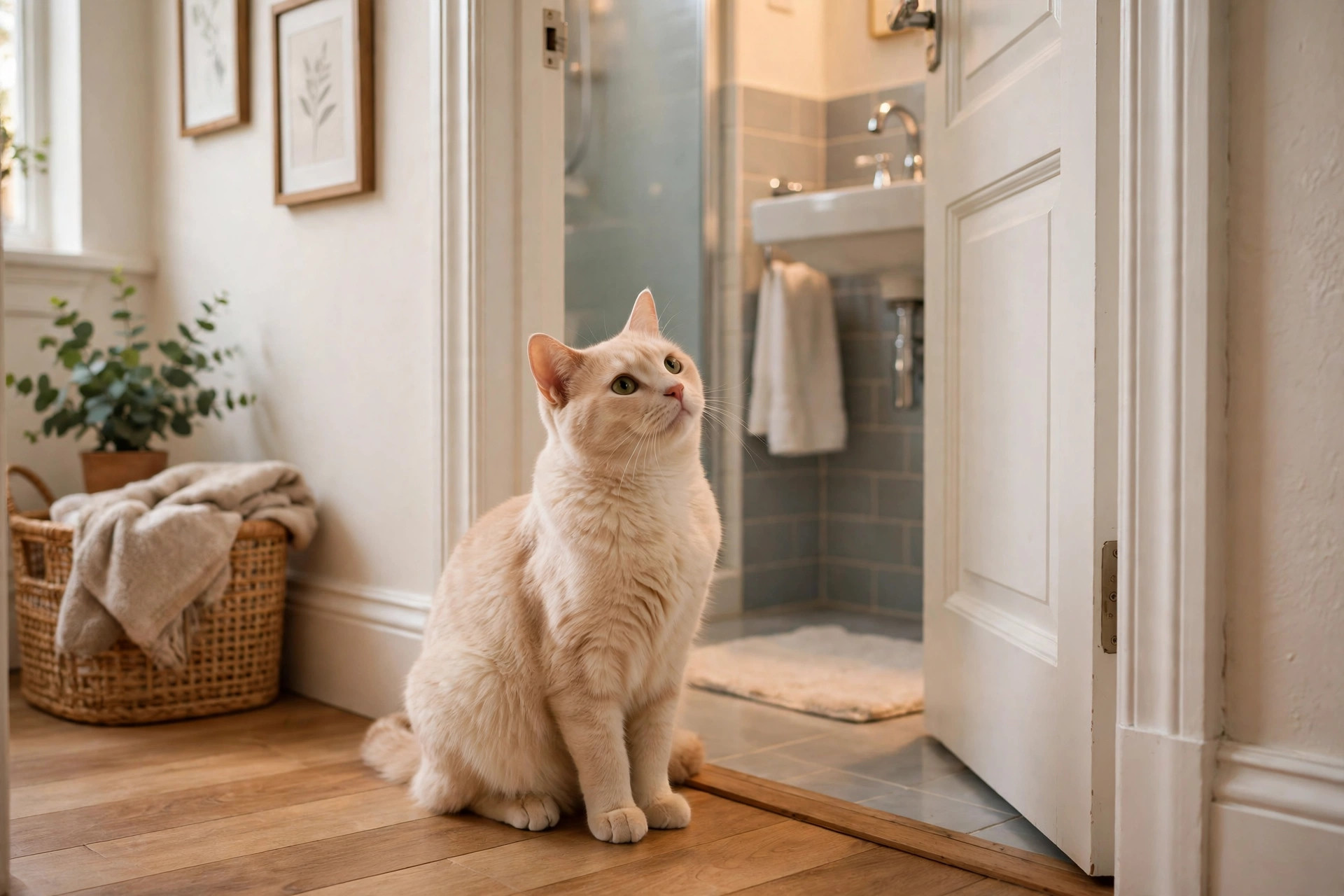
The bathroom bodyguard is such a universal experience it deserves its own section. Cats follow you to the bathroom for a few overlapping reasons. First, it is a small enclosed space — and cats love small enclosed spaces; a bathroom with the door open is an invitation to inspect prime real estate. Second, bathrooms are full of running water, interesting smells, and dangling objects — premium cat entertainment.
Third, and most importantly, a closed door is unacceptable. Your cat’s territory includes that room, and being shut out registers as an error to be corrected with immediate meowing. Finally, routine plays a role: if you have ever let the cat in, or responded to the meowing, you have taught her that door-scratching works. Every bathroom visit has now become a team activity.
Which Cat Breeds Follow Owners the Most?
Breed plays a real role in shadowing. Some breeds are famously people-oriented “velcro cats” that bond closely and follow more than average:
- Siamese — famously vocal, social, and glued to their humans.
- Ragdoll — famously relaxed and puppy-like; will trail you room to room.
- Burmese — exceptionally people-focused and demanding of attention.
- Maine Coon — gentle giants that participate in everything you do.
- Sphynx — seek human warmth constantly, and follow for it.
- Tonkinese — a Siamese-Burmese cross that doubles down on sociability.
That said, personality beats pedigree. Plenty of domestic shorthairs are full-time shadows, and plenty of purebred velcro breeds are aloof individuals. Know your cat, not just the breed stereotype.
When Following Means a Vet Visit
Most following is affection. The following table helps you tell the difference between normal shadowing and something that needs attention:
| Normal Following | Needs Closer Attention |
|---|---|
| Relaxed posture, upright ears, normal tail | Crouching, pacing, tense posture, persistent vocalizing |
| Settles fine when you leave the room | Becomes distressed whenever you are out of sight |
| Eating, grooming, and litter-box habits unchanged | Appetite loss, overgrooming, hiding, or litter-box changes |
| Follows at familiar times (before meals, at bedtime) | Behavior started suddenly with no routine change |
| Can choose solo play and rest happily alone | Cannot settle, eat, or play without you present |
| Comes and goes voluntarily | Scratches doors, eliminates outside the box, or hurts itself when separated |
See your veterinarian if the clinginess appeared suddenly, is paired with appetite or litter-box changes, comes with lethargy or pain signs, or does not improve after 2–3 weeks of enrichment work. Veterinary behavior resources including ASPCA note that sudden behavior changes can signal underlying medical issues — rule those out before assuming the cause is purely emotional.
Also Read: Is My Cat Jealous? Signs & How to Help (2026) — sudden clinginess after a household change often overlaps with the insecurity behind jealous-like behavior.
How to Help a Clingy Cat Be More Independent
If the following comes from a settled, healthy cat, there is nothing to fix — enjoy it. But if you need a little breathing room, or the following looks anxiety-driven, these steps build confidence and independence:
- Enrich the environment. The fastest cure for boredom-following is a more interesting home: a window perch, a cat tree, food puzzles, rotating toys, and scratching posts give your cat reasons to be somewhere other than behind you.
- Schedule structured play. Ten to fifteen minutes of interactive play twice daily — with a wand toy or similar — burns off the energy that turns into shadowing. End each session with a “catch” so the hunt feels complete.
- Keep routines rock-solid. Feed, play, and cuddle at the same times every day. Predictability is the fastest anti-anxiety tool you own; a fixed routine tells your cat her world still works even when you are out of sight.
- Reward settled behavior. Notice and reward the moments your cat rests calmly alone — a treat, a quiet word, a gentle stroke. You are teaching her that being apart from you also predicts good things.
- Create rewarding solo spaces. A cozy perch by a sunny window, a hiding box with your worn T-shirt, or a heated bed can become a destination your cat chooses over following. Familiar scent makes solo spots reassuring.
- Gradually build separation tolerance. Practice short, calm departures and returns without making them events — no long goodbyes, no dramatic hellos. A pet camera can reassure you that most cats settle within minutes of your departure.
Also Read: Why Do Cats Love Boxes? Science Explained (2026) — a simple cardboard box is one of the best solo enrichment tools for an indoor cat.
Frequently Asked Questions
Is it normal for my cat to follow me everywhere?
Yes. Most cats follow their owners out of affection, curiosity, habit, or food expectations. It is considered normal social behavior, especially in people-oriented breeds. Only sudden, new, or distress-driven following is a concern.
Why does my cat follow me to the bathroom?
Cats follow you to the bathroom out of curiosity, a love of small enclosed spaces, territorial instinct (closed doors are unacceptable), and learned habit — if it ever earned attention, the behavior was reinforced.
Does my cat follow me because they love me?
Often, yes. Following is frequently part of a positive social bond: your cat voluntarily stays near you with relaxed body language because your presence feels safe and good. It is one of the clearest signs of trust a cat shows.
Why does my cat suddenly follow me everywhere?
Sudden clinginess usually signals a change: a new routine, a new pet or person, environmental stress, or — importantly — pain or illness. Rule out medical causes with a vet visit, especially in senior cats.
How do I get my cat to stop following me?
You do not need to eliminate the behavior, but you can reduce it: enrich the home, schedule daily interactive play, keep routines consistent, reward calm solo resting, and provide cozy independent spaces like window perches and hiding boxes.
Is my cat’s following a sign of separation anxiety?
Not necessarily. Following while you are home is usually affection; separation anxiety is defined by what happens when you leave — persistent vocalizing, destructive behavior, house-soiling, or refusal to eat during your absence. A camera can show which one you are dealing with.
Final Thoughts
So, why does my cat follow me everywhere? Because in most cases, she has decided you are worth following. The affection, the curiosity, the dinner-time lobbying, the bathroom supervision — it is all your cat’s way of staying connected to the center of her world.
Enjoy the shadow for what it usually is: a compliment. Build enrichment, keep routines steady, and reward independent resting so the bond stays healthy rather than needy. And if the following ever changes suddenly or comes with warning signs, trust your cat’s communication and get her checked — she is telling you something, and listening is what good owners do.
By Dr. Ayaz Ali