
A cat that supposedly rode on Viking longships, charmed Norse goddesses, and evolved to shrug off Scandinavian winters — the Norwegian Forest Cat sounds like a legend. The truth is nearly as impressive. Known affectionately as the “Wegie” (pronounced wee-gee), this large, fluffy breed is one of the most striking cats you can share your home with: gentle, athletic, and built like a tiny lynx.
This complete Norwegian Forest Cat breed guide covers everything a prospective owner needs to know in 2026: temperament and personality, size and appearance, daily care, grooming, common health issues, and the true cost of bringing one home.
Table of Contents
- What Is a Norwegian Forest Cat?
- Norwegian Forest Cat Breed at a Glance
- Norwegian Forest Cat Temperament & Personality
- Size, Appearance & Coat
- Norwegian Forest Cat Care: Daily Needs
- Norwegian Forest Cat Health Issues to Know
- Is a Norwegian Forest Cat Right for You?
- Wegie Kitten & Breeder Tips
- Frequently Asked Questions
What Is a Norwegian Forest Cat?
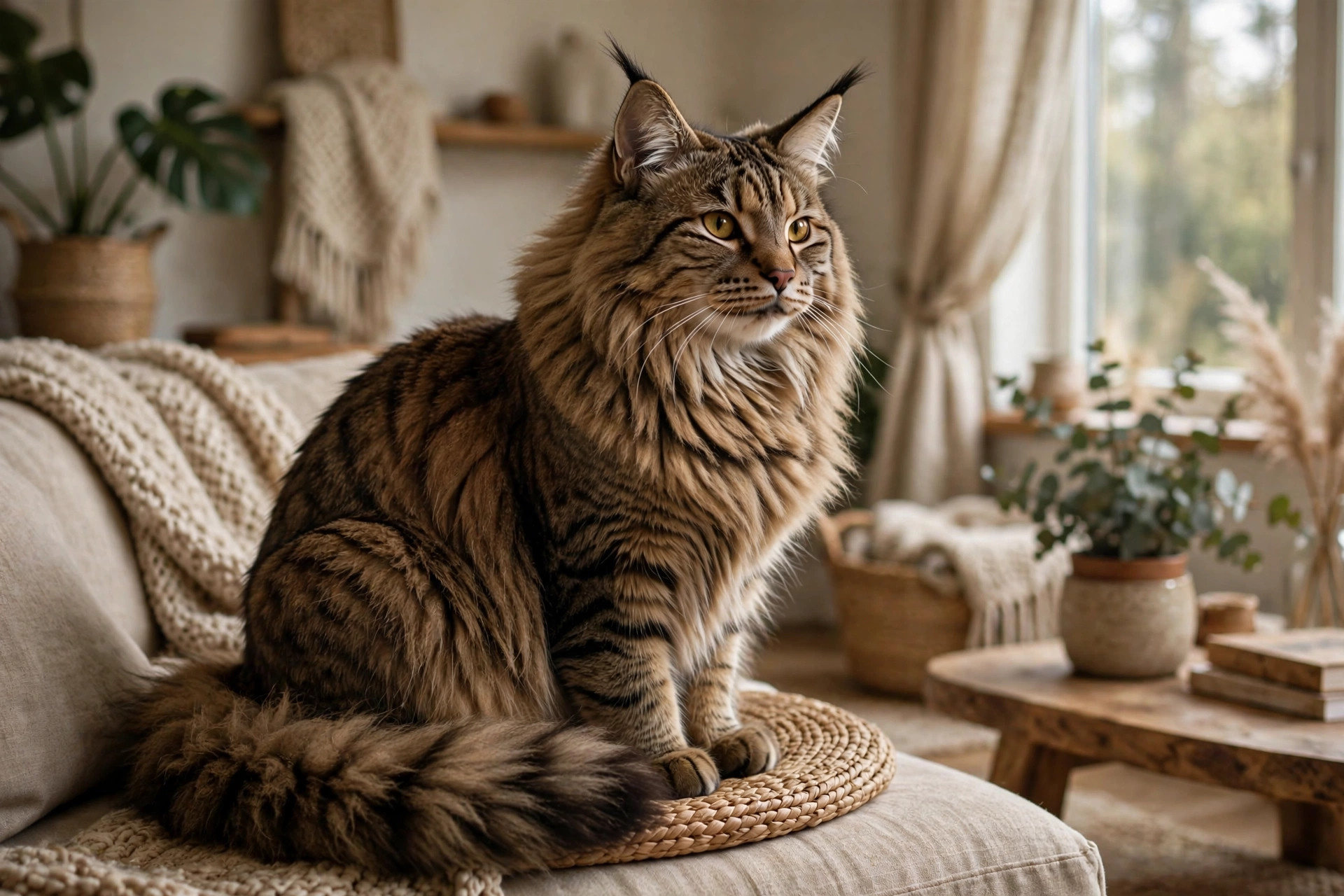
The Norwegian Forest Cat is an ancient, natural landrace breed — meaning it developed on its own in Norway’s forests and farms over centuries, not in a breeder’s program. In its homeland it is called the skogkatt (“forest cat”) and honored as Norway’s national cat. Legend says these sturdy cats sailed with the Vikings, hunting rats aboard longships, and Norse mythology credits the goddess Freyja with driving a chariot pulled by two giant cats.
Modern breeders refined rather than invented this natural breed, and the Cat Fanciers’ Association accepted it for full championship status in 1993.
Also Read: Maine Coon Breed Guide: Temperament, Care & Health (2026) — how the two gentle giants compare.
Norwegian Forest Cat Breed at a Glance
| Trait | Details |
|---|---|
| Origin | Norway (natural landrace; national cat) |
| Size | Large — males 13–22 lbs, females 8–12 lbs |
| Maturity | Very slow — full size and coat at about 5 years |
| Coat | Semi-long, dense, water-resistant double coat |
| Lifespan | 12–16 years with good care |
| Vocal level | Quiet — soft chirps and trills |
| Best for | Families, multi-pet homes, homes with vertical space |
Norwegian Forest Cat Temperament & Personality
Despite its wild, forest-born looks, the Wegie is a mild-mannered, family-friendly companion. Here is what living with one really feels like:
1. Gentle and Patient, Not Clingy
Wegies are affectionate on their own terms — supervising from a favorite perch or settling beside you on the sofa — but they are not usually lap cats or demanding cuddlers. That balance of warmth and independence makes them easygoing roommates.
2. Excellent With Children and Other Pets
Wegies are patient with children and generally coexist well with cat-friendly dogs and other cats. Their large size and confidence mean they are rarely intimidated, and they play gently with respectful kids.
3. A Born Climber
No breed climbs like the Norwegian Forest Cat. These cats seek the highest point in every room and — unlike most cats — will happily come down headfirst, a quirk of their powerful shoulders and hips. A sturdy, large-breed cat tree is not a luxury for a Wegie; it is essential equipment.
4. Intelligent, Playful, and Quiet
Wegies stay playful well into adulthood, love interactive wand toys and puzzle feeders, and are quick problem-solvers. Instead of loud meowing, they communicate with soft chirps and trills. Veterinary breed profiles such as PetMD’s Norwegian Forest Cat overview note the breed is loyal, playful, and interactive while keeping its independence.
Size, Appearance & Coat
The Wegie is built like a survivor. The silhouette is unmistakable once you know what to look for:
1. Large and Slow to Mature
Males commonly weigh 13–22 pounds, females 8–12 pounds, with a long, muscular body that can stretch up to 36 inches nose to tail. This is one of the slowest-maturing cat breeds: your 2-year-old may still look lanky, with the full ruff, britches, and bushy tail not arriving until around age 5. Patience is part of the breed’s deal.
2. The Waterproof Double Coat
The coat is the breed’s masterpiece: a dense, woolly undercoat plus long, coarse, water-resistant guard hairs. Signature features include a full ruff around the neck and chest, “britches” on the rear legs, a long bushy tail, and tufts between the toes. The coat thickens each autumn and sheds most of the undercoat each spring.
3. Colors and Distinctive Details
Wegies come in nearly every color and pattern except colorpointed — tabby, solid, smoke, tortoiseshell, and more, with or without white. The breed even has its own amber gene found in no other breed. Look for the triangle-shaped head with a straight profile, large almond-shaped eyes, and the lynx-like ear tufts that give the breed its wild look.
Norwegian Forest Cat Care: Daily Needs
A big, athletic, long-coated cat has specific daily needs. Here is the routine that keeps a Wegie healthy and happy:
Grooming: 2–3 Times a Week
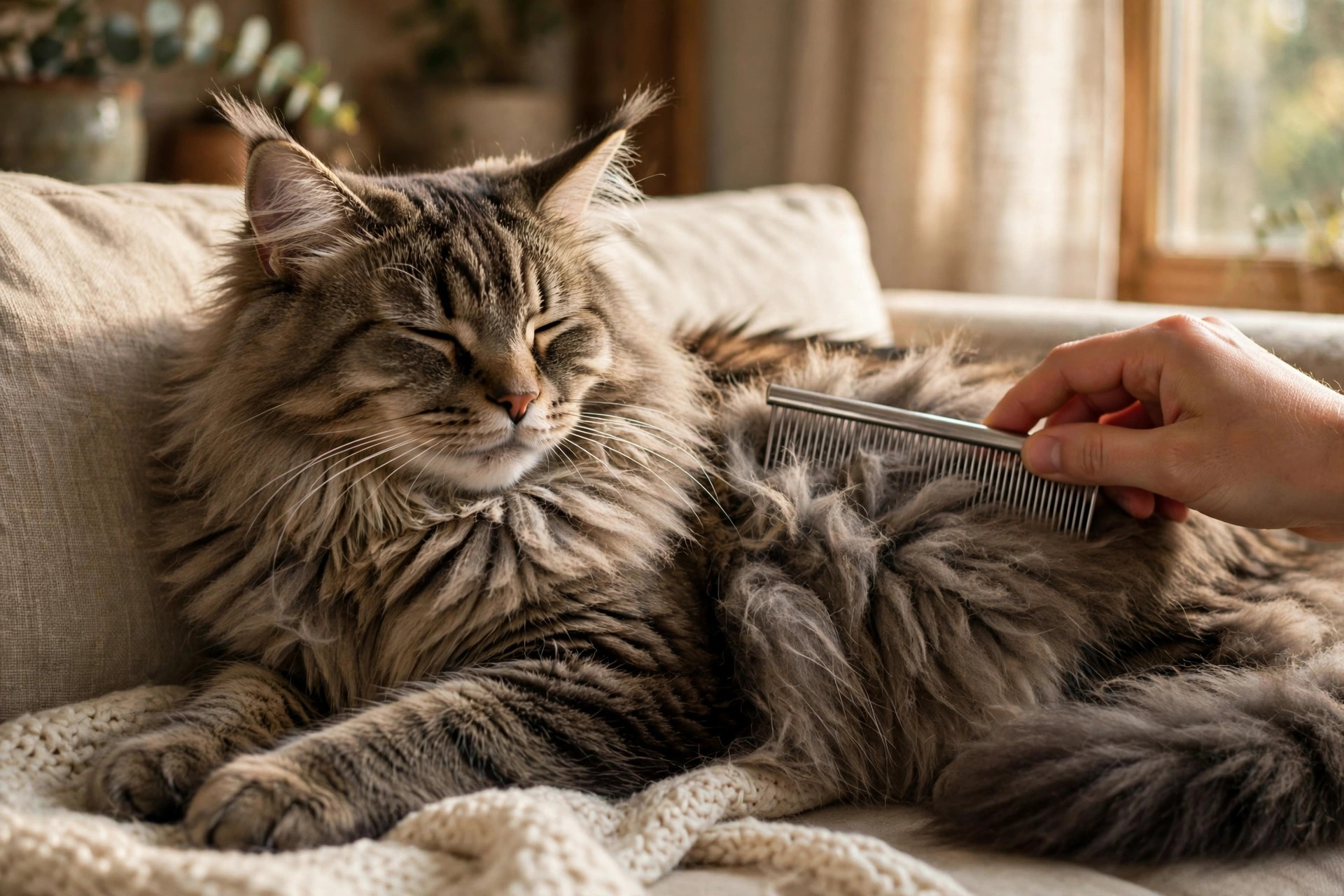
The coarse, water-resistant coat resists matting better than softer long-haired coats — but it still needs combing 2–3 times a week with a wide-toothed stainless-steel comb, worked down to the skin. During the spring and autumn sheds, switch to daily brushing to stay ahead of the undercoat blowout. Focus on high-friction areas: armpits, belly, groin, and behind the ears. Bathing is rarely needed, and trim nails every 2–3 weeks.
Diet and Feeding
Feed a high-quality, protein-rich diet in measured portions scaled to this large frame. Never free-feed — use a measuring cup or kitchen scale and split food into two measured meals a day. Look for animal protein first on the label, plus taurine and omega fatty acids. Kittens need 3–4 small meals daily during their long maturation. Also Read: Is My Cat Overweight? Body Condition Guide (2026) — long coats hide fat, so learn the rib check.
Exercise and Enrichment
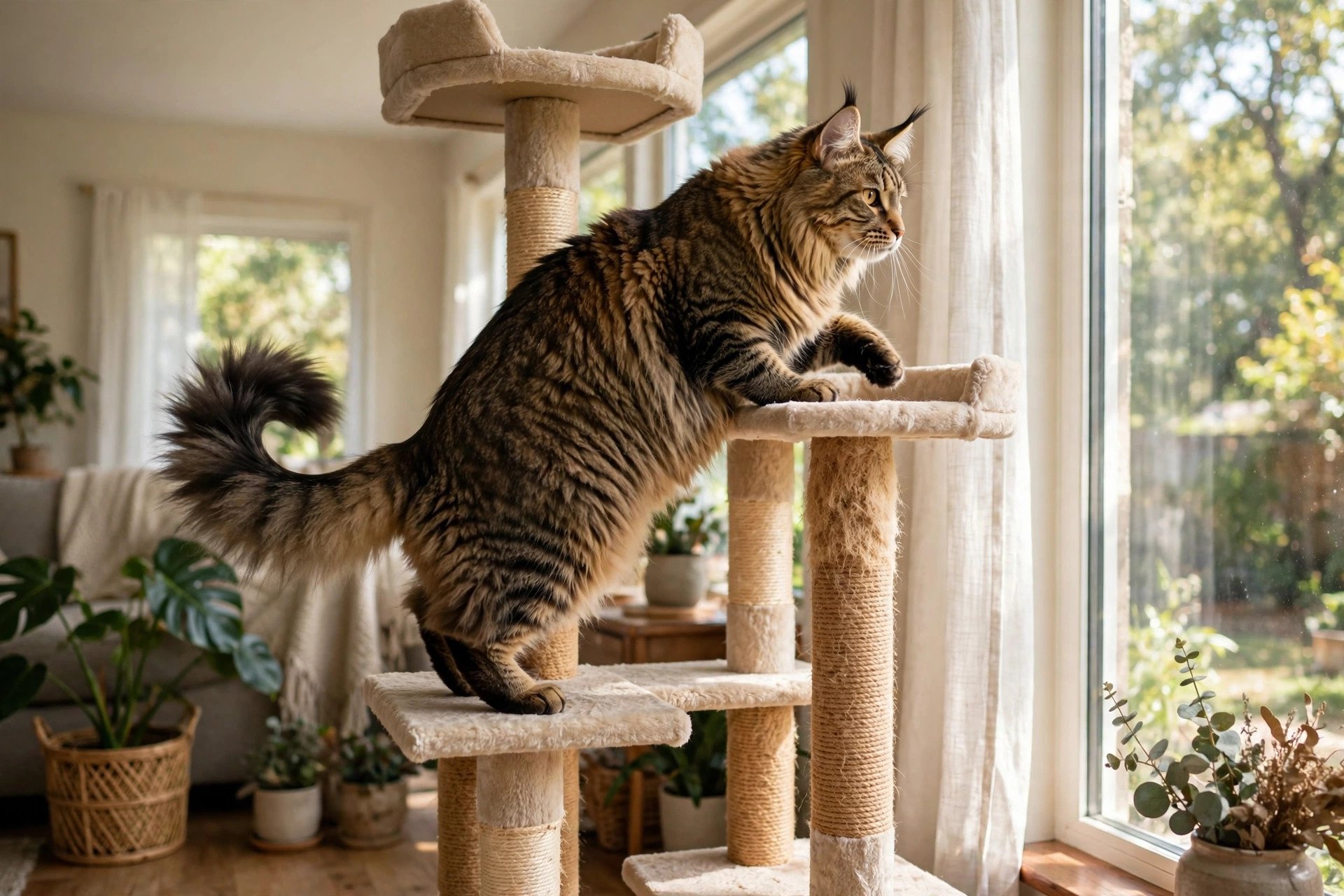
Plan on 20–30 minutes of interactive play daily: feather wands, crinkle balls, and food puzzles suit this breed’s hunting instincts. The single most important purchase is a cat tree rated for large breeds — place it near a window so your Wegie can birdwatch from its throne. Make sure any shelf or perch it jumps onto is sturdy enough to hold 20 pounds of enthusiastic athlete. A secure outdoor cat enclosure gives this adventurous breed safe fresh-air time.
Litter Box and Routine
A big cat needs a big box — choose an extra-large, low-sided litter box and scoop daily. Keep feeding times, play sessions, and bedtime predictable.
Norwegian Forest Cat Health Issues to Know
Wegies are a hardy natural breed, but large pedigreed cats carry a few well-documented genetic concerns. Every owner — and every responsible breeder — must know these:
1. Hypertrophic Cardiomyopathy (HCM)
HCM — abnormal thickening of the heart muscle — is the most serious concern shared with other large breeds. Ask your breeder for written cardiac-screening results (echocardiograms of the parents), because heart disease is diagnosed by ultrasound, not by looking healthy.
2. Glycogen Storage Disease Type IV (GSD IV)
This inherited metabolic disorder affects how the body stores glycogen. Fortunately, a DNA test exists, and reputable breeders screen their lines and never breed two carriers — always ask for the test documentation before committing.
3. Hip Dysplasia
The breed’s large frame stresses joints, and hip dysplasia is documented in Wegies. Watch for stiffness after rest or reluctance to jump; keeping your cat lean is the single best prevention.
4. Obesity
A big, food-loving, indoor Wegie is an obesity risk. Weigh regularly, measure every meal, and keep up daily play — a long coat hides weight gain until it is significant.
Schedule vet checkups every 6–12 months and ask your vet about baseline heart screening in young adulthood, especially if the parents’ cardiac status is unknown.
Is a Norwegian Forest Cat Right for You?
A Norwegian Forest Cat is a great fit if: you want a large, gentle, striking companion; you have children or other pets and need a tolerant breed; you can provide tall, sturdy climbing space; you can commit to brushing several times a week (daily during coat blows); and you don’t mind seasonal shedding.
Reconsider if: you want a true lap cat that craves constant cuddles; you are a meticulous housekeeper horrified by fur (spring and autumn sheds are real); you cannot provide vertical space in a small apartment; or you want a cat that reaches full size quickly — the Wegie takes years to finish growing.
Wegie Kitten & Breeder Tips
A responsible breeder provides written HCM cardiac screening, GSD IV DNA test results, and hip evaluations for both parents, raises kittens in a home with early socialization, offers a written health guarantee, screens buyers, and never sells unvaccinated kittens “cheap, no papers.”
Expect to pay roughly $800–$3,000+ for a pet-quality kitten from a reputable breeder. Adoption costs run closer to $100–$300, and breed-specific rescues regularly have adult Wegies and mixes needing homes — with an adult, temperament and size are already predictable. Meet the kitten’s mother when possible, and always visit the cattery before paying anything.
Frequently Asked Questions
How big do Norwegian Forest Cats get?
Males typically weigh 13–22 pounds and females 8–12 pounds, with some males exceeding 20 pounds of bone and frame. They are one of the slowest-maturing breeds, reaching full size around 5 years of age.
Are Norwegian Forest Cats good with dogs?
Yes — their large size, confidence, and calm temperament make them one of the better breeds for multi-pet households. They usually coexist well with cat-friendly dogs, especially when introduced gradually.
Do Norwegian Forest Cats shed a lot?
Moderately most of the year, heavily during spring and autumn when they blow the dense undercoat. Brush 2–3 times a week — daily during shedding seasons.
Are Norwegian Forest Cats hypoallergenic?
No. No cat breed is truly hypoallergenic — Wegies shed and produce dander like all cats.
How long do Norwegian Forest Cats live?
A healthy Wegie typically lives 12–16 years with proper nutrition, regular veterinary care, and an indoor lifestyle.
What is the difference between a Norwegian Forest Cat and a Maine Coon?
The Wegie has a more triangular head with a straight profile, a lighter, longer frame, and a coarser, more water-resistant coat. Maine Coons are stockier with squarer muzzles and silkier coats.
Final Thoughts
So, is the Norwegian Forest Cat the right breed for you? If you want a large, gentle, quietly loyal companion that climbs like an athlete and looks like a creature from a Viking saga, few breeds deliver like the Wegie. Just commit to regular brushing, measured meals, breeder health testing for HCM and GSD IV, and the vertical space this natural climber craves. Do that, and you will understand why Norway made it the national cat.
By Dr. Ayaz Ali