
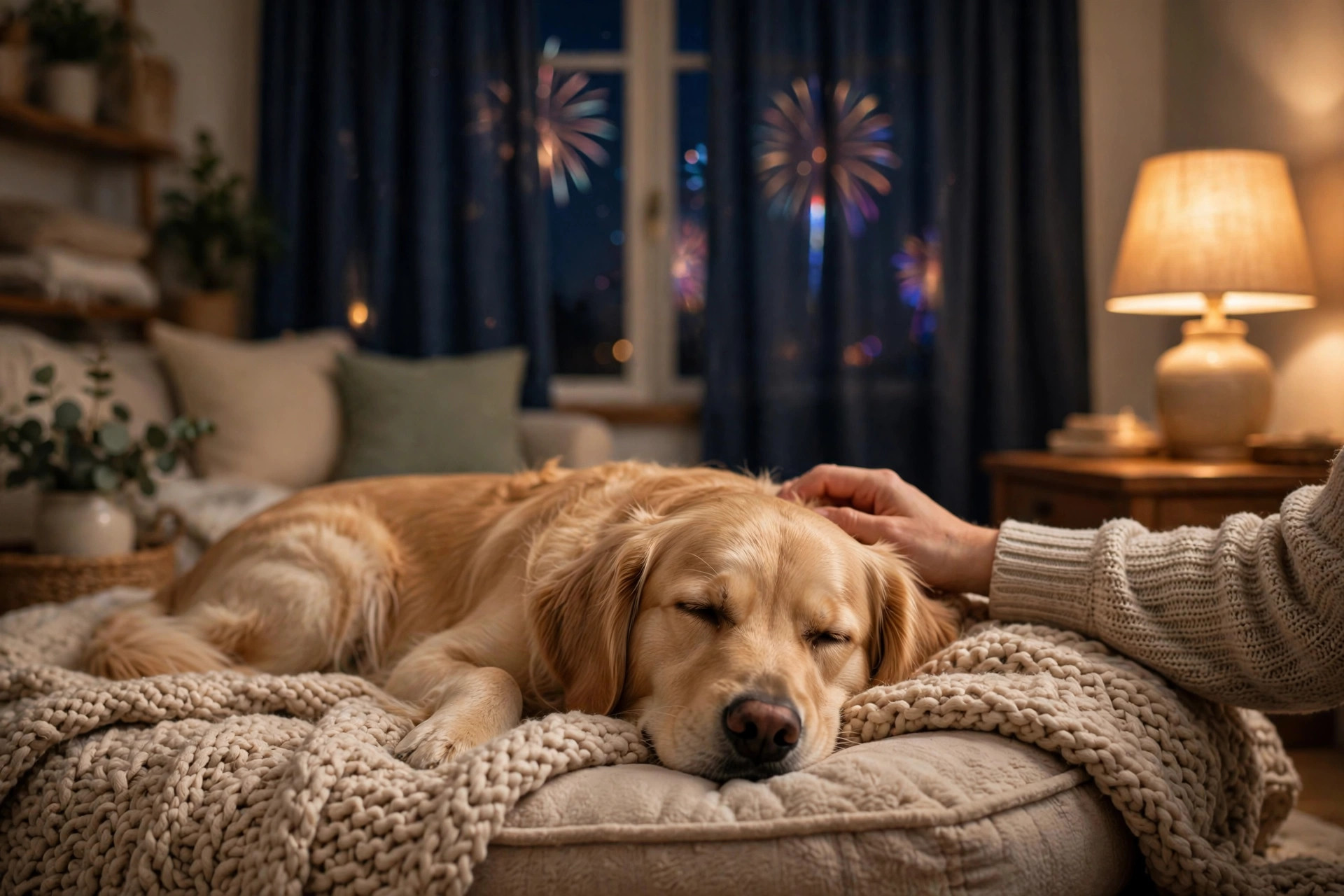
Every October, the same scene plays out in homes everywhere: the first distant boom of a firework sends your dog bolting under the bed — trembling, panting, drooling, and refusing to come out for hours. Fireworks anxiety in dogs is one of the most common behavior problems veterinarians see each fall, and with Diwali, Bonfire Night, and New Year’s Eve all packed into the season, noise-phobic dogs can face weeks of dread.
The good news: you can dramatically reduce your dog’s suffering — but the real secret is that the work starts before the first bang, not during it. Dogs with a prepared safe space, a desensitization head start, and a calm night-of plan cope far better than dogs whose owners scramble once the sky lights up.
In this complete 2026 guide, we’ll walk you through everything: why fireworks terrify dogs, the warning signs of fireworks anxiety in dogs, a two-week prep plan you can start today, the exact night-of playbook to follow when the booms begin, which calming products are actually worth your money, and when it’s time to call your vet.
Table of Contents
- Why Fireworks Terrify Dogs
- Signs of Fireworks Anxiety in Dogs
- Your 2-Week Fireworks Prep Plan
- The Night-Of Calming Plan
- Calming Tools: What Works and What’s Hype
- What NOT to Do When Your Dog Panics
- When to Call Your Vet
- Frequently Asked Questions
Fireworks Anxiety in Dogs: Why the Booms Terrify Them
To your dog, a fireworks display is a full sensory assault with zero warning. Dogs hear roughly four times better than humans and can detect sounds at much higher frequencies — so a boom that startles you can feel physically overwhelming to them. Add the unpredictable flashes lighting up the sky, the vibrations rattling the windows, and the sharp smell of sulfur drifting through the air, and you have a perfect storm of triggers.
Worst of all, fireworks give no pattern a dog can learn. A thunderstorm at least builds gradually; fireworks explode at random intervals, which keeps the fight-or-flight system firing at full blast. That is why even confident, well-socialized dogs can develop fireworks anxiety in dogs seemingly out of nowhere — and behaviorists warn that noise aversions rarely resolve on their own. Left unmanaged, the fear often worsens year after year and can generalize to thunderstorms, gunshots, or even slamming doors.
Some dogs are more vulnerable than others. Herding and working breeds tend to be sound-sensitive, rescue dogs with unknown histories may carry old trauma, and senior dogs can become newly fearful as hearing changes or arthritis pain makes them feel less able to escape.
Signs of Fireworks Anxiety in Dogs
Not every scared dog looks the same. Mild fireworks anxiety shows up as restlessness and clinginess; severe cases look like genuine panic. Watch for:
- Trembling, panting, and drooling when it isn’t hot — the classic stress trio
- Pacing, whining, or barking that won’t settle
- Hiding under beds, in closets, behind furniture — or pressing hard against you for reassurance
- Escape attempts: scratching at doors, digging under fences, jumping gates, even breaking through screens
- Loss of appetite, house soiling, dilated pupils, pinned-back ears, tucked tail
- Bolting: more dogs go missing around fireworks than almost any other time of year, so a secure collar, ID tag, and up-to-date microchip are non-negotiable
If your dog shows several of these signs every fireworks season, don’t write it off as “just being dramatic” — it’s a real phobia, and it deserves a real plan.
Start Now: Your 2-Week Fireworks Prep Plan
The single biggest mistake owners make is doing nothing until the night itself. Veterinary behaviorists recommend starting preparation at least two weeks before the big displays. Here’s your timeline:
| When | What to Do |
|---|---|
| 2+ weeks before | Book a vet visit to discuss situational anti-anxiety medication; confirm microchip details and ID tags are current |
| 2 weeks before | Begin sound desensitization: play firework recordings at very low volume during meals and play, pairing the sound with treats; raise the volume gradually over days |
| 1 week before | Build the safe room (see below); let your dog relax there daily; fit and test the anxiety wrap; run a trial dose of any prescribed medication |
| Day of | Big walk and play session well before dark; feed dinner early; bring the dog inside before sunset; set up white noise |
Desensitization deserves special emphasis: it only works when the sound stays below your dog’s fear threshold. If your dog shows any stress, the volume is too high — turn it down and go slower. The American Kennel Club recommends tossing your dog a treat as the sounds play, building a positive association with the noise over time.
And if your vet prescribes medication such as trazodone, gabapentin, or Sileo, always do a trial dose on a calm day first — fireworks night should never be the first time your dog takes a new drug.
Fireworks Anxiety in Dogs: The Night-Of Calming Plan
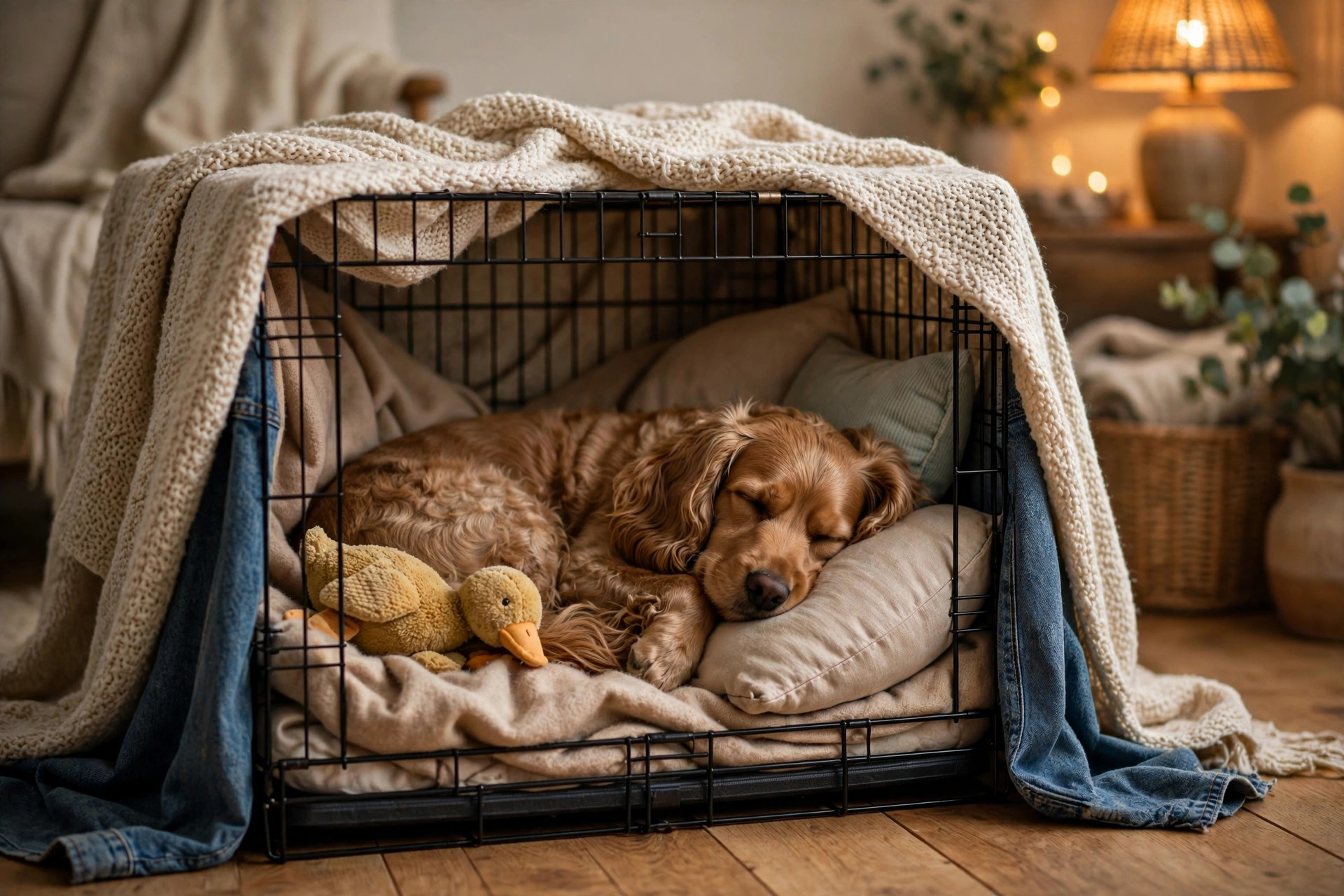
When the first booms start, execute this playbook in order:
1. Get everyone inside before dark
Walk and toilet your dog well before sunset. Once fireworks begin, keep every door, window, and dog flap shut — a panicking dog can clear a fence or smash through a screen in seconds.
2. Build the safe haven
Choose the most interior, windowless-feeling room you have — a basement, inner bathroom, or large closet works. Set up your dog’s bed or crate (door open, never locked), familiar blankets, a worn t-shirt that smells like you, and water. Close the curtains and blinds, turn the lights on to soften the flashes, and run a fan, TV, or white-noise machine to blunt the booms.
3. Tire them out early, feed them early
A long walk or vigorous play session 3–4 hours before the display burns off nervous energy — a tired dog copes better than one buzzing with pent-up energy. Feed dinner earlier than usual, since many anxious dogs refuse food once the noise starts.
4. Stay home and stay calm
Your presence is the single most reassuring thing in the room. But how you comfort matters: use a low, steady voice and long, slow, firm strokes — and stay genuinely relaxed yourself, because dogs read your tension instantly. You absolutely can comfort a frightened dog; calm reassurance does not “reward” the fear. What backfires is frantic fussing — rapid-fire “it’s okay, it’s okay!” in a high pitch can convince your dog there really is something to fear.
Also Read: Why Does My Dog Lean on Me? Vet Guide (2026) — if your dog presses hard against you during the display, that’s fear-based leaning; stay calm and let them stay close.
5. Distract with long-lasting enrichment
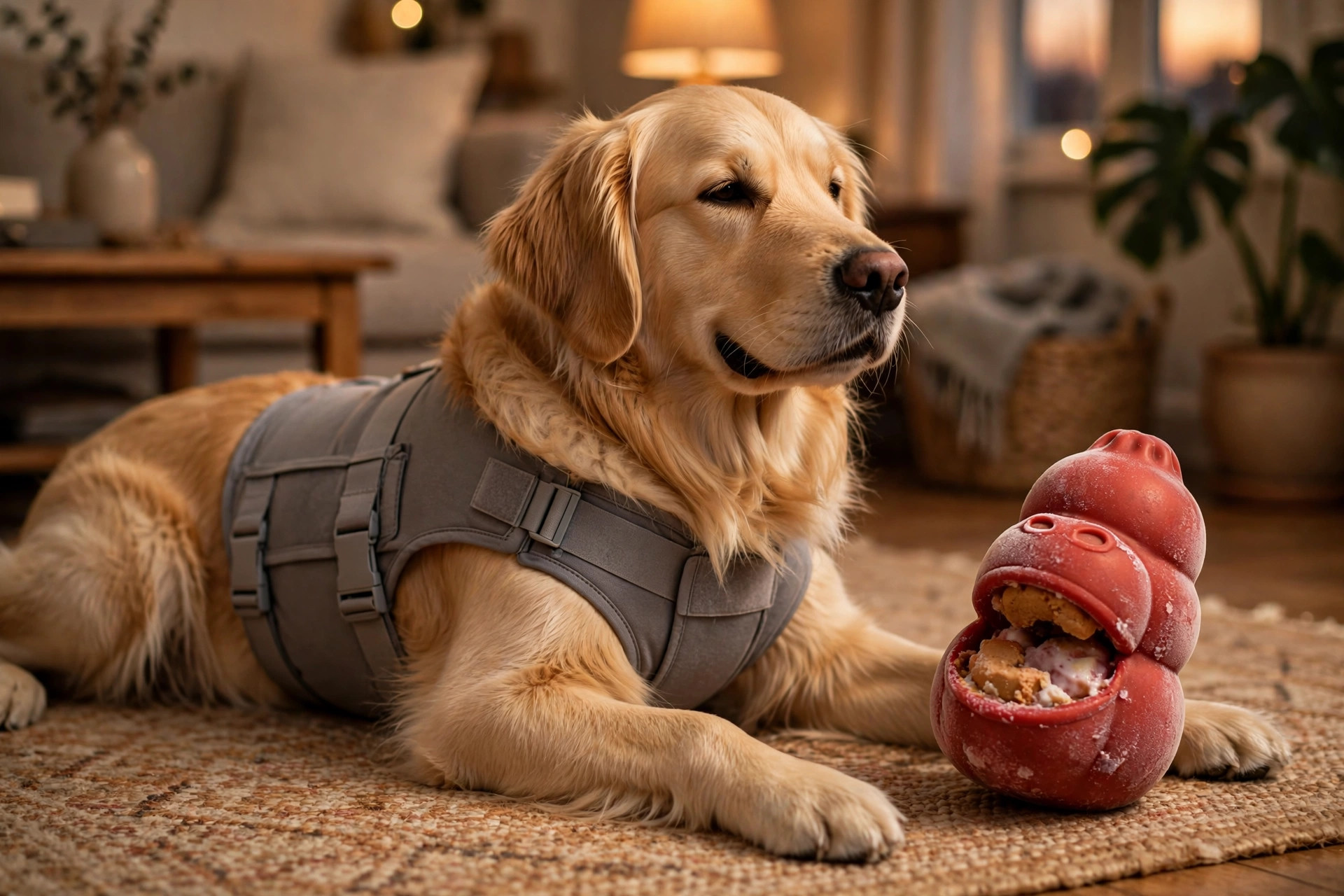
A frozen stuffed Kong, a fully loaded food puzzle, or a snuffle mat loaded with kibble gives your dog a job to focus on instead of the noise. Prepare these in advance — you won’t want to be stuffing toys mid-display.
Also Read: What Is a Snuffle Mat? Dog Enrichment Guide (2026) — ten minutes of foraging tires a dog out and shifts them out of an anxious state.
6. Let them hide
If your dog retreats under the bed or into the closet, let them. Hiding is a coping strategy, not a behavior problem — never drag a terrified dog out of their chosen spot.
Calming Tools That Actually Help (and What’s Just Hype)
Pet stores overflow with “calming” products every October. Here’s the honest breakdown:
Anxiety wraps (ThunderShirt-style)
These snug garments apply gentle, constant pressure — similar to swaddling an infant. Studies and owner reports suggest they reduce visible anxiety signs in a majority of dogs. Fit it 30 minutes before the noise starts; it’s far less effective once panic has set in. No wrap? A snug t-shirt knotted at the back mimics the effect in a pinch.
Pheromone diffusers and sprays
Synthetic dog-appeasing pheromone products (such as Adaptil) have modest evidence behind them. They won’t sedate a panicking dog, but as one layer in a multi-layer plan — diffuser in the safe room, spray on bedding — they can take the edge off. Start diffusers a week or two early.
White noise and calming music
A fan, white-noise machine, or TV left on masks the sharp attack of each boom. Classical music composed for canine calming (“Through a Dog’s Ear”) has shown measurable calming effects in kennel studies.
Prescription medication
For true noise phobia, this is the heavy hitter. Sileo is the only FDA-approved medication specifically for canine noise aversion; vets also commonly prescribe trazodone or gabapentin situationally. These work far better than scrambling on the night — but only with a vet’s guidance, correct timing (often 1–2 hours before the noise), and a prior trial dose.
What’s mostly hype
Calming chews and herbal supplements have thin evidence and unregulated dosing — only use vet-approved products, and never as your sole plan. CBD oil for pet anxiety has almost no direct clinical studies; the AKC advises discussing it with your vet before trying anything. And “calming” collars or charms with no active mechanism are marketing, not medicine.
What NOT to Do When Your Dog Panics
Well-meaning owners often make fireworks anxiety worse. Avoid these mistakes:
- Never punish or scold a panicking dog. They’re not misbehaving — they’re terrified. Punishment deepens the fear and damages your bond.
- Don’t force “exposure.” Dragging your dog outside to “get used to it” (flooding) can traumatize them and make the phobia dramatically worse.
- Don’t leave them alone outdoors. Never leave a noise-phobic dog in the yard, on a balcony, or tied up during fireworks — escape and injury risk skyrockets.
- Don’t fuss frantically. As covered above, panicky comforting confirms the danger. Calm and boring beats emotional and intense.
- Don’t debut medication on the night. A drug that sedates too heavily or paradoxically agitates your dog is a crisis you don’t need mid-display.
When to Call Your Vet About Fireworks Anxiety
Book a vet visit — ideally before the season peaks — if your dog injures themselves trying to escape, drools or pants to the point of exhaustion, refuses all food and water through the night, or shows panic that lasts hours after the noise stops. Dogs with heart conditions, epilepsy, or senior dogs with new-onset fear deserve particular attention, since pain and cognitive decline can amplify noise sensitivity.
Also call if the fear is spreading: a dog that starts panicking at thunderstorms, car backfires, or everyday bangs needs a full behavior plan, not just a fireworks-night bandage. Your vet may refer you to a certified animal behaviorist for a structured desensitization and counterconditioning program.
Also Read: Separation Anxiety in Dogs: Signs & Help Guide (2026) — noise phobia and separation anxiety often travel together; the calming routines overlap.
Frequently Asked Questions
Should I comfort my dog during fireworks or ignore them?
Comfort them — calmly. The old advice that comforting “rewards” fear is outdated. What matters is how: stay relaxed, speak in a low steady voice, and offer slow, firm strokes. Frantic, high-pitched fussing can make things worse, but your calm presence genuinely soothes.
Do anxiety wraps like ThunderShirts really work?
For many dogs, yes — the gentle constant pressure has a swaddling-like effect, and studies report reduced anxiety signs in a majority of dogs tested. They work best as prevention (fitted before the noise starts) rather than rescue, and they work best combined with a safe room and sound masking.
What can I give my dog for fireworks anxiety?
Only what your vet prescribes. Common situational options include trazodone, gabapentin, and Sileo (the only FDA-approved drug specifically for canine noise aversion). Over-the-counter calming chews have limited evidence. Never give human sleep aids or sedatives — some are toxic to dogs.
How do I desensitize my dog to fireworks?
Play firework recordings at a volume so low your dog barely notices, while feeding high-value treats and playing. Over days and weeks, raise the volume in tiny steps — always staying below any sign of stress. Done correctly over several weeks, this builds genuine tolerance; rushed or too-loud sessions can backfire.
Why is my dog suddenly scared of fireworks when they weren’t before?
New-onset noise fear in an adult or senior dog warrants a vet check. Hearing changes, arthritis pain (which makes a dog feel unable to flee), canine cognitive dysfunction, or a single genuinely terrifying experience can all trigger it. Pain-related fear is especially common in older dogs.
Can fireworks physically harm my dog?
Very loud blasts at close range can damage hearing, but the bigger risks are behavioral: panicked escape (lost dogs spike every fireworks season), self-injury breaking out of crates or through windows, and ingestion of firework debris containing heavy metals and oxidizers. Check your yard for debris the morning after.
Final Thoughts
So, fireworks anxiety in dogs doesn’t have to mean weeks of misery every autumn. The formula that actually works is simple: prepare early, build the safe haven, tire them out before dark, stay calm beside them, and layer your tools — sound masking, enrichment, a wrap, and vet-prescribed medication for severe cases.
Start your two-week plan today, while the season is still ramping up. Your dog can’t understand why the sky is exploding — but with the right preparation, they can learn that the booms always end, and that their safe place (and you) are right there waiting.