

You brush your cat and notice a small, round bald spot on her ear — flaky at the edges, with stubby broken hairs around it. Your first thought is probably the obvious one: is this ringworm in cats, and do I need to worry?
Despite the alarming name, ringworm is not a worm at all. It is a common, highly contagious fungal skin infection that affects a cat’s skin, hair, and sometimes claws. The good news is that it is very treatable — but it spreads easily to other pets and people, and it will not clear up on its own. In this 2026 vet-style guide, we will walk you through the signs of ringworm in cats, how veterinarians diagnose it, the treatment plan that actually clears it, and how to decontaminate your home so it does not come back.
Table of Contents
- What Is Ringworm in Cats?
- Signs of Ringworm in Cats
- How Do Cats Get Ringworm?
- How Vets Diagnose Ringworm in Cats
- How to Get Rid of Ringworm in Cats: Treatment Plan
- How Long Does Ringworm in Cats Last?
- Cleaning Your Home to Stop Ringworm Reinfection
- Can Humans Catch Ringworm from Cats?
- Frequently Asked Questions
What Is Ringworm in Cats?
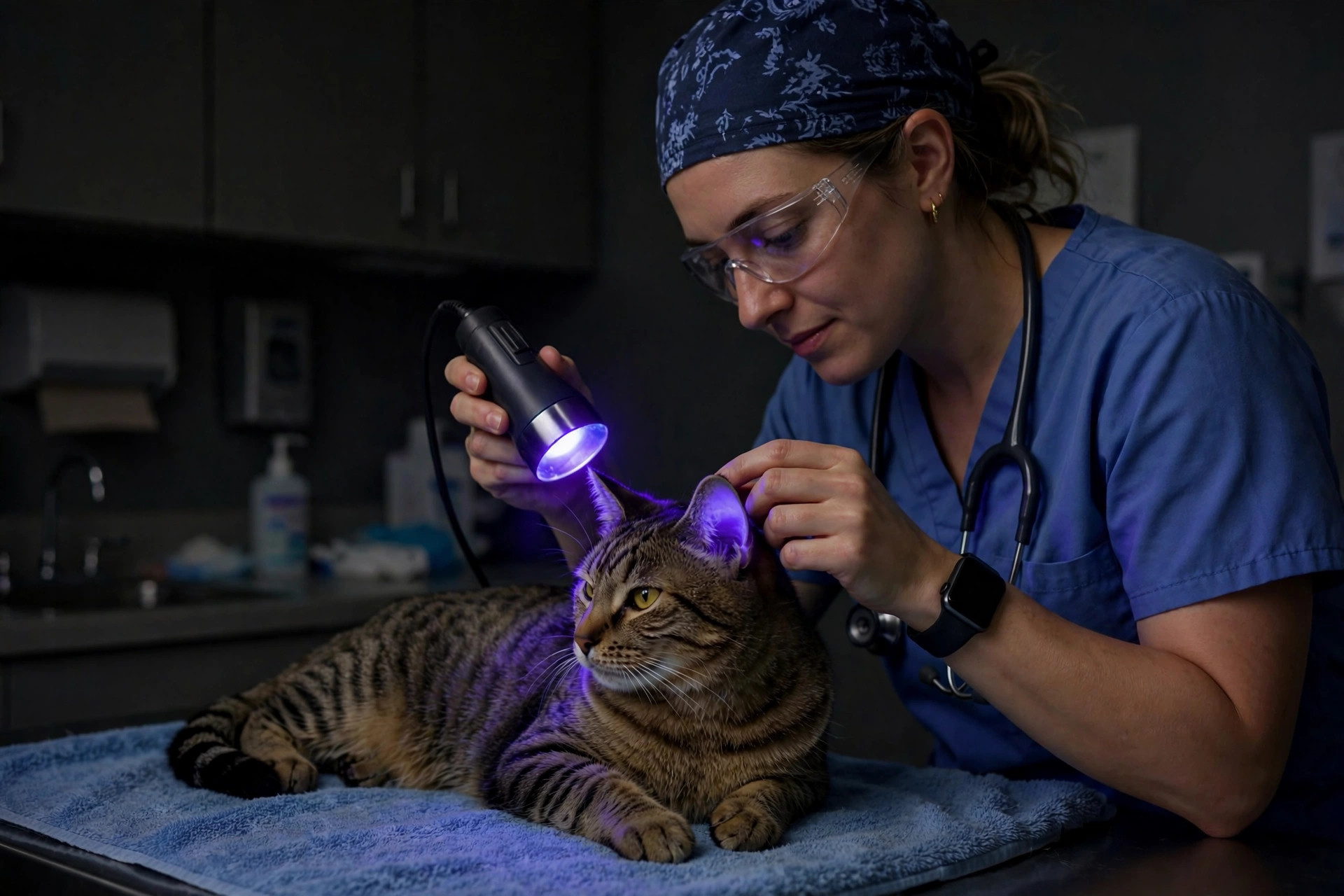
Ringworm is the common name for dermatophytosis, a fungal infection caused by a group of fungi called dermatophytes. These fungi feed on keratin, the protein found in skin, hair, and nails — which is why the infection shows up as hair loss and skin changes rather than internal illness. In cats, the species responsible for roughly 90% of cases is Microsporum canis.
The name comes from the ring-shaped lesion it can cause on human skin — a red, round, raised “ring” marking the boundary of the inflammation — not from any actual worm. Veterinary sources including PetMD confirm that ringworm in cats typically presents as hair loss and scaly lesions, and that long-haired cats can carry the fungus without showing any symptoms at all. These asymptomatic carriers are important to know about: even though they do not look sick, they can still infect other pets and humans.
Kittens, young cats, and cats with weakened immune systems are the most vulnerable. Long-haired breeds face extra risk because they groom less efficiently, so fungal spores get trapped more easily on their skin.
Signs of Ringworm in Cats
Early ringworm lesions are easy to miss, especially on long-haired cats. Watch for these signs of ringworm in cats:
- Circular patches of hair loss — round or oval bald spots, often on the head, ears, chest, front legs, and along the spine
- Scaly, crusty, or flaky skin at the center of the patch, sometimes with redness or a grayish tone
- Broken, stubby, or brittle hairs around the edges of the bald area
- Dandruff-like flaking scattered through the coat
- Excessive grooming or scratching of one area (though some cats barely scratch at all)
- Dull, rough coat with changes in hair or skin color
- Nail problems — thickened, misshapen, or crumbling nails if the infection reaches the claws
In more severe cases, the lesions can become raised and nodular (called granulomas), sometimes with discharge. Unlike allergies or flea infestations, ringworm patches are usually dry and distinctly circular rather than wet or oozing.
Also Read: Fall Allergies in Dogs: Signs & Relief (2026) — itchy skin has many lookalikes, and learning how allergies present helps you tell them apart from fungal infections.
How Do Cats Get Ringworm?
Ringworm spreads because the fungus releases microscopic spores into the environment. A cat becomes infected through:
- Direct contact with an infected animal — playing, grooming, or fighting with a cat (or dog) that carries the fungus
- Contaminated objects — bedding, carpets, furniture, grooming tools, clothing, or human hands that touched an infected animal
- Soil — some dermatophyte species live in the ground, so outdoor or digging cats face higher exposure
The durability of these spores is what makes ringworm so stubborn: they can survive on surfaces indoors for months — up to 18 months or more in hard-to-clean areas. A cat can also shed infectious hairs around the home, silently contaminating carpets and furniture.
Common risk situations include multi-cat households, shelters and rescues, catteries, and any new cat arriving from an environment where other animals were present. This is one reason a vet check in the first week matters so much after adoption.
Also Read: First-Time Cat Owner Checklist: 12 Essentials (2026) — book a wellness exam within the first week so your new cat’s skin, coat, and parasite status are checked early.
How Vets Diagnose Ringworm in Cats
If you suspect ringworm, veterinary confirmation is essential — you cannot diagnose it reliably at home. Your vet will typically start with a physical exam and then use one or more of these tests:
1. Wood’s Lamp Exam (UV Light Test)
A special ultraviolet light called a Wood’s lamp can make some strains of Microsporum canis glow a yellowish-green color on infected hairs. It is a quick, painless screening tool — but not all cases fluoresce, so a negative result does not rule ringworm out.
2. Microscopic Hair Examination
The vet may pluck hairs from around the lesion and examine them under a microscope for fungal spores and damaged hair shafts.
3. Fungal Culture
Hair and skin samples are placed in a special growth medium for up to 2–3 weeks. This is the most reliable way to confirm ringworm and identify the exact fungus — and your vet will use repeat cultures later to confirm the infection is truly gone.
4. PCR Testing
Polymerase chain reaction testing detects the fungus’s DNA directly from a sample and returns results much faster than a culture, though it is more expensive.
How to Get Rid of Ringworm in Cats: Treatment Plan
Ringworm treatment in cats requires patience and consistency — there is no overnight cure. Most treatment plans combine approaches:
1. Topical Antifungal Therapy
Antifungal shampoos (miconazole or ketoconazole), creams, sprays, or lime sulfur dips are applied to affected areas, usually 2–3 times per week. Clipping the fur around lesions helps the medication reach the skin — your vet will decide whether clipping is needed, since it must be done carefully to avoid spreading spores. Topical treatment alone is rarely enough for full clearance.
2. Oral Antifungal Medication
For anything beyond the mildest single lesion, vets prescribe oral antifungals such as itraconazole or terbinafine. Oral therapy is the most effective way to clear the infection from the inside, since the fungus lives in the hair shafts where creams cannot fully reach. Never use human antifungal creams on your cat without veterinary guidance — some ingredients are toxic to cats.
3. Follow-Up Cultures
Keep treating until your vet confirms the infection is gone with a negative fungal culture — not just until the bald patches look better. Stopping early is the most common reason ringworm relapses.
| Treatment Step | What It Does | Typical Frequency |
|---|---|---|
| Topical antifungals | Kill fungus on skin and reduce spore shedding | 2–3 times per week |
| Oral antifungals | Clear fungus from hair shafts systemically | Daily, per vet prescription |
| Environmental cleaning | Remove spores from the home to prevent reinfection | Daily vacuuming + weekly deep clean |
| Recheck cultures | Confirm the infection is truly cleared | Every 2–4 weeks |
How Long Does Ringworm in Cats Last?
With consistent treatment, most cases of ringworm in cats resolve in 6 to 12 weeks. Milder, caught-early cases can clear faster; long-haired cats, multi-pet households, and cases with reinfection can take longer.
The critical point: visible improvement in the first couple of weeks does not mean the infection is gone. Hair starts regrowing before the fungus is fully cleared, and stopping treatment at that stage almost guarantees a relapse. Finish the full course your veterinarian prescribes and get the final negative culture.
Cleaning Your Home to Stop Ringworm Reinfection

Treating the cat without treating the home is like mopping while the tap is still running. Since spores survive for many months, environmental decontamination is half the battle:
- Isolate the infected cat in one easy-to-clean room until your vet clears them
- Vacuum daily — carpets, furniture, cat trees — and dispose of vacuum bags (or empty the canister) in an outside bin
- Wash all bedding, blankets, and soft toys in hot water with detergent; dry on high heat
- Disinfect hard surfaces with a dilute bleach solution (1:10 bleach to water) or a veterinary-approved antifungal disinfectant
- Clean grooming tools, brushes, and food bowls regularly during treatment
- Wash your hands after handling the infected cat, and wear gloves when applying topical treatments
Skip the cleaning step and the odds of reinfection are high — this is why many “stubborn” ringworm cases are really reinfections from a contaminated environment.
Can Humans Catch Ringworm from Cats?
Yes. Ringworm is zoonotic, meaning it spreads from animals to people — usually through direct skin contact with an infected cat or through contaminated bedding, furniture, or clothing. In humans it causes an itchy, red, ring-shaped rash.
Children, older adults, and anyone with a weakened immune system face the highest risk. If you develop a round, itchy, red rash after handling your cat, see your doctor — ringworm is very treatable in people too, typically with topical antifungal cream. Good hand hygiene is the single best defense: wash your hands thoroughly after touching your cat, her bedding, or her grooming tools, and avoid cuddling an infected cat close to your face.
Also Read: Why Does My Cat Keep Sneezing? Vet Guide (2026) — fungal infections are not the only hidden health issue in cats; learn another common one that spreads easily in multi-cat homes.
Frequently Asked Questions
What does ringworm look like on a cat?
Ringworm in cats typically appears as circular, hairless patches with scaly, red, or grayish centers and broken, stubby fur around the edges. The patches are most often found on the head, ears, chest, front legs, and along the spine.
Is ringworm in cats contagious?
Yes — it is highly contagious to other cats, dogs, and humans. It spreads through direct contact with an infected animal or by touching contaminated bedding, furniture, grooming tools, or clothing. Spores can survive in the home for months.
Can ringworm in cats go away on its own?
No. Ringworm will not resolve on its own and can spread rapidly through a household. It requires veterinary treatment with antifungal medication plus environmental cleaning.
How did my indoor cat get ringworm?
Indoor cats can catch ringworm from spores brought in on human clothing, contaminated grooming tools, or new pets and items from shelters or rescues. The spores are extremely durable and can hitchhike on everyday objects.
Can I treat my cat’s ringworm with over-the-counter cream?
Do not use human antifungal products without veterinary guidance — some ingredients are toxic to cats. See your vet for a proper diagnosis and a cat-safe treatment plan.
When can my cat socialize again after ringworm treatment?
Only after your vet confirms clearance with a negative fungal culture — not when the fur simply grows back. Ending isolation too early risks reinfecting the whole household.
Final Thoughts
So, what should you do about ringworm in cats? Do not panic — but do act. This contagious fungal infection will not clear on its own, and the longer it lingers, the more of your home and family it contaminates. Get a veterinary diagnosis, follow the full antifungal treatment course, decontaminate the environment, and confirm clearance with a final culture.
The combination of medicine plus home cleaning is what separates a six-week success story from a six-month ordeal. Spot the signs early, treat it thoroughly, and your cat will be back to full-fluff in no time.
By Dr. Ayaz Ali