
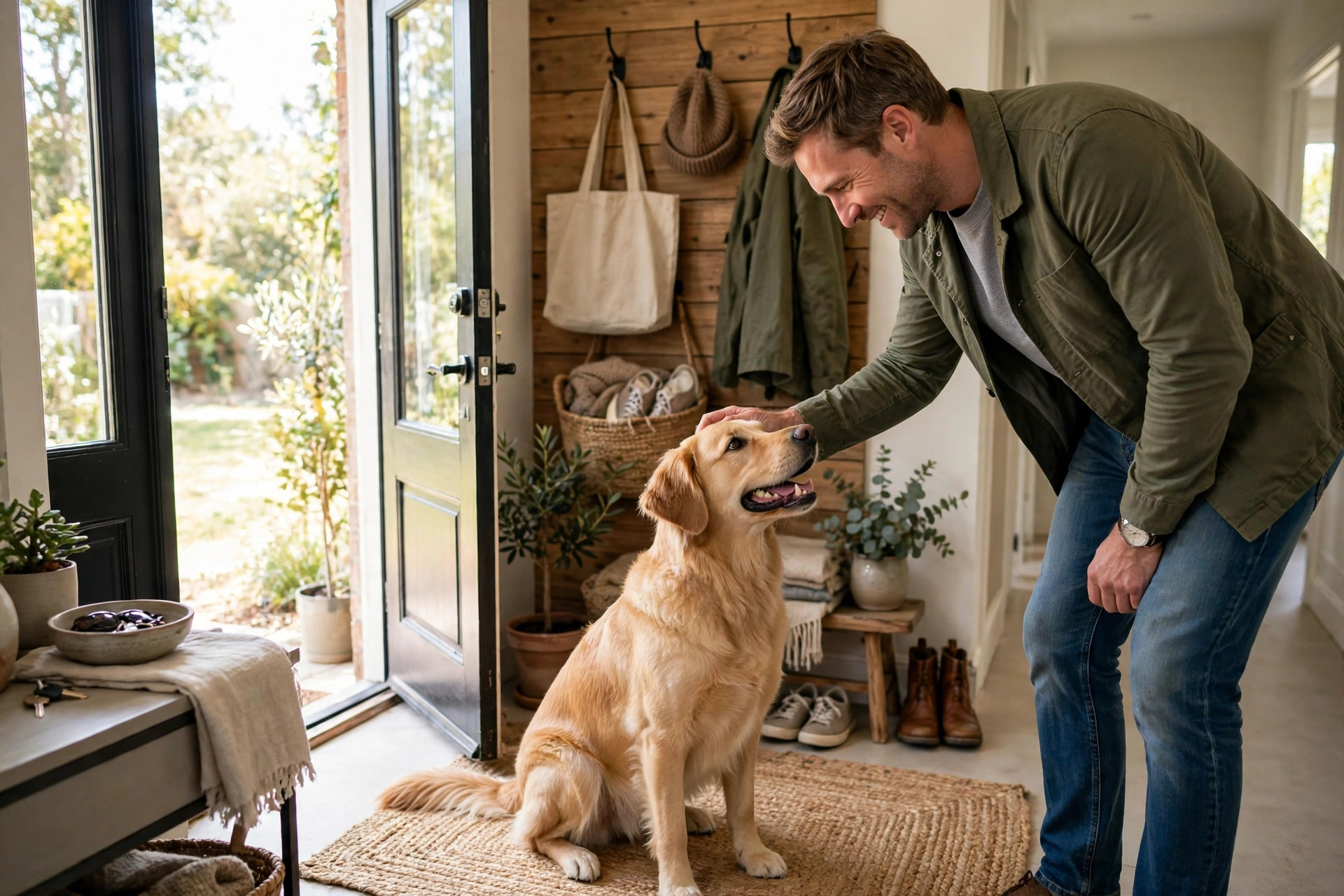
The doorbell rings, you open the door, and your dog launches at your guest like a furry missile. If this sounds familiar, you are not alone — learning how to stop dog jumping on guests is one of the most common training goals dog owners search for. The good news is that jumping is not aggression and it is not stubbornness. It is a habit your dog learned because it works, and with a consistent plan, you can replace it with a polite greeting in just a few weeks.
In this trainer-style guide, we will walk you through why dogs jump on visitors, the “four paws on the floor” rule that fixes it, a step-by-step training plan, how to manage arrivals while your dog is still learning, and the mistakes that keep jumping going.
Table of Contents
- Why Dogs Jump on Guests
- The Four Paws on the Floor Rule
- Step-by-Step Training Plan
- Teach Sit-to-Greet
- Managing Arrivals While Training
- Briefing Your Guests: The Script That Works
- 5 Mistakes That Keep Your Dog Jumping
- How Long Does It Take?
- When to Get Professional Help
- Frequently Asked Questions
Why Dogs Jump on Guests
Dogs jump for a simple reason: it gets them exactly what they want. A jumping dog gets face-to-face contact, excited voices, hands reaching out, and petting — all within seconds of launching. Even pushing a dog down or scolding is still attention, and for an excited dog, any attention beats none. Every time a guest laughs, pets, or talks to a jumping dog, the habit gets stronger.
There is also biology behind it. Dogs naturally greet each other face to face, and jumping is how a dog tries to reach a human face. Puppies jump because everyone finds it cute at first, then the habit survives into adulthood — when a 30 kg dog launching at a visitor is no longer funny. Excitement, under-exercised energy, and a lack of any trained alternative all make jumping more likely.
The fix follows the same logic that created the problem. If jumping stops producing attention and keeping four paws on the floor starts producing it, your dog will choose the floor. That is the entire foundation of this training. Guidance from the American Kennel Club backs this approach: teach an alternative greeting behavior and reward it consistently, rather than only punishing the jump.
The Four Paws on the Floor Rule
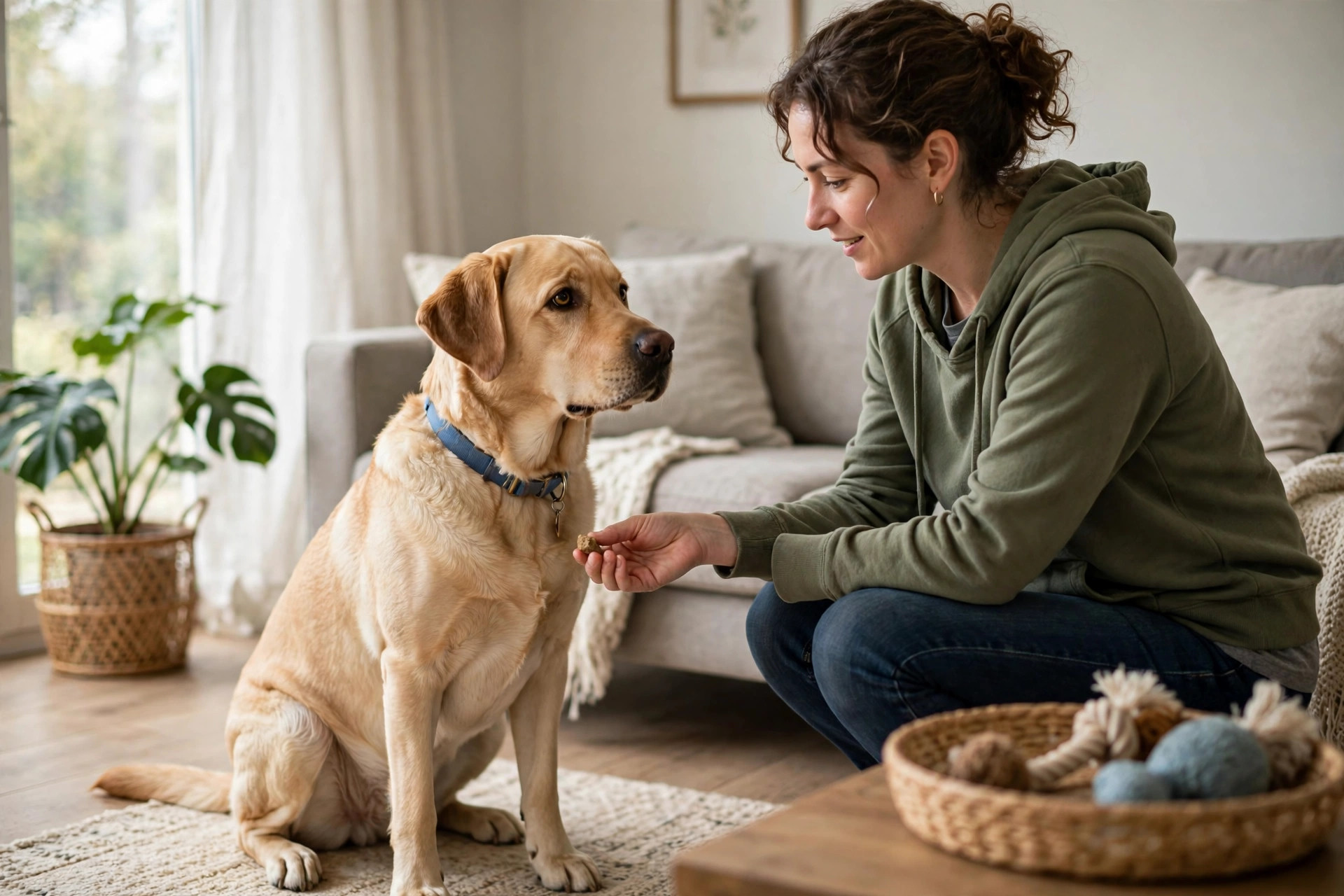
Before you start training, pick one clear greeting rule and use it every single time. The simplest rule is: all four paws stay on the floor. Your dog cannot jump and stand with four paws on the ground at the same time, so the rule is physically clear. Alternatively, you can require a sit for greetings — we cover that below. Either rule works; what matters is that every person in your household enforces the same one.
The core technique has two halves, and both matter equally:
- Jumping switches attention off. The instant paws leave the ground, calmly turn your back, fold your arms, and look away. No talking, no eye contact, no pushing. Step behind a door or gate for a few seconds if needed.
- Four paws on the floor switches attention on. The moment all four paws are down, turn back with quiet praise and a treat delivered low, near your dog’s chest height. Delivering treats low keeps your dog’s head down instead of lifting it up into a jump.
Timing is everything. The reward must land within a second or two of the paws hitting the floor, or your dog will not connect the two. Keep your own energy calm — squealing praise will re-excite your dog and undo the lesson.
Step-by-Step Training Plan
Train in stages, starting where your dog can succeed and only adding excitement when the current stage is reliable. Short sessions of 5 to 10 minutes, a few times a day, beat one long frustrating session.
Stage 1: Calm practice with you
Walk toward your dog in a quiet room. The instant paws leave the ground, stop approaching and turn away. When all four paws are back down, turn around, praise quietly, and deliver a treat low. Repeat until your dog stays grounded as you approach at a normal pace.
Stage 2: Practice with a helper
Ask a calm, familiar person to play the guest. They approach, and the moment your dog jumps, they turn and walk away. When paws are down, they return and greet calmly. Repeat several times, then let the greeting last a little longer each round. The helper must be briefed in advance — one inconsistent greeter can slow the whole process.
Stage 3: Real arrivals, managed
Move to genuine doorbell arrivals, but keep your dog on a leash or behind a gate (see managing arrivals below). Let guests in only when your dog is calm, and keep early real-guest sessions short. If your dog jumps, the guest turns away and you reset — no drama, no scolding.
Stage 4: Proof it against excitement
Gradually raise the difficulty: more excited guests, children (supervised), guests carrying bags, and outdoor greetings on walks. Reward calm greetings generously in each new setting before expecting reliability. A dog that greets politely in the kitchen has not yet learned to greet politely at a busy park gate.
Also Read: Stop Your Dog Pulling on the Leash: 7 Trainer Tips (2026)
Teach Sit-to-Greet
Four paws on the floor is a great minimum, but many owners prefer a sit for greetings because it is even clearer. A sitting dog cannot jump, and guests instantly understand the picture.
- With your dog on a leash, ask for a sit a few feet from the approaching guest.
- The guest approaches only while your dog stays seated. If your dog stands, the guest stops and turns away.
- When your dog sits again, the guest resumes approaching and, once close, calmly pets your dog’s chest or side — not the top of the head, which encourages upward excitement.
- Reward the sit with a treat delivered low, then release your dog with a cue like “okay” once the greeting is done.
Practice sit-to-greet away from the door first, so the behavior is solid before you add doorbell excitement. If your dog breaks the sit, simply reset — no scolding, just another repetition.
Managing Arrivals While Training
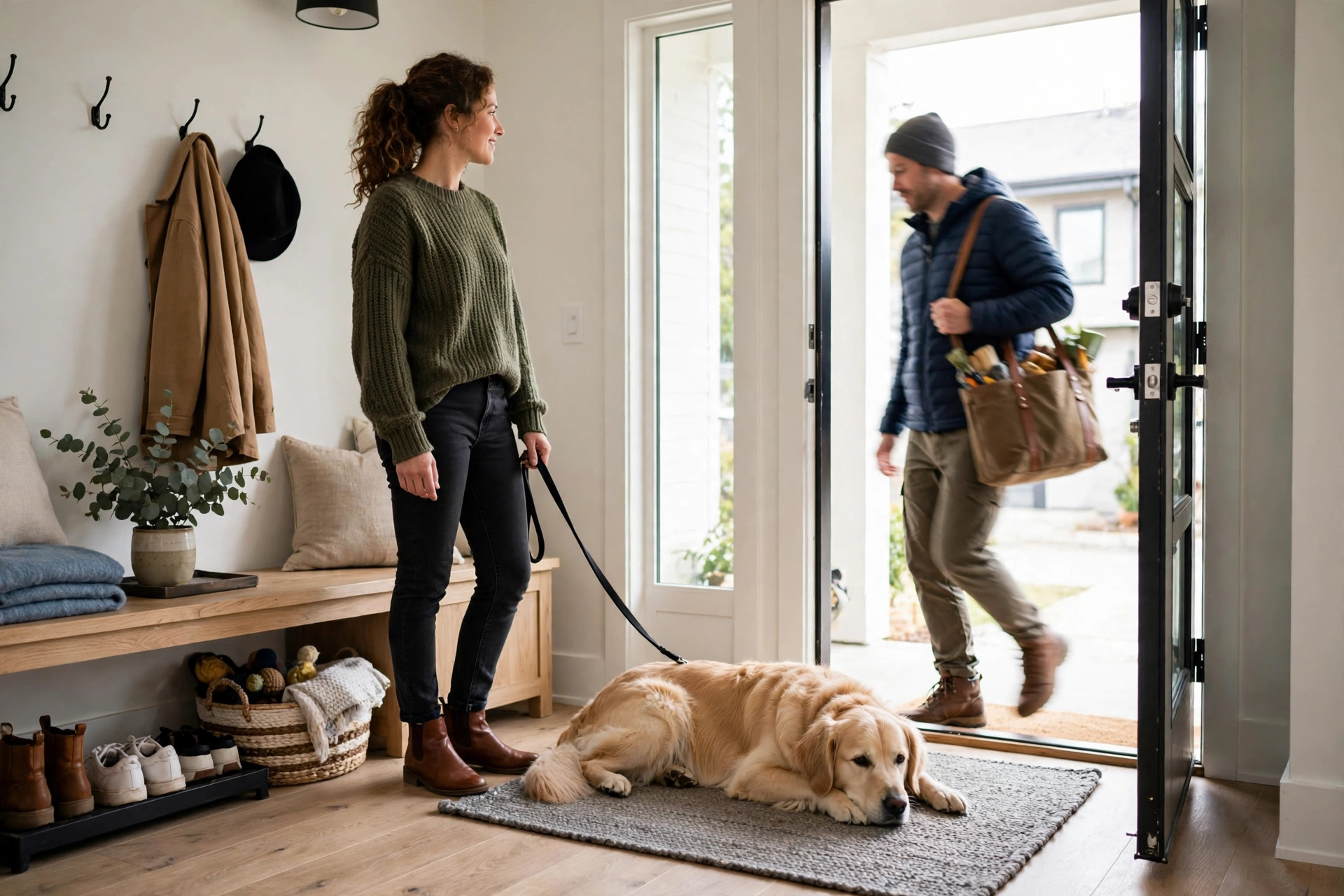
Training takes weeks, and guests will arrive before your dog is reliable. Management stops your dog practicing the old habit in the meantime — every uncorrected jump is a rehearsal that slows training.
- Leash at the door. Hold a short leash (or tether it to heavy furniture) so your dog cannot reach the guest. Step on the leash with just enough slack for your dog to stand or sit comfortably, but not enough to jump up.
- Gate or separate room. Keep your dog behind a baby gate or in another room until the initial excitement passes, then bring them out on a leash for a calm greeting. This is the best option for strong or very excitable dogs.
- Send to a place. Teach a “go to your mat” cue and send your dog there before opening the door. A dog lying on a mat cannot jump on a guest at the same time.
- Burn off energy first. A short play session or walk before guests arrive takes the edge off high-energy dogs and makes calm greetings far more likely.
- Give your dog a job. Handing your dog a toy to hold during greetings gives an excited mouth something legal to do and makes jumping physically harder.
Also Read: How to Stop Puppy Biting: Vet Training Guide (2026)
Briefing Your Guests: The Script That Works
Guests undo training faster than anything else. Many visitors love being jumped on and will reward it even after you ask them not to. Brief every guest before they enter, with a script like this:
“We are training polite greetings. Please ignore him completely — no eye contact, no talking, no petting — until all four paws are on the floor. Then you can greet him calmly. If he jumps, just turn your back and I will reset him.”
Have treats ready by the door so guests can reward the calm greeting themselves. For guests who cannot follow the script — especially excited children — keep your dog behind the gate and let them meet once the excitement has settled. Protecting the training is more important than one greeting.
| Guest Does This | Dog Learns |
|---|---|
| Turns away when the dog jumps | Jumping makes people disappear |
| Greets calmly when paws are down | Four paws down brings attention |
| Pets an excited jumping dog anyway | Jumping still works sometimes — habit survives |
| Uses a high excited voice at the door | Arrivals are a high-excitement event |
5 Mistakes That Keep Your Dog Jumping
1. Letting it slide “just this once”
Jumping that works one time in ten is still worth trying from your dog’s point of view — it is the same psychology as a slot machine. Every greeting must follow the same rule, including greetings with you.
2. Pushing the dog down or kneeing
Pushing is physical attention, and for many dogs it feels like play. Kneeing can injure your dog and teaches them that people are unpredictable at greetings. Withdraw attention instead — it is calmer and it works.
3. Training only when guests arrive
Real arrivals are the hardest test, not the classroom. If you only practice when the doorbell rings, your dog never gets easy repetitions to learn from. Practice daily with helpers before expecting real-arrival reliability.
4. Rewarding too late or too high
A treat delivered five seconds late teaches nothing, and a treat held up high invites the next jump. Mark the moment paws hit the floor (“yes!”) and deliver low, fast, and calmly.
5. Skipping management
Letting an untrained dog greet guests freely “to see how it goes” just rehearses jumping. Use the leash, gate, or mat every time until the trained greeting is reliable.
How Long Does It Take?
With consistent daily practice, most dogs show real improvement within 2 to 4 weeks, and many are reliable with familiar guests sooner. Full reliability with highly exciting visitors — children, favorite people, guests arriving after a long absence — can take longer, sometimes 6 to 8 weeks.
Progress depends on how long the habit has been practiced, your dog’s age and energy level, and above all your consistency. Two short focused sessions a day will outperform one long frustrated session. Expect good days and bad days; a relapse after a stretch of calm greetings is normal, not failure. Simply return to an easier stage and rebuild.
When to Get Professional Help
Most jumping responds well to the plan above. Consider a certified professional dog trainer (CPDT-KA) who uses positive-reinforcement methods if:
- Your dog is strong enough that you cannot safely hold the leash during arrivals.
- Jumping is paired with growling, snapping, or stiff body language rather than loose, wiggly excitement.
- Jumping started suddenly in an older dog — sudden behavior changes can signal pain or vision loss, so a vet check comes first.
- You have practiced consistently for 6 weeks with no improvement.
Avoid anyone who recommends shock collars, prong collars, or physical corrections for jumping — these can create fear and anxiety that are far harder to fix than the jumping itself.
Also Read: Separation Anxiety in Dogs: Signs, Causes & How to Help (2026)
Frequently Asked Questions
Is jumping on guests a sign of aggression?
Almost never. Jumping is usually excitement and a learned greeting habit. True aggression looks very different: stiff posture, hard staring, growling, and bites that do not stop when you freeze. If you see those signs, get professional help.
Should I punish my dog for jumping?
No. Hitting, shouting, or kneeing your dog can increase fear and make greetings worse. Calmly withdrawing attention and rewarding four paws on the floor teaches the lesson without damaging trust.
Why does my dog only jump on some people?
Because those people reward it. Guests who squeal, pet, or play with a jumping dog teach your dog that jumping works on them specifically. Briefing every guest on the same rule is what fixes selective jumping.
Can old dogs learn to stop jumping?
Yes. Older dogs can learn new greeting habits just like puppies, though a habit practiced for years takes longer to undo. Short, consistent sessions and good management at the door still work at any age.
What if my dog jumps on walks, not just at home?
Use the same rule outdoors: stop, turn away, and wait for four paws on the floor before moving on. Keep greetings with strangers short and managed on a leash until the behavior is reliable at home first.
Final Thoughts
So, how do you stop your dog jumping on guests? Teach one clear rule — four paws on the floor earns attention, jumping earns nothing — practice it in easy stages, manage arrivals with a leash or gate while training, and make sure every guest follows the same script. Most dogs improve noticeably within a few weeks when the whole household stays consistent.
Polite greetings are a skill, not a switch. Celebrate the calm hellos, reset the jumps without drama, and your dog will soon greet visitors the way you always wanted.
By Dr. Ayaz Ali